Home Office

Best Office Hutches of 2026

A hutch is the rare piece of office furniture that buys you storage without taking another inch of floor — it turns the dead space above your desk into shelves for the printer, the binders, the mug you keep knocking over. What it doesn't do is hide its mistakes. A hutch that wobbles when you lean on it, shows a row of silver screw heads on the finished side panels, or runs two inches too deep for your desk reads as cheap from across the room, and you'll be staring at it every day. The right one settles in quietly: solid under a forearm, clean from the front, and roomy enough that the paper stops migrating to the kitchen table.

I've lived with a rotating cast of hutches on my own desk, including one that looked great online and rattled every time I typed. Over the past eight months, my team and I built, loaded, and worked under 12 of them, and the differences came down to details you only notice after a few weeks. One thing I'd tell any first-time buyer: measure your desk depth and your monitor height before you fall for a finish, because a hutch that crowds your screen or leaves no room for a keyboard tray will annoy you more than a mismatched wood tone ever could. The picks below were chosen for the way they hold up, not just the way they photograph.

#1

Best Overall

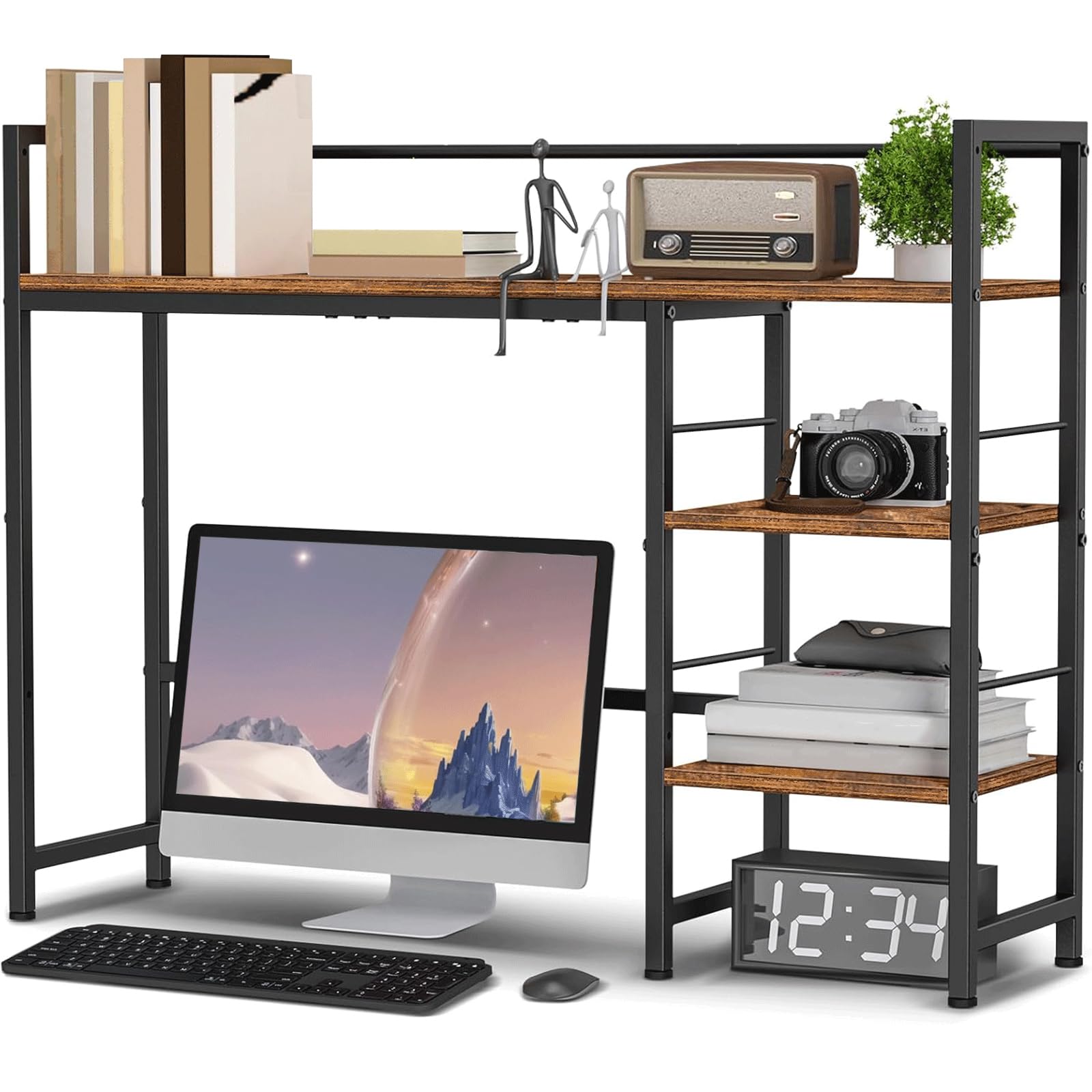
IOTXY 2-Tier Desk Hutch

IOTXY 2-Tier Desk Hutch

9.3/10 Outstanding
  • Included: 5 grid hooks, anti-tip hardware
  • Material: Engineered wood and steel
  • Dimensions: 7.9"D x 45.3"W x 38.6"H
  • Monitor Fit: Up to 27 inches
Check Price on Amazon

Pros

  • Widest shelf in this group at 45.3 inches
  • Steel frame and thick MDF shelves, no wobble
  • Bottom bay clears a 27-inch monitor
  • Grid panel with five hooks for tools and cables

Cons

  • 7.9-inch shelves will not take deep bins

The 45.3-inch width is why this hutch takes the top spot. About seven inches more span than the other full-width units here means the frame straddles a working desk instead of skulking behind the monitor, and the bottom bay is sized for a 27-inch screen, so the display sits under the shelf rather than beside your keyboard. On a 60-inch desk it reads as built-in rather than added on.

Build is the other half of the argument. The shelves are 0.6-inch MDF on a steel frame with a double-layer support structure, and the difference from the particleboard hutches in this group shows the first time you lean on it: nothing shivers, and the grid panel with its five hooks takes real weight instead of just looking industrial. We hung a cable reel and a pair of scissors off it and never thought about it again.

Two things to plan around. At 38.6 inches tall it is the tallest unit here, so measure from the desk to whatever is above — a wall cabinet, a floating shelf, the underside of a monitor arm — before you order. And the feet are plain rather than nonslip, so on a smooth plastic desk mat the whole thing walks when you push it; a strip of felt or rubber pads solves that and protects the desk at the same time.

Bottom Line: The hutch we recommend for most desks: the widest shelf here, a steel frame that stays square, and a bay that clears a 27-inch monitor.
#2

Best Value

Snughome Desk Shelf

Snughome Desk Shelf

9.0/10 Outstanding
  • Material: Particleboard and metal
  • Dimensions: 38.6"D x 9.8"W x 29.5"H
  • Weight Capacity: 50 lb
Check Price on Amazon

Pros

  • Full-width hutch for budget money
  • Shelves can be built left- or right-handed
  • Sturdy once built, with no rocking

Cons

  • Rustic finish is darker than the photos suggest

If the top pick's price is the sticking point, this is where we send you. The Snughome gives you a 38.6-inch hutch with a monitor bay and three storage tiers for a fraction of the outlay, and the rustic panels against the black frame look far more considered than the money would suggest. In a room where the desk is visible from the sofa, that counts.

We recommend it as a first hutch — a dorm, a rental, a teenager's room where furniture gets replaced before it wears out. The opening takes a 27-inch screen, the frame does not rock when you nudge it, and the instructions let you build the shelves on the left or the right, which saves a rebuild if the desk moves to the other wall halfway through the year.

Assembly is a screwdriver job and mostly uneventful, though the joints are where the price shows: panels can arrive slightly out of square, so dry-fit everything before the final tighten and be ready to loosen a bolt and nudge a shelf flush. Width is the other number to check, since 38.6 inches across is wider than a lot of dorm and rental desks and will overhang anything narrower.

Bottom Line: For the money, this is the hutch we suggest: a full-width shelf and 27-inch monitor clearance at a budget price, with a look that outclasses the hardware.
#3

Best for Maximum Storage

REIBII Desktop Bookshelf

REIBII Desktop Bookshelf

9.1/10 Outstanding
  • Drawers: 2 fabric
  • Dimensions: 10"D x 37"W x 31"H
  • Compartments: 8 open
  • Weight Capacity: 100 lb
Check Price on Amazon

Pros

  • Eight open compartments in varied sizes
  • Dividers slide or lift out for tall items
  • Anti-tip wall brackets included
  • Two drawers hide small clutter

Cons

  • Fabric drawers, not the wooden ones the photos imply
  • Heaviest here at 36.5 pounds to move

Eight compartments, two drawers, and sliding dividers — the REIBII answers a different problem from the rest of this group. It is for the desk where the monitor is fine and everything else is not: the stapler, the chargers, the pens, the paper that piles up because it has nowhere to go. At 37 inches wide it splits into cubbies of varied sizes instead of three long shelves, which is exactly what a dorm desk wants.

It is also the pick here that expects to be fastened down. Anti-tip wall brackets come in the box, three reinforced vertical panels hold the frame steady, and the stated capacity of 100 pounds is the highest in this group. The upper dividers slide or lift out entirely, so a tall thermos or a stack of binders can have the full height when the mood changes.

Our take: this is the best hutch in the group for a small shared room where clutter breeds, and the plainest one to look at. White engineered wood, an open back, and no pretense of being furniture — it is a storage unit that happens to sit on a desk, which is exactly right in a dorm and a little utilitarian in a home office you show people.

The build is the practical cost. At 36.5 pounds it is the heaviest unit here, so plan to assemble it where it will stand rather than carrying it up afterwards. Numbered parts and an illustrated manual do most of the work, and the instructions suggest a second person for the last steps, which matches what a wide flat-pack frame usually asks for.

Bottom Line: The storage-first pick: we point anyone with a shared or dorm desk here, where eight compartments and two drawers beat a wide open shelf.
#4

Rentals and dorms

HavenlyYouth Desk Shelf

HavenlyYouth Desk Shelf

8.7/10 Excellent
  • Shelves: 3 tiers
  • Material: Melamine and metal
  • Dimensions: 38.6"D x 9.8"W x 29.2"H
  • Item Weight: 12.8 lb
Check Price on Amazon

Pros

  • Lightest full-width hutch here at 12.8 pounds
  • Metal frame takes magnets
  • Three tiers on a 38.6-inch span

Cons

  • Open back leaves cables and the wall on show

At 12.8 pounds this is the hutch you can carry up a stairwell, tip onto its side to reposition, and shift between rooms without asking for help. It shares the 38.6-inch span and the rustic-panel look of the Snughome, so on paper the two are close cousins; the difference is that this one is built light enough to count as temporary furniture.

That is exactly why it stayed in the roundup. A dorm, a first apartment, a desk that gets rearranged every semester — places where a hutch needs to arrive flat, go up in an evening, and come apart again in May. The metal frame takes magnets, which is a small thing until you want a shopping list or a photo strip at eye level, and three tiers hold books and boxes without any drama.

The open back is the honest trade-off: there is no panel behind the shelves, so cables and the wall stay on show and a tidy desk depends on you. The other number worth checking is width, because 38.6 inches across is more than many rental desks offer and the back corners will hang over a narrow one.

Bottom Line: We point movers here: the lightest full-width hutch in this group, easy to carry and rebuild, and it holds three tiers without crowding the desk.
#5

Narrow desks

NUTIKAS Desk Organizer Shelf

NUTIKAS Desk Organizer Shelf

8.2/10 Very Good
  • Shelves: 3
  • Dimensions: 6.7"D x 16.3"W x 13.8"H
  • Weight Capacity: 5 lb
Check Price on Amazon

Pros

  • 16.3-inch footprint fits desks nothing else will
  • Two units combine into an L-shape
  • Locking bolts hold the width adjustment

Cons

  • Screw heads are visible from most angles

Five pounds of capacity decides this one. That is the stated limit, and it rules out the job most people are shopping for — a monitor, a stack of hardbacks, a printer — so we are not recommending it as a desk hutch in the usual sense. What it is: a small, genuinely useful three-tier organizer for a narrow desk, a corner, or the top of a nightstand, where a 16.3-inch shelf is all the room there is.

Two of them can be combined into an L for a corner, and the locking bolts hold the width adjustment where you set it, which is more thought than most organizers at this level get. The look is clean white lacquer and the compartments suit pen cups, chargers, a couple of paperbacks, and a small plant. Assembly takes more screws than a shelf this size deserves, so use your own screwdriver rather than the one in the box.

The photographs flatter the size. At 16.3 inches across and 6.7 inches deep it is roughly the width of a keyboard and a half, and the compartments are scaled for cups, cables, and paperbacks rather than binders. Measure the gap you are filling before you order, and check the shelf heights against what you actually want to put on them.

Bottom Line: Buy it as a small desk organizer rather than a monitor hutch: we like it for narrow desks and bedside tops, and the five-pound limit is the whole story.

How We Tested the Best Office Hutches

We started by pulling listings from major furniture and office-supply retailers, then narrowed by specs: overall depth against a standard desk, the clearance between shelves, whether the unit sits on the desktop or mounts to the wall, and the range of finishes available. We also cut anything whose customer feedback kept circling the same complaints about missing hardware or instructions that skipped steps. That left 12 hutches, which we built and used over eight months.

Assembly happened on a Saturday morning with a cordless drill, a stopwatch, and, for the taller units, a second set of hands. We timed each build from opening the box to the last screw, noted which steps genuinely needed two people, and checked whether the pilot holes lined up or wandered. Then we loaded them the way a real desk gets loaded: a 25-pound box of copy paper on the bottom shelf, binders stood upright, a printer on top where it fit, and a forearm leaned on the upper panel mid-typing to see if the whole thing swayed or creaked.

Screw visibility got its own pass. I sat at each desk at eye level and counted every fastener I could see without crouching, then checked the side panels and the back under a desk lamp, since that's where cheap hardware usually gives itself away. We measured usable shelf height and depth with a tape and tried to fit the things people actually store — a ream of paper, a 2-inch binder, a surge protector — and we ran cables behind the back panel to see whether the cutouts were big enough or just decorative. Value came last: we compared each hutch against similarly priced options and asked whether the materials, finish, and joinery justified the number on the tag.

A few of these are still holding printers and library books in our workspaces, and we'll keep using them and update this list if anything loosens, sags, or starts showing its hardware.

How to Choose Office Hutches

Start with the monitor bay, not the overall width

Every hutch here is sold on its overall span, but the number that matters is the gap underneath. A 45-inch unit with a narrow center bay holds a monitor and nothing beside it; a 37-inch one with a wide bay takes a 27-inch screen plus a stack of paper. Measure your monitor's width and the height of its stand, then compare those against the bay rather than the case.

If you run two screens, add both widths and the gap you like between them before you commit. Height matters just as much when the monitor stays on its own stand: the bay has to clear the stand, not just the panel.

Match depth to what shares the desk

These hutches run about 8 to 10 inches deep, which leaves most of a 24-inch desk for a keyboard and your forearms — provided the unit sits at the back. Check that the feet land on the desk surface rather than on a lip, a cable tray, or a raised edge trim.

Watch for overhang too. A 38.6-inch hutch on a 36-inch desk has nothing at either end, and the back corners hang over. Deeper bodies take binders and baskets; shallower ones keep the desk open but limit what fits on the shelf.

Decide between open tiers, cubbies, and drawers

Three long shelves suit books, a printer, and a plant. A grid of cubbies suits the small things that otherwise scatter across the desk, and adjustable dividers are worth having if what you store changes with the semester or the job.

Drawers are the only way to hide the odds and ends, and at this level they are usually fabric rather than wood, so treat them as a visual screen instead of a filing system. Count the compartments you will genuinely fill, not the ones printed on the box.

Plan the build and the wall behind it

Most of these arrive flat-packed and go together with a screwdriver in under an hour. A second pair of hands helps more with a wide hutch than a tall one, because wide panels are awkward to hold square while you drive a bolt.

Dry-fit before the final tighten, since joints that are slightly off will pull flush if you loosen and reset them. Where anti-tip brackets come in the box, use them on anything loaded above eye level, and put felt or rubber pads under plain metal feet so the unit and the desk both survive.

Frequently Asked Questions

Final Verdict

For most desks, the IOTXY is the hutch to buy: the widest shelf in this group, a steel frame that stays square once it is built, and a bay sized for a 27-inch monitor with room left for everything that follows it.

If money is the deciding factor, the Snughome does the same job in particleboard for far less, and it is the one we point at dorm-bound shoppers. Take the REIBII instead when the desk is shared, small, and drowning in small items, and the NUTIKAS only when nothing wider than 16 inches will fit.