Home Office

Best Rolling File Cabinets of 2026

A file cabinet has one job that contradicts itself: hold a great deal of weight and stay put, then move the moment you need to get behind it. I lived with a stack of folders on the floor for longer than I'd like to admit, and the fix was never a bigger cabinet — it was one on decent casters. The right one keeps hanging folders upright, shuts all the way, rolls over a rug without shimmying, and looks tidy enough to sit in a room guests actually see.

Over six months, my team and I built, loaded, and rolled 12 rolling file cabinets through real home offices, and the gaps showed up fast — mostly in the parts you can't see in a product photo. Assembly was often the first hurdle: some went together in twenty minutes with one screwdriver, others wanted two people and a lot of patience. Then we filled them with actual files and watched what the drawers, locks, and wheels did. One thing worth knowing before you order: measure the gap first, and check whether the drawers interlock. The ones that held up are below.

#1

Best Overall

DEVAISE 3-Drawer Mobile File Cabinet

DEVAISE 3-Drawer Mobile File Cabinet

9.1/10 Outstanding
  • Lock: One key, three drawers
  • Drawers: 3: 1 file, 2 supply
  • Weight Capacity: 330 lb
  • Overall Dimensions: 17.1" D x 14.6" W x 23.6" H
Check Price on Amazon

Pros

  • File drawer resets for letter, legal or A4
  • Two supply drawers keep the file drawer clear
  • Full-extension slides reach the back
  • Rated to 330 pounds with an anti-tip center caster

Cons

  • Can arrive dented in transit

Three drawers, and only one of them is a file drawer. The bottom drawer takes hanging folders on a bar that lifts out and resets for letter, legal or A4; above it sit two shallower supply drawers, the top one with a removable pencil tray. The stack is 23.6 inches tall and 14.6 inches wide, which is under-desk size in a normal home office.

That split is why this is our pick. Cabinets that give every drawer over to folders leave you nowhere for the stapler, so the clips migrate to a shoebox and the top of the cabinet becomes a shelf. Here the small drawers swallow envelopes, cables and the label maker, and the file drawer stays a file drawer.

The steel is rated to 330 pounds and the drawers run on full-extension slides, so the back of the file drawer is not a place folders go to be forgotten. One key locks all three, and a fifth caster sits under the front edge to stop the cabinet nosing over when a loaded drawer is out. Setup is a caster job: the cabinet arrives assembled and you bolt on the wheels.

The lock is the weak point. The mechanism itself does its job, but a cylinder that binds or a key that stops turning is the kind of fault that shows up early, so try every drawer with the key the day the box arrives, while a return is still simple. After that it is a home-office cabinet rather than a records-room one — three drawers of active paperwork, not fifteen years of it.
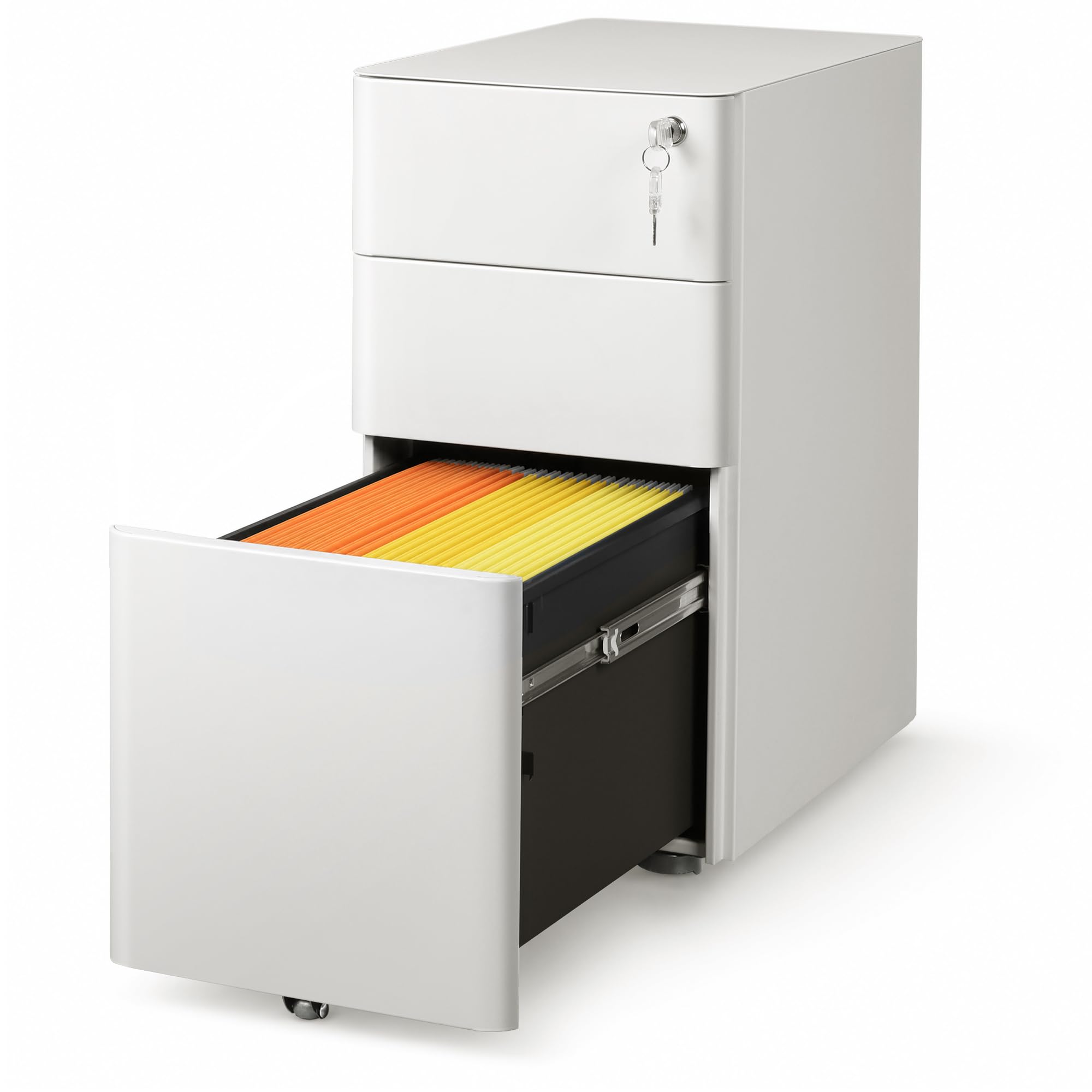
Bottom Line: The one we recommend first: steel, 330 pounds of capacity, a key that locks all three drawers, and a file drawer that resets for letter, legal or A4.
#2

Best for Narrow Spaces

DEVAISE 3-Drawer Slim File Cabinet

DEVAISE 3-Drawer Slim File Cabinet

8.7/10 Excellent
  • Lock: One key, three drawers
  • Drawers: 3: 1 file, 2 utility
  • Dimensions: 11.8"W x 17.7"D x 23.2"H
  • Weight Capacity: 330 lb
Check Price on Amazon

Pros

  • Fits gaps under 13 inches wide
  • Takes letter, legal and A4 folders
  • 330-pound steel body with an anti-tip caster
  • One key locks all three drawers

Cons

  • The lock can fail to catch

At 11.8 inches wide, this is the cabinet for the gap beside the desk — the slot that has been holding an umbrella stand because nothing else fits. We reach for it whenever a measurement comes back tight, because the standard steel cabinets here run 14.6 to 15 inches across and that inch and a half is the whole decision.

Narrow does not mean stripped. Three drawers, one of them a hanging-file drawer with a removable bar that takes letter, legal or A4, a key that locks all three, full-extension slides and 330 pounds of steel. The trade is internal width: everything inside is a little narrower than in a full-width cabinet, so wide binders and print trays need somewhere else to live.

The wheels are small, and carpet is where they show it. On hardwood the cabinet rolls cleanly; on pile it drags, and a loaded drawer takes a push to get moving. A chair mat under the desk fixes it — and if the office is carpeted wall to wall, that is a mat you want anyway.

Otherwise this is a slimmer stablemate of our top pick, and it earns its place on that alone: same steel, same lock, same under-desk height, in a footprint that gets into places the others cannot.

Bottom Line: We reach for this one when the gap beside the desk is the whole problem: at 11.8 inches it is the narrowest cabinet here and it still takes legal folders.
#3

Best for Living Rooms

BIRDROCK HOME Rolling File Cabinet

BIRDROCK HOME Rolling File Cabinet

9.4/10 Outstanding
  • Fits: Letter and legal files
  • Weight: 10 lb
  • Closure: Hinged lid, carry handles
  • Dimensions: 17.5"L x 14.5"W x 13"H
Check Price on Amazon

Pros

  • Reads as furniture, not office equipment
  • Holds letter and legal hanging files
  • Hinged lid keeps paperwork out of sight
  • Ten pounds with carrying handles

Cons

  • Weave and color vary between units

It looks like an ottoman. Woven abaca, a flat hinged lid, a cutout handle at each end — put this in a living room and it reads as a side table or a footstool, which is the whole reason to consider it. It is not meant for sitting, and the label inside makes that clear.

Inside is a single compartment with a built-in metal rack for hanging folders, and it takes both letter and legal sizes. There is no assembly at all: it arrives as a box with a lid, 10 pounds, 17.5 by 14.5 by 13 inches, light enough to lift onto a shelf or carry into another room by the handles.

What we keep coming back to is the double life. A steel cabinet in the corner of a living room is an admission that the paperwork won; this one holds the files nobody wants on display and rolls out of the way when the room has to be something else. It is the least office-like object here, and it does the job it is built for.

What it does not do is lock. No key, no latch, no interlock — if the point of the cabinet is keeping documents away from a child or a roommate, this is not it, and steel is. It is a place to put paperwork you want out of sight rather than out of reach.

Bottom Line: We like this one where the cabinet has to sit in a room guests use: a handwoven bin on casters that hides letter and legal files under a lid, with no lock.
#4

Light-duty filing

Letaya 3-Drawer Mobile File Cabinet

Letaya 3-Drawer Mobile File Cabinet

8.8/10 Excellent
  • Lock: One key, three drawers
  • Drawers: 3
  • Dimensions: 17.32"D x 14.57"W x 24.4"H
  • Weight Capacity: 120 lb
Check Price on Amazon

Pros

  • One key locks all three drawers
  • Casters fit in a few minutes
  • Slides under a desk at 24.4 inches
  • Even powder-coated finish

Cons

  • Drawers can stick or need a shove

Put this beside our top pick and the two look like siblings: same under-desk height, same three-drawer stack, same single-key lock, same five-caster base. The difference is inside the steel — the DEVAISE is rated to 330 pounds, this one to 120 — and for a home office that files a few years of statements, we think that is plenty.

What you get is a tidy cabinet. Three drawers that take letter, legal and A4 folders, one key for all of them, casters that bolt on in a few minutes, and a body 24.4 inches tall that slides under most desks. The powder coat is even and the drawer fronts line up, which is more than you can say for a lot of flat-pack office furniture.

It is a light-duty cabinet and does not pretend otherwise — a few years of household paperwork is its natural habitat. If your filing is denser than that, buy our top pick instead; the money is close and the steel is heavier.

Bottom Line: We think it is a sensible light-duty cabinet: steel, three locking drawers, casters that take minutes to fit, and about the same footprint and money as our top pick.
#5

Budget decor

Best Choice Products Woven File Cabinet

Best Choice Products Woven File Cabinet

9.0/10 Outstanding
  • Fits: Letter and legal folders
  • Casters: 4 locking, 360-degree
  • Dimensions: 18"D x 15"W x 14"H
  • Weight Capacity: 27 lb
Check Price on Amazon

Pros

  • Locking casters stay put while you dig
  • Strap across the lid secures the load
  • Non-scratch sliders for stationary use
  • Holds letter and legal hanging folders

Cons

  • Casters can be fiddly to fit

Two details separate this bin from the other woven cabinet here. The wheels lock — twist them and the bin stays put while you dig — and a faux-leather strap crosses the lid, which keeps the top down and the folders in if the bin gets tipped or investigated by a dog. It also ships with four non-scratch sliders, so you can leave the casters off and park it against a wall.

We think the strap and the locking wheels earn their keep. The bin holds letter and legal hanging folders in a single compartment, the weave photographs like furniture, and the wheels are there when you need them — which is the whole brief for a cabinet in a room that is not an office.

Water hyacinth over a steel-wire frame, and the ceiling is 27 pounds. That is a household's current paperwork and not much more, so a decade of legal files belongs in steel. Where this one wins, in our view, is the room it goes in: nobody asks about it, and it does not look like office equipment.

Bottom Line: Our budget pick: the least expensive way to get the woven look, with locking casters and a strap across the lid.

How We Tested 12 Rolling File Cabinets

The shortlist started as a spreadsheet. We pulled every rolling file cabinet we could find from brands we trust for office furniture, then filtered by the numbers that disqualify a cabinet: footprint depth, drawer count, letter- versus legal-width hanging files, lock type, and caster size. Price outliers got cut, and so did models whose wheels looked decorative. That left 12 cabinets, which we bought ourselves and put to work.

Assembly came first, since a cabinet you can't build is a cabinet you can't test. We built each one alone with only the hardware in the box and timed it, noting whether the pre-drilled holes lined up, whether the casters threaded in cleanly or cross-threaded, and whether one person could tip the finished unit upright without help. Then every cabinet got the same load: a full run of hanging folders, two three-inch binders, and a ream of copy paper.

For six months each cabinet lived in a working space — beside a desk, under a printer table, in a spare bedroom. We rolled them across hardwood, low-pile rug, and a metal threshold strip, watching whether they tracked straight or shimmied and whether a loaded drawer made the whole thing lurch. We opened one drawer at a time, then tried two at once to see if the interlock caught it and how far the cabinet leaned. Locks got cycled daily, finishes got wiped with a damp cloth and checked for scuffs at the seams, and we measured the real footprint against the listed dimensions, because a cabinet that doesn't fit the gap is a cabinet you'll be returning. We also kept a running note on what each one cost relative to how it was built.

How to Choose Rolling File Cabinets

Measure the gap before you count drawers

Width rules more cabinets out than anything else. The standard steel models here run 14.6 to 15 inches across; our slim pick is 11.8, which is the difference between a cabinet that fits the slot beside the desk and one that does not. Height is where the numbers get slippery, because some figures measure the cabinet body and others the body plus casters, which can add a couple of inches.

Measure from the floor to the lowest thing under your desk — the apron or a crossbar, not the desktop — and leave an inch of clearance so the top does not scrape when the cabinet rolls.

Check which folders the hanging bar takes

Folders hang from rails or a bar, so the drawer has to be set up for the size you actually file. Letter, legal and A4 each want different spacing, and the steel cabinets here handle it with a removable bar you reset when you change sizes. A drawer described only as a file drawer, with no size named, is a question to settle before you order.

Full-extension slides are the other half of the same problem. On a deep cabinet without them, the back of the drawer becomes the place folders go to be forgotten, and you end up buying a second cabinet for the files you actually use.

Steel, woven or wood

The material sets what the cabinet can do. Steel brings a lock, a load rating in the hundreds of pounds and a flat top that can take a printer, at the cost of looking like office equipment and arriving heavy. Woven and engineered-wood cabinets disappear into a living room but carry far less, and the inexpensive woven ones rarely lock at all.

Choose by room first. If the cabinet lives where you work, buy steel and stop worrying about the look. If it lives where you sit, weave or wood earns its place, and the real archive stays in something stronger.

Casters, brakes and what is underfoot

Four corner wheels make a cabinet that skates; a fifth caster under the front edge is what keeps a loaded cabinet from nosing over when the file drawer is out, and it is the detail to check on any steel model. Look for two locking casters at the front, too — a cabinet that rolls away mid-search is how fingers get pinched.

Then think about the floor. Small hard wheels run beautifully on wood and drag on carpet pile, where a chair mat is the cheap fix and often the difference between a cabinet you move and one you stop moving.

Frequently Asked Questions

Final Verdict

Our default is the DEVAISE three-drawer. It covers the most situations: a file drawer that resets for letter, legal or A4, two supply drawers for everything that would otherwise land on the desk, one key for the lot, and casters that keep it useful when the room gets rearranged.

Buy the slim DEVAISE instead when the gap is narrow enough that nothing wider fits, and the woven BIRDROCK when the cabinet has to live where you sit. The slim gives up interior width; the woven one gives up the lock. Neither gives up much else.