Home Office

Best Standing Desk Chairs of 2026

A standing desk is supposed to save your back—until you sit down and realize your old office chair was built for a lower desk. Most standard chairs top out around 20 inches; standing desks often sit at 24 or higher. That gap leaves you perching, slouching to reach the keyboard, or giving up on sitting altogether. A proper standing desk chair closes it: high enough to keep your feet flat, supportive enough to lean on, and easy to shove aside when you stand.

We spent eight months with 12 chairs, assembling each one, rolling them between hardwood and carpet, and sitting through full workdays rather than polite ten-minute trials. The surprise was that cushion thickness gets all the attention, but height range is what keeps your shoulders out of your ears; a chair that tops out too low will have you perching no matter how plush the seat. The picks below are the ones that held their shape, adjusted without a fight, and made sitting feel like a choice rather than a compromise.

#1

Best Overall

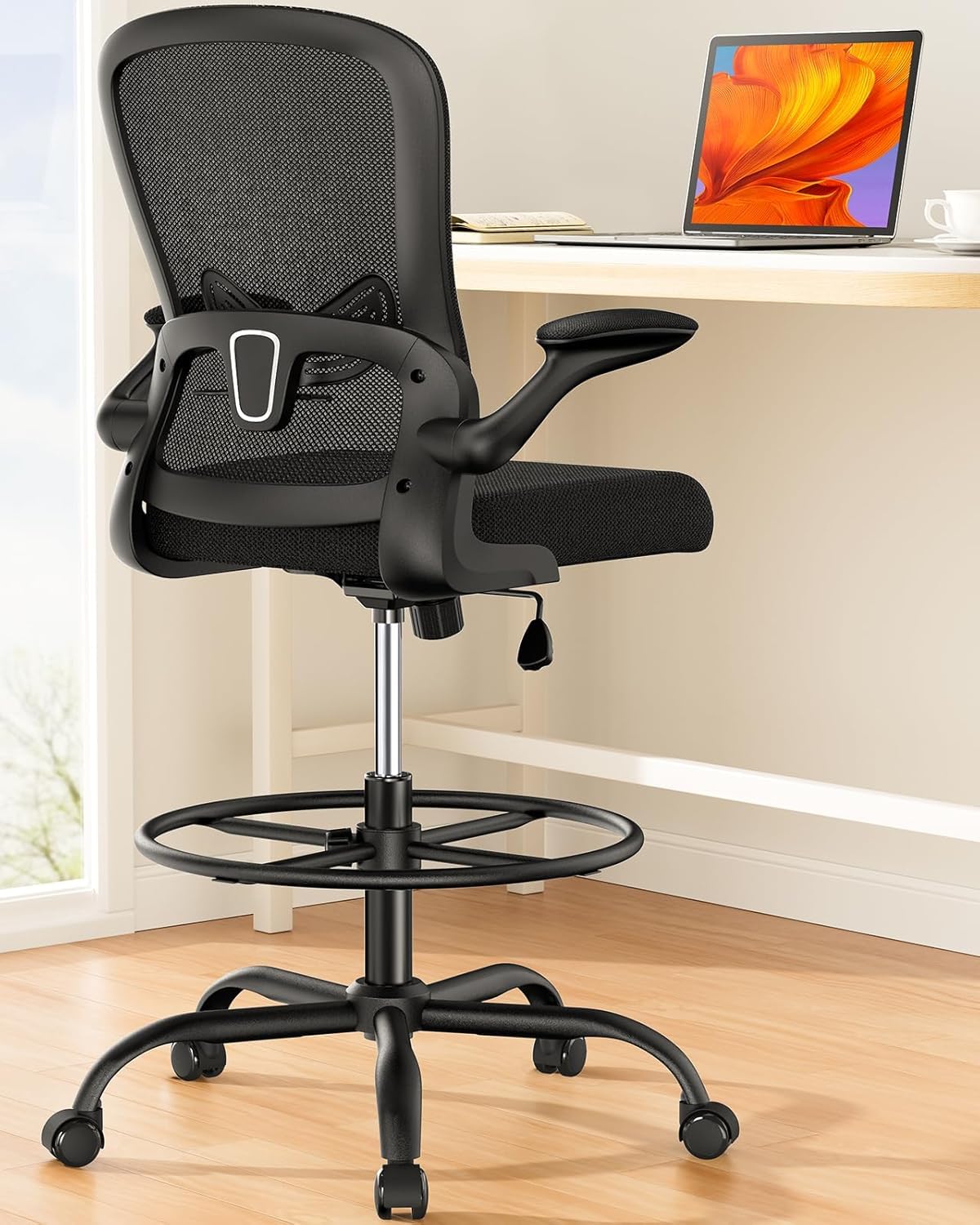
ErGear Drafting Chair

ErGear Drafting Chair

8.8/10 Excellent
  • Armrests: Flip-up padded
  • Foot Ring: 19.7 in wide, 5 in adjustable
  • Weight Capacity: 300 lb
  • Seat Height Travel: 8 inches
Check Price on Amazon

Pros

  • 8 inches of seat-height travel
  • 19.7-inch foot ring adjustable through 5 inches
  • Flip-up arms let you pull right up to the desk
  • Adjustable lumbar and a thicker seat pad

Cons

  • Foot ring can work loose and need re-tightening

Eight inches of seat-height travel is the number that decides this chair's place in the guide. That is enough range to follow a standing desk from a low seated position up to full height, and it is the reason we put the ErGear at the top: at a raised desktop you are not choosing a chair for how it looks, you are choosing how much of the day your feet spend flat instead of dangling. The foot ring does more for that than any other part. At 19.7 inches across it takes both feet comfortably, and it adjusts through five inches of its own, so you can set it under your soles instead of perching on one foot.

The flip-up arms are the detail we appreciated most in a small office. Fold them back and the chair pulls right up to the desk, which is what you want when you are typing at a raised surface; drop them and you have padded rests for the parts of the day you spend reading. The lumbar pad slides up and down two inches, a small adjustment that decides whether a fixed curve digs into your back or lands where it should. Add a thicker seat pad than most of the group and a mesh back that does not trap heat, and it is a chair built for a full session rather than a quick perch.

The lift is a Class 4 cylinder tested to 120,000 cycles, and that is the specification we check first on a tall chair, because a sinking gas lift is the failure that ruins them. One thing to know before you buy: this is a tall chair first and a general office chair second. If your week splits between a normal-height desk and a standing one, the range here lives too high for the lower desk. For the desk that goes up and stays up, it is the one we reach for.

Bottom Line: We recommend it as the default tall chair for a standing desk: the wide, adjustable foot ring and 8 inches of seat travel do more for all-day comfort than any feature here.
#2

Best Budget

Brick Attic Drafting Chair

Brick Attic Drafting Chair

8.8/10 Excellent
  • Backrest: Detachable
  • Seat Width: 15.8 inches
  • Height Range: 33.86 to 41.75 inches
  • Weight Capacity: 300 lb
Check Price on Amazon

Pros

  • Cheapest chair in this group
  • Backrest unbolts to make a rolling stool
  • Quick assembly with spare screws included
  • 300-pound weight rating

Cons

  • Narrow 15.8-inch seat

The Brick Attic is the cheapest chair here, and it gets the fundamentals right. The height runs from 33.86 to 41.75 inches, there is a foot ring that moves with the seat, and the 23.6-inch five-star base stays planted when you are sitting up high. It also goes together quickly — the frame, the lift, and the casters are about as simple as chair assembly gets, and the backrest is a separate piece you can leave in the box.

What we like is that removable back. Unscrew it and this becomes a rolling stool that slides under a workbench, which is more useful than it sounds if your day is spent getting up every few minutes. That flexibility is what earns it a place over a plain stool, and it is why we see it in garages and workshops rather than home offices.

The seat is where the savings show. At 15.8 inches it is the narrowest here, and the padding is not deep enough to carry a full working day for most sitters — an hour at a craft table, yes; eight hours at a keyboard, less so. If a long desk session is the plan, the ErGear's thicker pad and wider ring are worth the step up. For a garage, a shop, or a counter you sit at in bursts, this does the job for the least money in the guide.

Bottom Line: Our budget pick: buy it if you want a tall, rolling seat for short stints and can live with a narrow, thinly padded cushion.
#3

Best Armless

Primy Armless Tall Chair

Primy Armless Tall Chair

9.0/10 Outstanding
  • Warranty: 1 year
  • Foot Ring: Height adjustable
  • Seat Depth: 17.3 inches
  • Weight Capacity: 250 lb
Check Price on Amazon

Pros

  • Armless and light enough to move one-handed
  • Foot ring adjusts independently of the seat
  • Breathable woven mesh seat and back
  • One-year warranty and 15-minute assembly

Cons

  • 250-pound weight limit, the lowest here

Some rooms cannot give a chair a permanent home, and this is the chair for them. It is armless, so it slides entirely under the desk, and at 15 pounds it is light enough to lift out of the way with one hand. We found it is the sort of chair you move rather than work around, which is the whole point when a desk doubles as a dining table or a shared homework station.

The rest is sensible. The foot ring is height adjustable rather than fixed, the back is a C-shaped mesh panel that keeps air moving on warm afternoons, and the seat is woven mesh over foam, which is cooler than leather and easier to live with than it sounds. Height holds where you set it, assembly is a 15-minute job with the included tool, and there is a one-year warranty behind it.

Two things are worth naming. Armless is the whole design, and it means there is nothing to lean on during a long afternoon; if you like to rock back between tasks, this is not that chair. The seat is also 17.3 inches deep, which taller sitters will feel at the front edge sooner than shorter ones. In a room where the chair has to vanish when you stand up, neither matters much.

Bottom Line: For a small room or a desk you have to share, we think this light armless mesh chair is the easiest of the group to live with.
#4

Best for Bigger Users

Misolant High-Back Drafting Chair

Misolant High-Back Drafting Chair

8.6/10 Excellent
  • Upholstery: PU leather
  • Height Range: 46.5 to 54.3 inches
  • Weight Capacity: 350 lb
  • Lumbar Adjustment: 2 inches
Check Price on Amazon

Pros

  • 350-pound rating, the highest here
  • Wide 22.75-inch backrest with 2-inch lumbar travel
  • SGS-certified four-level gas rod
  • Wipe-clean PU leather

Cons

  • Foot ring hardware can break underfoot

350 pounds is the highest rating in this guide, and headroom is the right way to think about it. A tall chair asks a lot of its gas lift, and a lift that will not hold is the failure that ruins a drafting chair. Misolant fits a four-level rod certified by SGS and builds the rest around a 22.75-inch backrest, the widest here.

Sitting in it, the leather back wraps your shoulders rather than just touching your lower back, and the lumbar pad moves up and down two inches so you can put support where your spine actually curves. The seat has a waterfall front edge, which keeps the cushion from cutting into the back of your thighs at counter height — a real difference over an hour, not just a brochure word. At 40.8 pounds it also stays exactly where you put it, which is reassuring until you want it somewhere else.

We steer heavier and taller sitters here first. Between the weight rating, the wide back, and the adjustable lumbar, it is the one in this group with something to spare for a large frame at full height. What it will not do is change shape: the back angle does not adjust, so you sit upright whether or not that suits your desk, and the leather warms up on a summer afternoon. It rewards a firm, upright sitter and frustrates a sloucher.

Bottom Line: We point heavier and taller sitters here first, because the 350-pound rating and wide leather back hold up at full height where flimsier lifts sag.
#5

Small spaces

Misolant Armless Drafting Chair

Misolant Armless Drafting Chair

9.0/10 Outstanding
  • Seat Depth: 16.3 inches
  • Seat Width: 16.5 inches
  • Upholstery: Faux leather
  • Seat Height: 23.5 to 31.9 inches
Check Price on Amazon

Pros

  • Compact footprint for small rooms
  • Reaches 31.9 inches at the cushion
  • Adjustable foot ring on its own track
  • BIFMA-tested frame with SGS-certified gas lift

Cons

  • Faux leather runs warm on long sits

Sixteen and a half inches wide, armless, and 21.6 pounds: on paper this is the smallest chair here. In a studio apartment or a shared office that is the entire argument. It tucks into a corner, rolls out of the way, and does not announce itself as office furniture. The seat is 16.3 inches deep, so it is compact without becoming a bar stool.

What we noticed is that it does not feel like the compromise its dimensions suggest. The padding is generous for a chair this size, the back has a wrap-around curve that meets your shoulders instead of poking them, and the range runs from 23.5 inches at the cushion up to 31.9 — comfortably into standing-desk territory, with a foot ring that adjusts on its own track. Underneath it all sits a BIFMA-tested frame and an SGS-certified gas lift, which is the sort of reassurance you want under a seat that goes this high.

Two things to know before you order. The faux leather wipes clean easily and does not breathe, so a long summer afternoon leaves you shifting; the mesh chairs here handle heat better. And if you are a heavier sitter, confirm the weight limit with the seller before you commit.

Bottom Line: We rate it for tight corners: compact, wipe-clean, and tall enough for a raised desk, provided you can live without arms.
#6

Under-desk storage

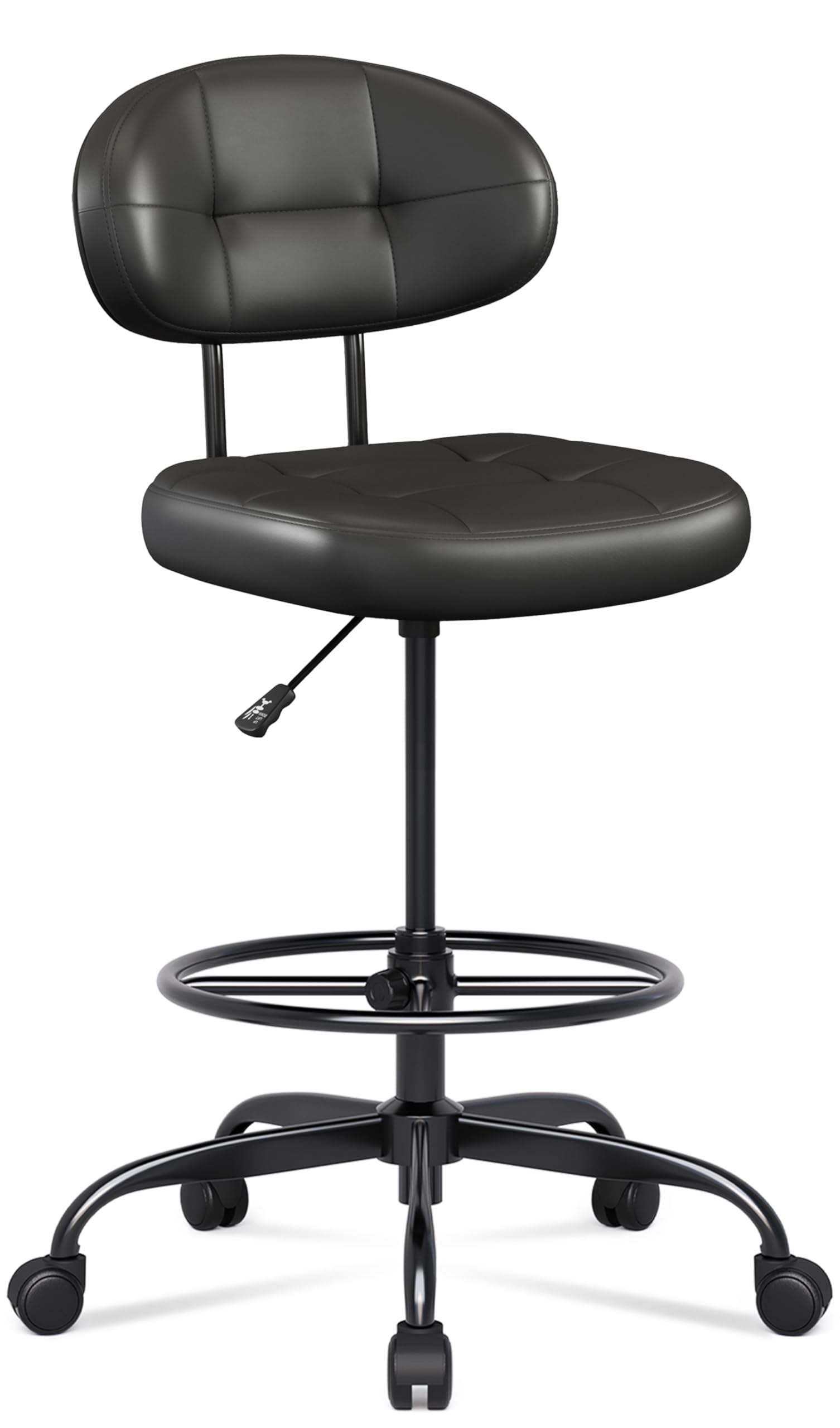
HYLONE Armless Drafting Chair

HYLONE Armless Drafting Chair

8.6/10 Excellent
  • Warranty: 12 months
  • Foot Ring: Adjustable
  • Seat Depth: 18.7 inches
  • Weight Capacity: 280 lb
Check Price on Amazon

Pros

  • Armless frame rolls fully under the desk
  • Adjustable foot ring
  • Breathable mesh back
  • 280-pound rating and 12-month warranty

Cons

  • Casters let it slide away as you sit

Sit in this chair for an hour and you will notice yourself drifting toward the monitor. The seat surface slopes forward, and the tilt adjustment does not fully cancel it, so you end up perched on the front of the cushion with your back doing the work. It is the reason this chair sits lower in our list than its specifications suggest.

Everything else is competent. The mesh back breathes, the frame is armless and rolls completely under a desk, the foot ring adjusts to meet your feet, and the seat board is FSC-certified wood under the foam — a small thing that matters on a chair rated to 280 pounds. There is a 12-month warranty, and the 18.7-inch seat depth gives taller sitters more thigh support than the compact chairs here.

Where it earns its place is at a drafting or sewing table, where you are leaning into the work anyway and the forward pitch stops fighting you. We came back to it for exactly that: a chair you roll up to a table for an hour of close work, not one you park at a keyboard for a full day. The casters are also light enough that it can slide away as you sit down, so keep a foot on the floor until you are settled.

Bottom Line: Worth it if you want an armless mesh chair that disappears under the desk and you do not mind sitting slightly forward all day.

How We Tested 12 Standing Desk Chairs

We started by pulling together standing desk chairs from brands we trust and a few newer names, then narrowed the list by height range, weight capacity, seat depth, price, and whether the arms adjusted independently. We ruled out chairs that topped out below 22 inches—too low for most standing desks—and ones with fixed armrests that blocked the chair from tucking under a desk. That left 12 chairs, which we assembled ourselves and rotated through eight months of real workdays.

Every chair went through the same first week: I assembled it solo with the included tools, timed how long it took, and noted whether the bolts lined up cleanly or needed a second pair of hands. Then I rolled each one across a hardwood floor and a low-pile rug, checking whether the casters caught or glided, and whether the seat height could be adjusted while sitting without a jarring drop. During full workdays, I switched between standing and sitting every 30 to 45 minutes—the way you actually use a standing desk—and paid attention to where the back support landed: mid-back, lumbar, or nowhere useful.

By the end of month two, we checked cushioning by seeing whether the foam still rebounded after a long sit or had started to flatten, and we re-tightened every bolt to catch loosening early. We also watched for the smaller signs of quality: stitching that held, armrests that didn’t creep downward, and a seat edge that didn’t dig into the backs of my thighs. The chairs that survived all eight months without a wobble, a squeak, or a height mechanism that slipped are the ones below.

How to Choose Standing Desk Chairs

Start with the seat height range, not the top number

This is where most buyers go wrong. A chair that reaches 32 inches sounds like a standing desk chair, but what matters is where the range starts and how much travel sits between the ends. A seat that bottoms out at 28 inches is useless at a normal desk, and one that stops at 22 inches is a standard desk chair with a taller name. Ordinary office chairs top out around 21 inches; a desk used at standing height wants a seat somewhere in the high twenties or low thirties.

If you want one chair for both a sitting desk and a standing one, check the low end of the range before anything else, because most tall chairs never come back down far enough. The Misolant armless chair, which runs from 23.5 to 31.9 inches at the cushion, is the clearest example here of a range that genuinely covers both.

The foot ring is not an accessory

At counter height your feet cannot reach the floor, and everything above your hips pays for it: dangling legs drag the seat edge into your thighs and load your lower back. A foot ring fixes that, but only if it adjusts independently of the seat and is wide enough for both feet. Narrow rings take the ball of one foot and nothing else, which is why the rings on cheaper chairs are the first thing we check.

The ErGear's 19.7-inch ring is the widest in this group and moves through five inches on its own track, so it can sit where your legs want it rather than wherever the seat happens to be. Treat a fixed ring as a warning sign on a chair you plan to use for hours at a time.

Judge the gas lift and the base together

A tall chair is less forgiving than a low one. The column is extended, the base sits further from your hips, and small weaknesses show up as wobble or a slow sink that starts halfway through the morning. Look for a rated, tested cylinder, take the stated weight capacity seriously rather than optimistically, and favour a wider base if you spend the day near the top of the range.

The paperwork is worth reading here. Misolant's 350-pound rating and the Class 4 lift on the ErGear are the two specifications in this group that actually tell you something about how the chair behaves at full height.

Arms, back angle, and what the seat is covered in

Flip-up arms are the most useful compromise: down for support between tasks, up when you need to pull close to a raised desktop. Fixed arms can stop you getting near enough to type, while armless designs like the Primy slide away completely and leave you nothing to lean on. Back angle matters more than the word ergonomic on the box, and several chairs here sit you upright with no way to change it. Mesh breathes and suits long, warm sessions; leather wipes clean and shrugs off workshop dust. Choose by the room, not the brochure.

Frequently Asked Questions

Final Verdict

Most people shopping for a standing desk chair should buy the ErGear. It has the widest foot ring here, 8 inches of seat-height travel, and arms that fold out of the way when you want to sit close to a raised desktop — the three things that decide whether a tall chair is comfortable or merely tall.

If the budget is tight and the chair is for a workshop rather than a workday, the Brick Attic does the same job for less. If the chair has to disappear every time you stand up, buy the armless Primy instead.