Home Office

Best Drafting Chairs of 2026

A drafting chair has one job an ordinary office chair can't do: put you at eye level with a tall desk without leaving your feet dangling. That extra height is also where things go wrong. Plenty of chairs stretch a standard office seat onto a longer gas cylinder, so you end up perched too high, hunting for a footrest that flexes under your heels, or wobbling when you roll away from the table. A good one fixes that: seat height matches a 36- to 42-inch work surface, the foot ring supports your legs, and the base stays planted when you lean.

I spent eight months using 11 drafting chairs at a sketching table and a standing-height desk, and the differences show up fast—especially in the cushion after a long afternoon and in the foot ring when you shift your weight. Assembly is another tell: the chairs that felt solid later went together without wobble or stripped threads. Measure your desk first; seat-height range matters more than the box, and the picks below are the ones that got it right.

#1

Best Overall

Office Star DC517V

Office Star DC517V

8.9/10 Excellent
  • Foot Ring: Height adjustable
  • Certification: GREENGUARD certified
  • Weight Capacity: 275 lb
  • Seat Height Range: 24 to 34 inches
Check Price on Amazon

Pros

  • 24-to-34-inch seat range covers tables and standing desks
  • Height-adjustable foot ring rises with the seat
  • GREENGUARD certified and approved for commercial use
  • Five-year cover on the gas cylinder and mechanism

Cons

  • Armless, with nowhere to rest your forearms
  • Ships with carpet casters rather than hard-floor wheels

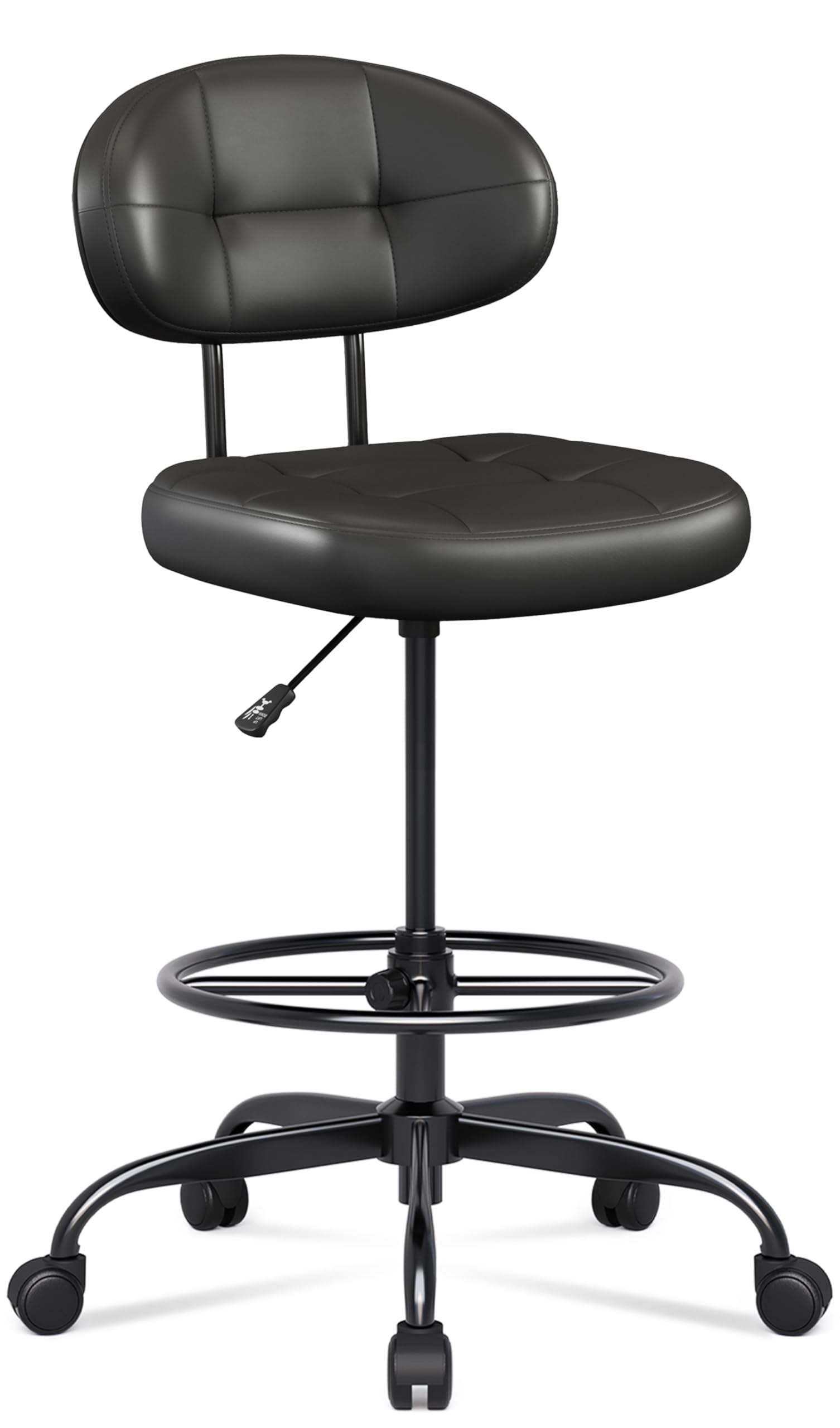
Ten inches of seat travel is what separates this chair from the rest of the group. The DC517V runs from 24 inches up to 34, which covers a low craft table, a 42-inch drafting surface, and everything in between, and the foot ring slides up the column with the seat so your feet stay planted instead of swinging. The ErGear offers eight inches of the same travel and the BOLISS about seven, so nothing here matches the spread.

We recommend it without much hesitation because nothing about it asks for special treatment. The vinyl wipes down with a dry cloth after a glue-up, the foam seat is 2.5 inches thick under a 17.5-inch-wide back panel, and the chair is GREENGUARD certified, which counts for something in the small spare room where most of these end up. At 275 pounds it is not the heaviest-rated chair here — the BOLISS takes that — but it is rated for commercial use rather than a hobby bench, and that shows in how planted the base feels at full height.

The warranty is the detail that settled it for us. Office Star covers non-moving metal parts for 15 years, the mechanism, cylinder, base, and casters for five, and the foam and upholstery for three — and the gas cylinder is exactly the part that quits first on a tall chair. Our one reservation is the back: it is a low, fixed panel with no recline, so it supports you while you work and does nothing for you when you lean back to think. If you want arms, the ErGear is the swap; if you want the height range and nothing else, this is it.
Bottom Line: For most people shopping for a drafting chair, this is the one: a genuine 24-to-34-inch seat range, a foot ring that rises with it, and a build approved for daily commercial use.
#2

Best for Standing Desks

ErGear EGOC5-US

ErGear EGOC5-US

8.8/10 Excellent
  • Foot Ring: 19.7 in wide; adjustable 5 in
  • Lumbar Support: Adjustable 2 inches
  • Weight Capacity: 300 lb
  • Seat Height Adjustment: 8 inches
Check Price on Amazon

Pros

  • Lumbar pad adjusts through two inches
  • Flip-up padded arms clear a desk edge
  • Class 4 gas lift rated to 120,000 cycles
  • Wide 19.7-inch foot ring with five inches of adjustment

Cons

  • Foot ring can slip down its collar over time

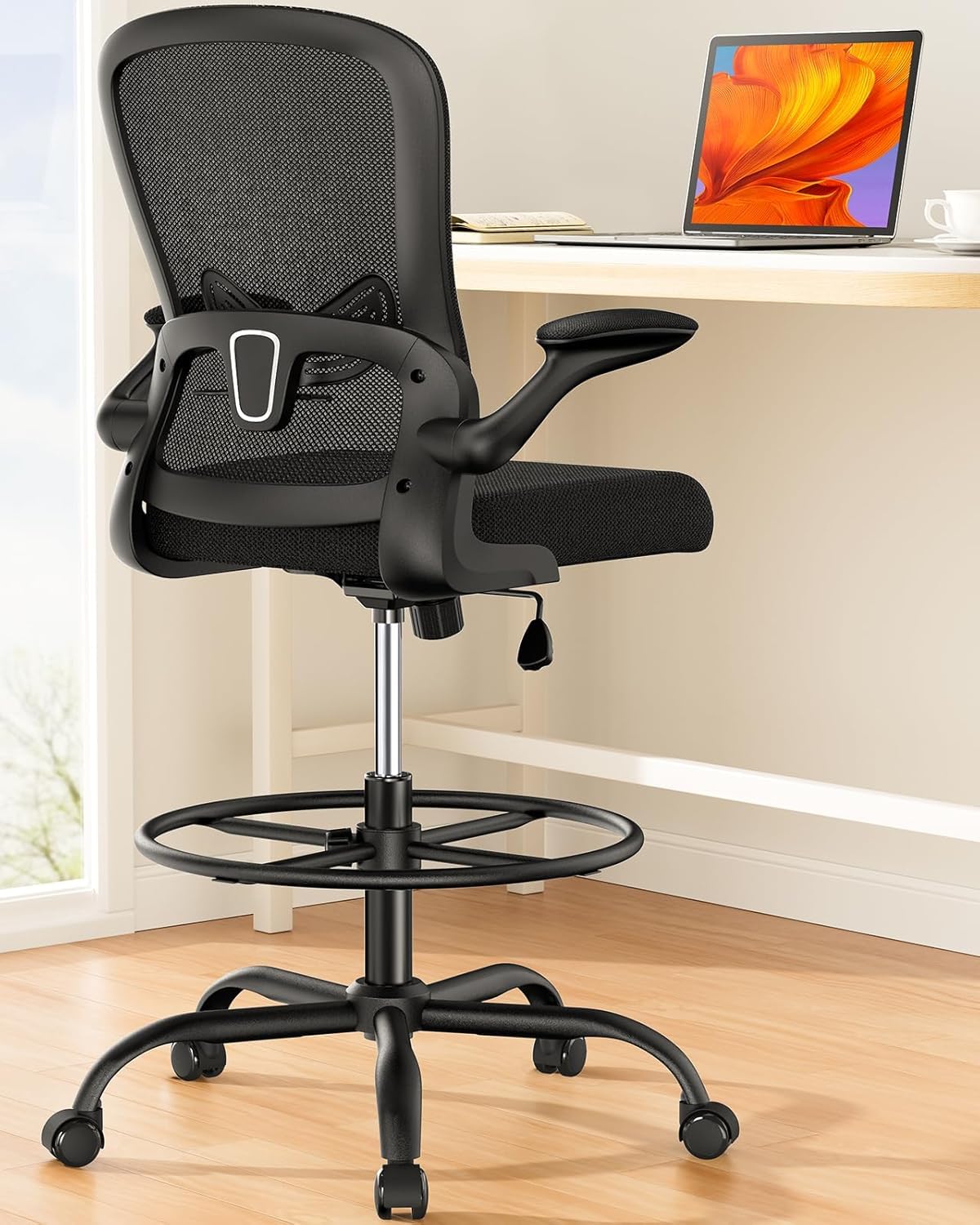
The case for the ErGear is made in the two inches of travel built into its lumbar panel. On a sit-stand desk you change posture a dozen times a day, and a pad you can slide up or down to meet your lower back at each height does more for a long afternoon than another half-inch of foam. We also like that the arms fold up through 90 degrees — the chair slides under a shallow desk instead of stopping at the drawer apron, which is the thing that usually forces people into an armless chair they did not want.

The rest of the specification supports the pitch. The foot ring is 19.7 inches across, wide enough to take both feet, and adjusts through five inches; the seat is thickly padded with a waterfall front edge; the mesh back sits at 17 degrees and the base is oversized relative to its 300-pound rating. The lift is a Class 4 cylinder rated to 120,000 cycles, which is the number that matters on the part holding you at standing height all afternoon.

The foot ring is our one gripe. It tightens onto the column with a collar, and it works its way down over a week of daily use until you notice your heels sitting lower than they were. We tightened it once and stopped thinking about it — but check it on arrival, because a ring that starts loose only gets looser.

Bottom Line: If your desk goes up and down through the day, buy this one — the lumbar pad moves with you and the arms fold out of the way when you roll in close.
#3

Best for Big and Tall

BOLISS 2818HD

BOLISS 2818HD

8.8/10 Excellent
  • Arms: Flip-up
  • Seat Size: 20.1 by 20.1 inches
  • Weight Capacity: 400 lb
  • Seat Height Range: 24.8 to 32.1 inches
Check Price on Amazon

Pros

  • 400-pound rating, the highest in this group
  • 20-inch molded foam seat with a five-inch cushion
  • Flip-up arms clear a workbench edge
  • Mesh back with lumbar cushion for long shifts

Cons

  • Fixed upright back with no recline
  • 46 pounds and a 27.6-inch base need space

Twenty inches square is the measurement to start with, because it is the one you feel. The BOLISS seat runs 20.1 by 20.1 inches under five inches of molded foam, and the frame is rated to 400 pounds — both figures are the largest in this group. If you have been making do on a 16-inch stool, the difference is not subtle: your hips land on the cushion instead of hanging off it.

Height runs 24.8 to 32.1 inches through a 7.3-inch hydraulic range, so it clears a drafting table and settles back down for a normal desk. The back is a tall mesh panel with a lumbar cushion, the arms flip up through 90 degrees, and there is a headrest on top. All of that comes to 46.2 pounds, so build it where it is going to live rather than assembling it downstairs and hauling it up.

What you give up is adjustment in the back itself. The angle is fixed upright — no recline, and no way to ease the backrest off vertical — so it holds you forward whether or not that is what your lower back wants that hour. The headrest is fixed too, which suits a long torso better than an average one, and the 27.6-inch base wants a decent patch of floor. At the lowest setting, shorter sitters may still have their feet off the ground. The flip-up arms are the detail we used most: folded down, the chair pulls right up to a bench without the pads catching.

Bottom Line: Built for sitters who need room and a real weight rating, with a 400-pound capacity, a 20-inch seat, and arms that fold up out of the way.
#4

Best for Small Spaces

Misolant Armless

Misolant Armless

9.0/10 Outstanding
  • Arms: Armless
  • Seat Width: 16.5 inches
  • Certification: BIFMA tested; SGS gas lift
  • Seat Height Range: 23.5 to 31.9 inches
Check Price on Amazon

Pros

  • Smallest footprint here at 17.3 inches wide
  • Adjustable foot ring and air-lift height control
  • BIFMA tested with an SGS-certified gas lift
  • Faux leather wipes clean with a damp cloth

Cons

  • Narrow 16.5-inch seat limits broader sitters
  • Faux leather runs warm in a closed room

Take the arms off a drafting chair and two things happen: it gets cheaper, and it gets out of the way. The Misolant measures 17.32 inches wide and 19.68 inches deep, the smallest footprint here, and at 21.6 pounds it is light enough to swing aside with one hand when you want to stand at the bench instead.

The seat runs from 23.5 to 31.9 inches off the floor on an SGS-certified gas lift, with an adjustable foot ring underneath, and the cushion measures 16.5 inches wide by 16.3 deep. It has passed BIFMA testing, which is a higher bar than most chairs at this end of the category clear. The PU leather wipes clean with a damp cloth, and that matters if the chair doubles as a painting stool or sits near a potting bench.

We recommend it to anyone whose work surface is in a tight spot — a dressing table, a lab counter, a sewing corner carved out of a bedroom. What it will not do is hold a broad sitter the way the BOLISS does; 16.5 inches of cushion is a perch for someone with wide hips, and that is the trade for the footprint. The casters roll from a hard floor onto a low-pile rug without catching, which is the test that actually matters in a bedroom.

Bottom Line: A 17-inch footprint is what makes this one worth buying when your work surface is wedged into a corner or a closet office you also sleep in.
#5

Best for Salons and Shops

Brick Attic T12

Brick Attic T12

8.8/10 Excellent
  • Backrest: Removable
  • Seat Width: 15.8 inches
  • Height Range: 33.86 to 41.75 inches
  • Weight Capacity: 300 lb
Check Price on Amazon

Pros

  • Backrest detaches to convert it into a stool
  • 23.6-inch five-star base holds on short carpet
  • 300-pound rating on a metal frame
  • Quick assembly with clear instructions

Cons

  • Backrest height is fixed and sits low
  • 15.8-inch cushion is the narrowest here

The backrest comes off. That single fact decides who this chair is for: a tattoo studio, a salon, a garage bench where you spend most of the day perched and only occasionally want something behind you. A few bolts and a couple of minutes and it is a plain rolling stool with a foot ring, which is often the more useful object.

The rest is built for that life. The five-star base is 23.6 inches across, and that spread is why it keeps its footing on short shag carpet where narrower bases bog down; the cushion is 15.8 inches wide and the chair is rated to 300 pounds. Height runs from 33.86 to 41.75 inches overall, enough to put you at a counter or a tall workbench, with the foot ring adjusting underneath. Assembly is a short job with labeled hardware and instructions clear enough to follow in one pass.

The catch is the seat. At 15.8 inches it is the narrowest cushion in this guide, and a broader sitter will feel the edges after an hour. The backrest is a flat panel rather than a shaped back, its height does not adjust, and it sits fairly low, so you get something behind you rather than proper lumbar support. For salon and shop work that is the right trade; for eight-hour desk days it is not.

Bottom Line: Buy this one for a salon, shop, or garage, where the backrest is optional and the wide base matters more than the padding.
#6

Padded all-day sitting

Misolant High-Back

Misolant High-Back

8.6/10 Excellent
  • Upholstery: PU leather
  • Lumbar Support: Adjustable 2 inches
  • Weight Capacity: 350 lb
  • Overall Height Range: 46.5 to 54.3 inches
Check Price on Amazon

Pros

  • Thick waterfall seat and upholstered back
  • 350-pound rating on a BIFMA-tested frame
  • Lumbar support adjusts through two inches
  • Widest backrest here at 22.75 inches

Cons

  • Foot ring can work loose and stop holding height
  • Fixed back angle with no recline

Padding is the whole pitch, and it is the first thing we noticed. The seat is a waterfall cushion shaped to wrap the thighs, the back is upholstered rather than mesh, the arms are padded, and the lumbar panel slides up and down through two inches. Overall height runs 46.5 to 54.3 inches and the frame is rated for 350 pounds on a BIFMA-tested build with an SGS-certified four-level gas lift.

It also has the widest back in this guide at 22.75 inches, which is why a larger sitter can settle into it rather than perch on it. The seat depth is 19.7 inches, so your thighs are supported past the edge of the cushion, and the PU leather has a convincing grain that wipes clean in a couple of passes. It is 40.8 pounds, so it arrives as a project rather than a pop-out-of-the-box chair.

Where it loses ground is the hardware around the seat. The foot ring is the part to watch: it can work loose and stop holding its height, and it is the first thing to check if the chair starts to feel wrong underfoot. The back angle is fixed as well, with no recline, so the padding is doing work the geometry cannot. We still rate it for a studio or home office where you sit for long stretches and would rather have a soft landing than another adjustment lever.

Bottom Line: You get drafting height with armchair padding here, along with a 350-pound rating and a lumbar panel that adjusts through two inches.

How We Tested 11 Drafting Chairs

We started by pulling together a shortlist of 11 chairs from the obvious office-furniture names and a few smaller workshop brands, filtering first by seat-height range, then by footprint, weight capacity, and price. That last filter mattered: we wanted chairs that made sense for a home studio or garage workbench, not just a commercial drafting room. Over eight months, we assembled each one solo with the tools in the box and noted how long it took, whether the bolt holes lined up, and whether the chair still felt tight after a week of rolling.

Every chair lived at a 36-inch drafting table for sketching sessions and at a 42-inch standing desk for full workdays. We rolled them across hardwood and low-pile carpet, leaned sideways to reach across the table, and shifted weight onto the foot ring dozens of times a day. We noted whether the cushion bottomed out by mid-afternoon, whether the foot ring flexed or stayed put, and whether the height adjustment moved smoothly when we switched from sitting to perching. We also checked whether the back tilt and seat lock engaged without a jolt.

After the first month, we checked welds, casters, and upholstery seams for looseness or wear, then kept using the chairs for the rest of the eight months to see what changed. Value came down to comparing the hardware and finish against what each chair cost, not just the sticker. We also measured each base and footprint to see which ones fit under a tall desk without crowding a small room. The chairs that scored best did the boring things well: they held their height, rolled without drama, and felt stable when we leaned.

How to Choose Drafting Chairs

Read the seat height, not the chair height

Product pages lead with the big overall dimension, but a tall-looking chair can still top out at a seat that leaves you hunched at a drafting table. Measure your work surface, then check the high end of the seat range against it: a 38-to-42-inch table wants a seat that reaches somewhere in the high twenties or low thirties, and a standing desk wants the same treatment at whichever height you actually stand at.

The Office Star spans 24 to 34 inches, the widest range here, so it covers a standard desk as well as a drafting table. The BOLISS covers 24.8 to 32.1 inches and the ErGear gives you eight inches of travel — plenty, as long as the bottom of that travel sits where you need it.

Insist on a foot ring that moves

Your feet will not reach the floor on a tall chair, and dangling feet pull your thighs off the seat and drop the load onto your tailbone. A foot ring fixes that, but only if its height adjusts: a ring fixed at one position suits one seat height, and the moment you drop the chair for a normal desk it is in the wrong place.

Every chair in this guide has an adjustable ring, which is not a given at the cheaper end of the category. The ErGear's moves through five inches and is wide enough for both feet; the Office Star's rides up the column with the seat, so one lever does the whole job.

Decide how you want the arms

Fixed armrests are the reason a tall chair stops dead at a drafting table with a drawer apron. Flip-up arms solve it — the ErGear and the BOLISS both fold theirs to 90 degrees — and an armless chair gets closest of all, which is the argument for the Misolant in a tight corner.

The trade is real. Arms take weight off your shoulders across a long session; without them, all of it lands on your seat and lower back. If you sit for six hours, flip-up arms are the better compromise, since you can drop them for the desk and raise them for the break.

Mesh or upholstery

Mesh breathes, and on a chair you occupy all day that matters more than it sounds — the ErGear and the BOLISS both use it, and both are the picks for warm rooms. Vinyl and PU wipe clean, which is why workshop and studio chairs lean that way: glue, ink, and clay come off with a dry cloth.

The Office Star's vinyl is the easiest of the group to keep presentable in a shared space, and the PU on the Misolants looks softer but runs warmer. If the chair lives in a garage or a sunlit studio, weight ventilation above finish.

Weight rating, base, and the sinking problem

The most common way a tall chair disappoints is the gas lift giving up and the seat settling under you. Two things guard against it: a capacity with headroom over the sitter, and a decent cylinder. Look for a Class 4 lift where it is stated — the ErGear's is rated to 120,000 cycles, the Misolants use an SGS-certified cylinder — and give yourself margin rather than shopping at the limit.

Base spread matters just as much. The Brick Attic's 23.6-inch five-star base is why it holds its footing on short carpet, and the BOLISS pairs its 400-pound rating with a base and seat to match.

Frequently Asked Questions

Final Verdict

Start with the Office Star DC517V. Ten inches of seat travel, a foot ring that climbs with it, GREENGUARD certification, and a five-year cover on the gas cylinder make it the safest buy for a drafting table or a standing desk, and it costs about what the mesh chairs here do.

If your desk moves up and down all day, the ErGear is the better companion: the lumbar pad travels two inches, the arms fold away, and the wide foot ring takes both feet. And if you need a chair to hold a genuinely heavy sitter, the BOLISS is the only one in this group rated for the job.