Kids & Nursery

Best Bunk Beds of 2026

A bunk bed promises to turn one bedroom into two, but the wrong one turns bedtime into a creaky, wobbly negotiation. I've watched kids love the idea of a top bunk until they climb up and the whole frame shifts, and I've seen parents worry about guardrails, ladder placement, and whether the thing will survive a sleepover. The right bunk bed frees up floor space, gives siblings separate corners, and feels solid enough that nobody thinks about it after lights-out.

Over the past eight months, my team and I assembled, climbed on, and lived with seven bunk beds in real kids' rooms. We paid attention to the stuff that only shows up after a few weeks: a squeak at 2 a.m., a missing bolt in the box, instructions that assume a second person who never arrives. Appearance matters, too—these beds sit in the middle of a child's room, not a showroom—and so does value, because a bunk bed should last through growth spurts and sleepover phases. The picks below are the ones that felt sturdy, assembled without drama, and looked good enough to keep.

#1

Best Overall

Max & Lily Solid Wood Bunk

Max & Lily Solid Wood Bunk

8.6/10 Excellent
  • Converts To: Two free-standing twin beds
  • Frame Material: Solid pine, low-VOC finish
  • Weight Capacity: 400 lb per sleeping surface
  • Guardrail Height: 14 inches
Check Price on Amazon

Pros

  • 400 pounds per sleeping surface
  • 14-inch guardrails on the upper bunk
  • Splits into two free-standing twin beds
  • Reversible ladder fits either side

Cons

  • Picture-only instructions slow the build
  • Costs more than the metal frames here

Four hundred pounds per sleeping surface is the figure that decided this one for us. It is the highest rating among the wood frames here, and it changes how the bed gets used: a parent can stretch out on the top bunk at bedtime, a teenager can flop down without the frame complaining, and nobody has to replace the furniture when the kids hit high school. The 14-inch guardrails are the tallest in the wood group too, which matters more than the styling does.

What we did not expect to care about was how the parts go together. The slats are solid wood rather than a composite panel, they sit over a metal center support bar, and the major joints use metal-on-metal bolt connections instead of threaded inserts buried in the wood. You notice it during assembly: it goes up square, and the corners come tight without that soft give you get when a bolt bites into pine. The ladder bolts to either side, and the whole bunk splits into two free-standing twin beds.

Two practical notes from the build. Stacking the upper section really does want two people — one to hold it square while the other drives bolts — and it is an afternoon rather than an hour. The finish is non-toxic and low-VOC, which is what you want in a small shared bedroom, though a painted surface would hide scuffs better than this one does.

If a soft foam mattress is going up top, plan for a bunkie board or a firmer 6- to 8-inch mattress. The slats are spaced for support rather than for hugging something squishy, and a soft one dips between them. That is a mattress decision, not a frame flaw — just make it before delivery day instead of after.

Bottom Line: The bunk we recommend to most families: solid pine, 400 pounds a surface, 14-inch rails, and two separate beds when the room changes.
#2

Best Traditional Wood Bunk

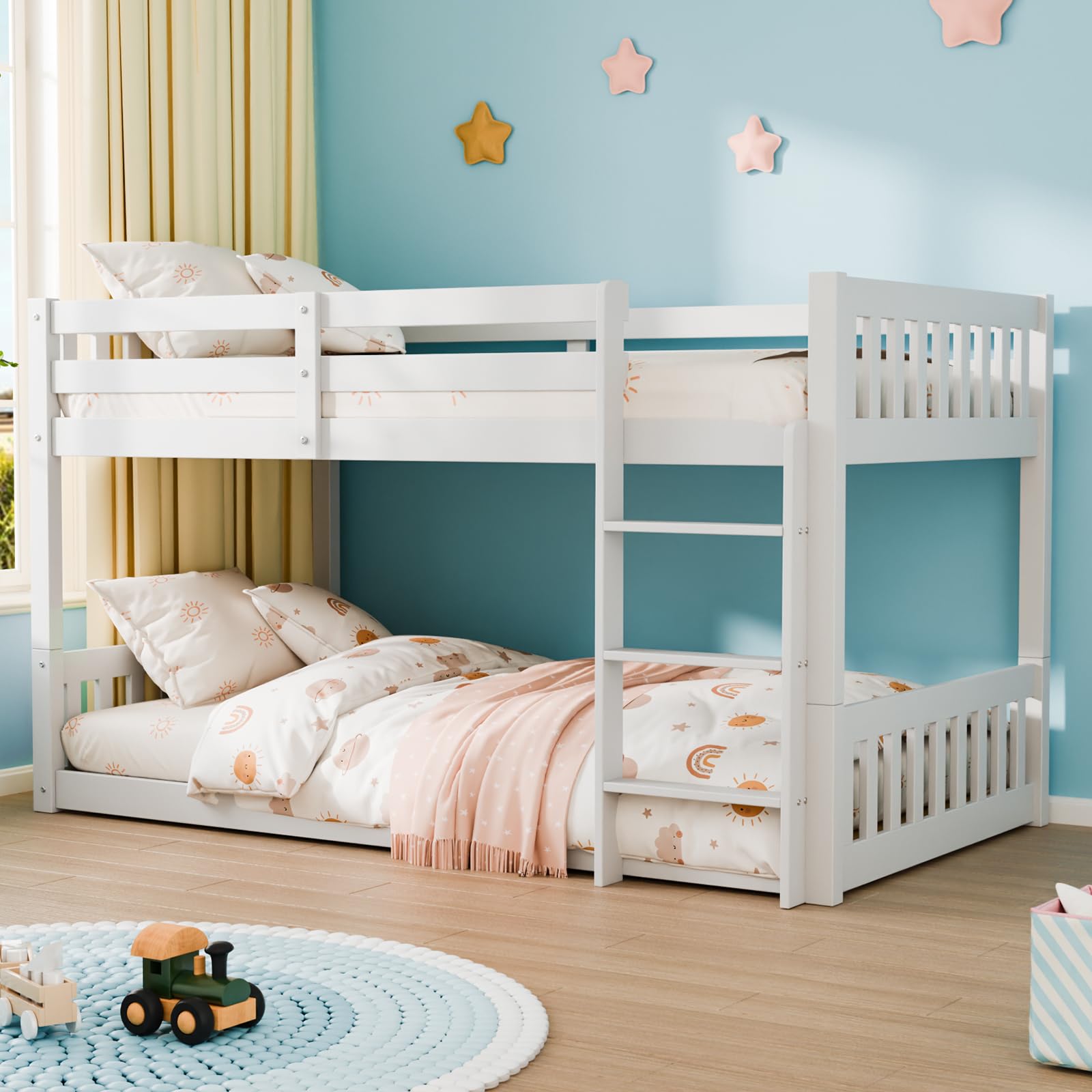
Storkcraft Long Horn Bunk

Storkcraft Long Horn Bunk

9.1/10 Outstanding
  • Converts To: Two individual twin beds
  • Certification: GREENGUARD Gold
  • Frame Material: Rubberwood and engineered wood
  • Weight Capacity: 225 lb
Check Price on Amazon

Pros

  • GREENGUARD Gold certified finish
  • Converts to two individual twin beds
  • Full-length guardrails and a fixed five-step ladder

Cons

  • 225-pound limit per bunk
  • Engineered wood and composites in the frame

The ladder on the Long Horn is fixed to one end, and that is the first thing to check against your room, because it decides which wall the bed can stand against. There is no moving it to the other side later. Get that right and the rest of the bed makes a lot of sense for a kids' room, particularly one that will eventually be split between two children.

We like where Storkcraft spent the money. The frame is rubberwood solids with engineered wood, it carries GREENGUARD Gold certification — the only bed here with that — and it breaks down into two full twin beds using the same hardware, with a five-step ladder rather than a two-rung afterthought. At 64.5 inches to the top rail it is a standard-height bunk, so there is real space underneath and a proper climb up.

The caveat is the wood. The top side rails are where this bed can crack, and the warranty runs one year, which is short for something you expect to last a childhood. Inspect the rails when the boxes arrive rather than after the return window closes, and keep the paperwork. Ours went together in a couple of hours without drama, which matches what we expected from a frame this straightforward.

Where it lands: a kids' room up through the early teens, in white, with a finish you can put in a small bedroom without worrying about what it is off-gassing. If an adult or a growing teenager will sleep up top regularly, spend the difference and take the Max & Lily instead.

Bottom Line: For younger kids this is the wood bunk we trust: GREENGUARD Gold, a proper five-step ladder, and two twin beds later.
#3

Best for a Bigger Bottom Bunk

SHA CERLIN Twin over Full

SHA CERLIN Twin over Full

8.6/10 Excellent
  • Ladder: Removable, mounts either side
  • Weight Capacity: 400 lb
  • Bunk Configuration: Twin over full
  • Under-Bed Clearance: 12.4 inches
Check Price on Amazon

Pros

  • Full-size lower bunk sleeps two
  • Ladder lifts off or mounts either side
  • 400-pound frame with 12.4-inch under-bed clearance

Cons

  • Needs about 56 inches of wall width

A twin-over-full is a different proposition from everything else on this page: the bottom bunk sleeps two, so the bed handles three children in the floor space a twin-over-twin would take up. That is the reason to buy it. The 400-pound square-tube frame underneath is competent rather than remarkable, and we are fine with that — you are paying for the extra sleeping surface, not for joinery.

The practical details are better than the price suggests. The ladder lifts off entirely or mounts on either side, so it does not have to live in the walking path between the door and the dresser, and there is 12.4 inches of clearance underneath for storage tubs. The tube is square rather than round, which reads as furniture in a way that round metal frames rarely do.

Two things to plan around. It runs about 56 inches wide, so in a small room it is a wall-and-a-half proposition and you need to measure the gap between the window and the closet before ordering. And the guardrail comes with its own rule: the top of the upper mattress has to sit at least five inches below the top edge of the rail. A deep pillow-top eats that margin fast.

Noise is the other thing we would tell a friend about. This frame creaks once the joints work loose, which on a metal bunk takes a few months of children climbing. A quarterly pass with the wrench quiets it again. If a silent bedroom matters more than the extra sleeping space, take one of the wood frames instead.

Bottom Line: We pick it for the full-size lower bunk: three sleepers in one bed's footprint, with a ladder you can move or lift off.
#4

Best Low Bunk for Young Kids

JOYMOR Low Twin Bunk

JOYMOR Low Twin Bunk

8.8/10 Excellent
  • Frame Material: Solid pine
  • Overall Height: 47.6 inches
  • Weight Capacity: 264.5 lb
  • Guardrail Height: 11 inches
Check Price on Amazon

Pros

  • 47.6-inch height suits young children
  • Full-length 11-inch guardrails
  • Reversible ladder fits either side

Cons

  • 264.5-pound limit per bunk
  • A thick mattress leaves the 11-inch rail too low

The top rail on this bunk sits at 47.6 inches, roughly shoulder height on an average adult. That is the whole pitch: you can change the sheets, reach a sleeping four-year-old, and lift them down without a step stool, and the bed slides under a sloped ceiling that would rule out a full-height frame entirely.

What you give up is capacity. The pine frame and its hardware are sized for children — an adult can perch on the edge to read, but this is not a bunk you put a grown-up in overnight, and it is not the bed that carries two kids into their teens. That is the honest boundary, and it is why the price sits where it does rather than up with the solid-wood frames above.

Assembly takes an afternoon and a second pair of hands; it is a multi-step build with a lot of pieces and instructions that are more diagram than guidance. The reversible ladder helps in a tight room, the full-length guardrails run the length of the upper bunk, and the white painted finish wipes clean, which is most of what you want in a room where somebody will eventually draw on it.

Bottom Line: The low bunk we point parents of small children to: a top rail you can reach over, in solid pine, with a reversible ladder.
#5

Best Playful Design

LIKIMIO House Bunk

LIKIMIO House Bunk

9.0/10 Outstanding
  • Footprint: 76.8 by 40.7 inches
  • Frame Material: Powder-coated metal
  • Overall Height: 71.7 inches
  • Weight Capacity: 400 lb
Check Price on Amazon

Pros

  • House design children actually want
  • 400-pound metal frame
  • Wall-anchor parts included

Cons

  • Tall 71.7-inch frame needs ceiling clearance
  • Flat metal ladder rungs are hard on bare feet

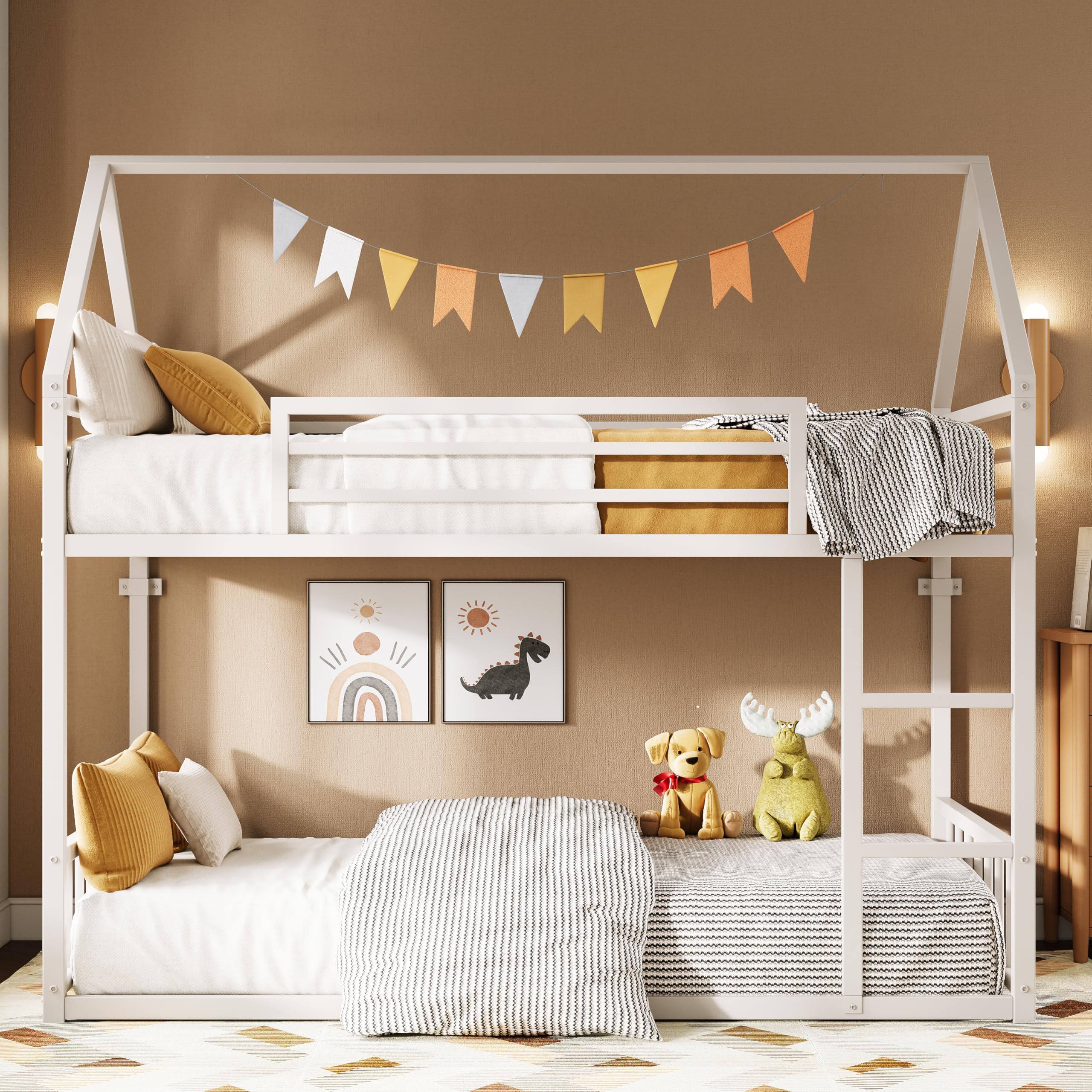
The house silhouette is the reason to look, and we are not going to pretend otherwise. A pitched roof over the top bunk and a window-like opening turn a corner of a shared room into something a five-year-old actively wants to sleep in. If bedtime is a negotiation in your house, that is worth more than a slightly better weld somewhere you will never see.

Underneath the paint it is a straightforward metal bunk: a 400-pound rating, full-length guardrails on the upper bed, and a frame that comes apart again when you move. It stands 71.7 inches tall, which is taller than the wood frames here, so check the ceiling and any fan before you commit. Use the wall brackets that come in the box — a tall metal frame with a child on the ladder wants them.

The ladder is the part we minded. The rungs are flat metal squares rather than wide steps, so barefoot climbs at two in the morning are a bit sharp on the soles. The upper rail is generous, but a deep mattress brings a small sleeper closer to the top edge than the numbers suggest, and a 6- to 8-inch mattress keeps things sensible up there.

Bottom Line: We recommend it when the room needs a bit of theatre: a 400-pound metal bunk kids want to sleep in, at a budget price.
#6

Best Budget Bunk

VECELO Metal Bunk

VECELO Metal Bunk

8.8/10 Excellent
  • Slats: 20 metal slats
  • Weight Capacity: 400 lb
  • Guardrail Height: 11 inches
  • Under-Bed Clearance: 13 inches
Check Price on Amazon

Pros

  • 400-pound capacity at the lowest metal price
  • 20 slats with buckle fastening
  • 13 inches of under-bed storage

Cons

  • 11-inch guardrail is short for a thick mattress

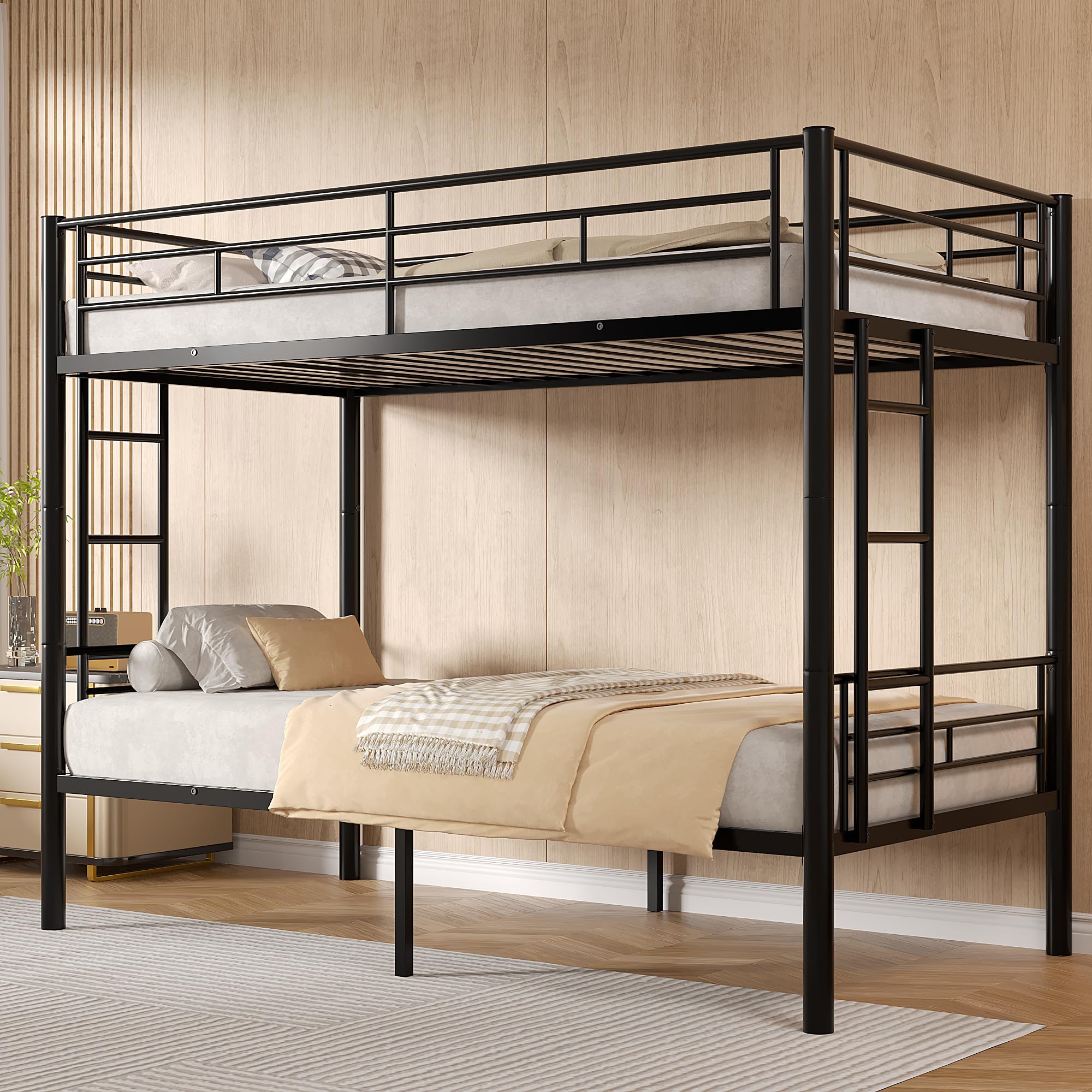
This is what the bottom of the metal group buys: 20 slats, a 400-pound rating, full-length guardrails and a powder-coated black frame, with nothing you did not ask for. For a spare room, a rental, or a first apartment, that is often exactly the right trade — the money goes into the steel rather than into a headboard profile.

The details are better than the position suggests. The slats fasten down with plastic buckles instead of rattling loose, there are 13 inches of clearance underneath for low storage bins, and the ladder bolts on rather than hooking over the top rail, so it does not shift when a child climbs. It goes together in an afternoon with the tools in the box, which is not something we can say for every frame here.

Where it shows its price is the guardrail. Eleven inches is the shortest rail on this page, and it assumes a thin mattress; put a deep hybrid up top and the effective protection drops by exactly the height you added. Buy a 6-inch mattress for the upper bunk and this frame does most of what a much more expensive one does, with a black finish that hides the scuffs a kids' room delivers.

Bottom Line: Our budget pick: 20 slats, a 400-pound rating, and full-length rails at a first-bunk price.
#7

Best Heavy-Duty Frame

Feonase Heavy-Duty Bunk

Feonase Heavy-Duty Bunk

8.7/10 Excellent
  • Slats: 22 metal slats
  • Weight Capacity: 800 lb
  • Guardrail Height: 11.2 inches
  • Under-Bed Clearance: 12.2 inches
Check Price on Amazon

Pros

  • 800-pound weight capacity
  • 22 tightly spaced metal slats
  • Mute buckles keep the frame quiet
  • 12.2 inches of under-bed clearance

Cons

  • 11.2-inch rail suits a thinner mattress
  • 96-pound frame is awkward to move

Twenty-two slats, tightly spaced, over a steel frame rated to 800 pounds. That is double what most of this group carries, and it changes what the bed is for: this is the one here you can put a grown adult or a growing teenager on the top bunk of without doing arithmetic first. The slat deck is firm enough that a foam mattress does not need a bunkie board underneath it.

The rest of the frame is aimed at the same buyer. Mute buckles under the slats keep the platform from clattering when someone rolls over, there is a wall anchor in the box, and 12.2 inches of clearance underneath takes proper storage tubs rather than the shallow ones. The 11.2-inch rail is the one number that gives us pause — pair it with a 6- or 8-inch mattress rather than a deep pillow-top.

At 96 pounds, the frame is a two-person carry up a staircase. On a ground-floor bedroom that is nothing; in a third-floor walk-up it is a morning. What we cannot tell you yet is how the powder coat looks after four years of children, because this frame simply does not have the history behind it that the Storkcraft or the Max & Lily do. What it does have is the strongest structure on the page.

Bottom Line: Our heavy-duty pick: an 800-pound steel frame and 22 slats, for households where the top bunk carries real weight.
#8

Wood-grain finish

Grain & Grove Bear Bunk

Grain & Grove Bear Bunk

8.5/10 Excellent
  • Footprint: 80.75 by 42 inches
  • Frame Material: Engineered wood
  • Weight Capacity: 400 lb
  • Guardrail Height: 14 inches
Check Price on Amazon

Pros

  • Embossed pecan wood-grain finish
  • 14-inch guardrails
  • 400-pound capacity with a reversible ladder

Cons

  • Engineered wood rather than solid pine

Most bunks here look like bunks. The Bear looks like furniture: an embossed pecan finish with a grain you can see across the room, squared posts, and color-matched hardware that disappears into the frame instead of announcing itself. In a guest room or a teenager's bedroom, that is worth something no specification records, and it is the reason we kept coming back to it.

The numbers hold up too. Four hundred pounds per bunk, 14-inch guardrails, a ladder that mounts at either end, and a 62.25-inch height that leaves usable space underneath without looming over the room. It takes standard twin mattresses between 5 and 8 inches, which is where most bunk mattresses land anyway, and the frame is compatible with a bunkie board if you want a firmer deck under foam.

The honest note is the material. This is engineered wood rather than the solid pine of the Max & Lily, so if you are buying for two rough children who will still be in the bed at fifteen, spend the difference and take the solid frame. For a lake house, a spare room, or a teenager who wants a room that does not look like a dormitory, this is the better-looking buy of the two.

Bottom Line: Our pick for a room that has to look grown-up: embossed pecan, 14-inch rails, and 400 pounds a bunk.
#9

Dorms and storage

Itaar Storage Bunk

Itaar Storage Bunk

8.8/10 Excellent
  • Storage: Four drawers and eight-hook pegboard
  • Charging: Two outlets, two USB ports
  • Footprint: 89 by 38.1 inches
  • Guardrail Height: 13 inches
Check Price on Amazon

Pros

  • Four drawers plus an eight-hook pegboard
  • Two outlets and two USB ports built in
  • 13-inch full-length guardrail

Cons

  • 89-inch footprint needs a long wall
  • Shakes until it is anchored to the wall

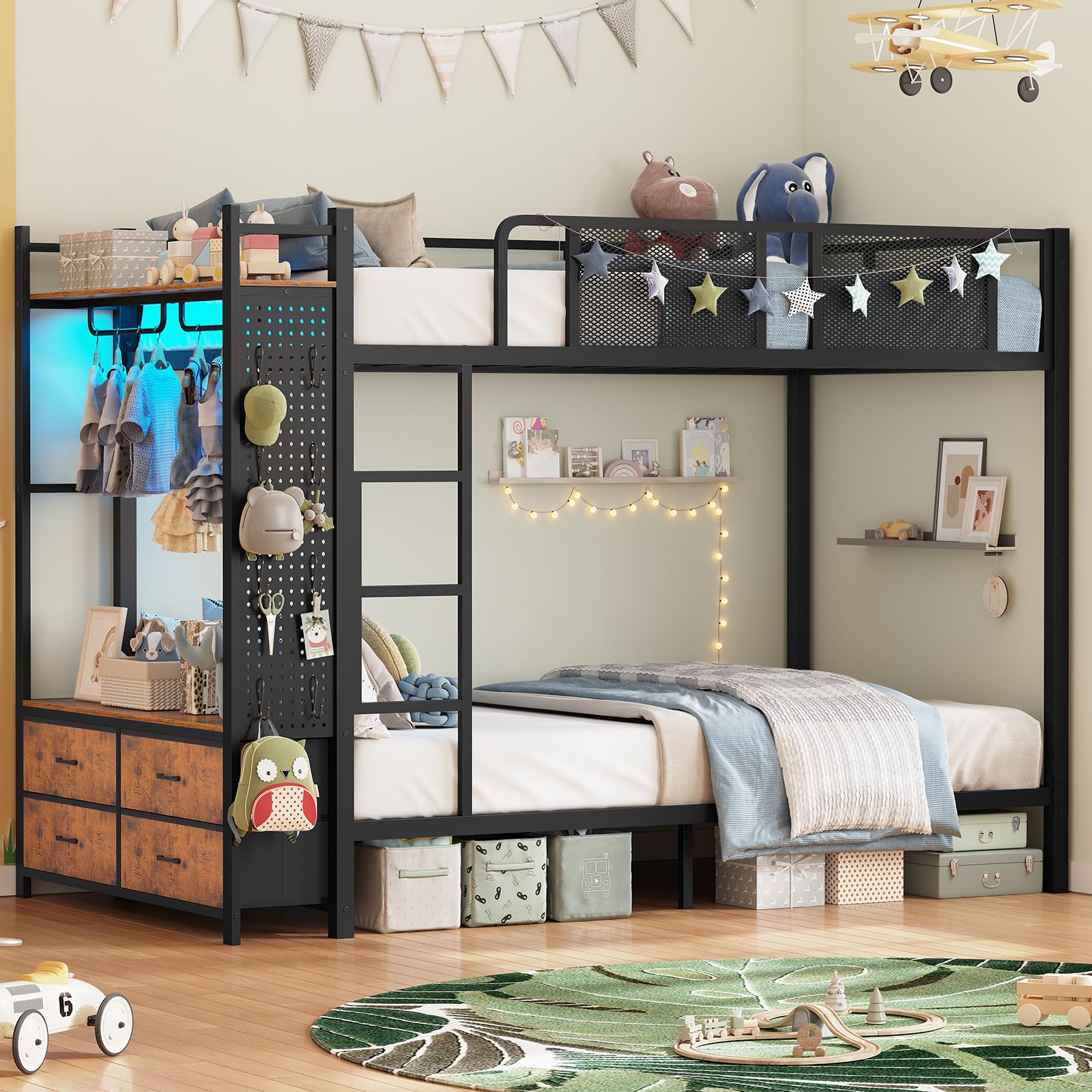
This is a bunk bed with a hall tree bolted to one end: a pegboard with eight hooks, four fabric drawers, two outlets and two USB ports, and an LED strip with a remote. Some of that is gimmick and some of it is genuinely useful, and the split is not where we expected it to be.

The parts we rate are the boring ones. The drawers sit at the end of the bed and can be fitted on either side, which is the difference between the frame fitting a room and not, and the outlets land where a teenager actually needs them rather than behind the mattress. Thirteen inches of guardrail is more than the budget metal frames give you. The LED strip loses its novelty by week two, but it works as a night light.

The catch is the footprint. At 89 inches long it is the longest frame here by nearly a foot, so it needs a wall with nothing else on it. It also needs to be fixed to that wall — the anti-toppling device is in the box for a reason, and this frame shakes when a child climbs until it is anchored. Put it in a dorm room or a teenager's bedroom with a long wall and it is a lot of furniture for the money.

Bottom Line: Our pick for a dorm or a teenager's room with a long wall: four drawers, a charging hub, and a bed in one frame.

How We Chose and Tested Bunk Beds

We started by researching dozens of bunk beds, filtering by frame material, weight capacity, footprint, guardrail height, and price relative to what you actually get. That narrowed the field to seven models—twin-over-twin and twin-over-full—which we assembled in homes with kids ages four to twelve. Before turning a single Allen wrench, we laid out every part against the instruction list to catch missing pieces, then timed assembly solo and with a second adult.

Over eight months, those beds lived through bedtime routines, sleepover weekends, and the occasional fort-building phase. We watched kids climb ladders in socks and in a hurry, shook the frames at the corners, and listened on quiet nights for squeaks when someone rolled over. We noted where instructions were vague, where a second set of hands was truly necessary, and whether the finish held up to stickers, markers, and the usual bumps.

Sturdiness was the make-or-break: we pushed and pulled at the headboards, checked that guardrails sat high enough, and made sure ladder rungs were easy for small feet without being a trap for older ones. We also compared what each bed offered for the money—solid joinery, useful under-bed space, a finish that looked intentional—because a bunk bed is a long-term purchase, not a seasonal swap. The ones that stayed in the running had no mystery parts, no late-night symphony, and no wobble after months of daily use.

How to Choose Bunk Beds

Check the weight rating before anything else

The number that decides how long a bunk stays useful is the weight capacity per sleeping surface, and these frames run from 225 to 800 pounds. A 225-pound rating suits young children and a parent reading stories; 400 pounds covers most teenagers and adults; 800 is what you want if the top bunk gets climbed on hard. Buy for the heaviest sleeper you expect in the next few years rather than the lightest one in the house today, because the frame will outlast the phase.

Match the height to the sleeper and the ceiling

Height is two decisions at once. A low bunk around 47 to 50 inches keeps the top rail within an adult's reach, which suits four- to eight-year-olds and rooms with sloped ceilings. A standard 62- to 65-inch frame buys real headroom underneath and works better for older kids. House-shaped designs push past 70 inches, so measure the clearance above the top rail rather than the middle of the room — and remember that a ceiling fan and a kid standing up top do not share space well.

Guardrail height only counts with the right mattress

A 14-inch rail is meaningless if a thick mattress lifts the sleeper to within an inch of the top. What matters is the gap between the mattress surface and the rail: SHA CERLIN specifies at least five inches, and JOYMOR recommends a 4- to 6-inch mattress for exactly this reason. If you already own a deep pillow-top, put a thinner mattress up top or choose a frame with taller rails, like the Max & Lily or the Bear.

Look at the slats, not the headboard

None of these beds needs a box spring. Support comes from slats, plus a metal center bar on frames like the Max & Lily, and slat count and spacing are where cheaper builds show themselves. Wide gaps let a soft foam mattress dip between them, which feels like a hammock within a month. A bunkie board or a firmer 6- to 8-inch mattress fixes it and costs far less than replacing the mattress, so decide that before the bed arrives.

Measure the wall, then think about the ladder

Frames here run from about 77 to 89 inches long, and the twin-over-full needs roughly 56 inches of width, so the mattress size you pick decides which wall the bed can use. Ladder placement is the second constraint: a reversible or removable ladder works around a door or a dresser, a fixed one does not. If the room may split into two someday, buy a frame that converts to free-standing twin beds — the Max & Lily and the Storkcraft both do, and it is the cheapest way to furnish two rooms later.

Frequently Asked Questions

Final Verdict

For most families, the Max & Lily solid wood twin-over-twin is the bunk to buy: 400 pounds per sleeping surface, 14-inch guardrails, and two free-standing beds when the room stops being shared. It costs more than the metal frames, and it is the one here we expect to still be in service when a child leaves for college.

Change one requirement and the answer changes. If the bottom bunk has to sleep two, the SHA CERLIN twin-over-full buys a full-size lower bed for less than the wood frames — just budget for a quarterly wrench pass. If adults or heavy teenagers will use the top bunk, the Feonase's 800-pound frame is the safer answer.