Kids & Nursery

Best Kids Recliner of 2026

The first time my nephew planted himself in my reading chair and refused to move, the case for a kid-size recliner made itself. A good one isn't just shrunken adult furniture: it gives a small person a seat that's actually theirs, with a footrest that kicks out and a back that leans just far enough. It also buys you back your own chair. My team and I spent six months assembling, sitting in, and wiping juice off 11 of these, from toddler seats to chairs sized for the 8-and-up crowd.

Here's what nobody tells you before you buy: the recline is the whole ballgame. Some chairs stop at a safe, kid-friendly angle; others lean back far enough to feel precarious, and a few have mechanisms that will find a finger. Size matters more than the age range on the box — a chair your 3-year-old can climb into is probably not the one they'll still fit at 7, so check seat height and armrest height before you fall for the fabric. The picks below cover that whole spread.

#1

Best Overall

MCombo Big Kids Recliner

MCombo Big Kids Recliner

9.2/10 Outstanding
  • Storage: 2 cup holders, 4 pockets
  • Seat Depth: 17 in
  • Stated Fit: Ages 3+, 31–47 in, 30–120 lb
  • Chair Weight: 51 lb
Check Price on Amazon

Pros

  • Heaviest, most planted frame here
  • Fits ages 3+ through the early grades
  • Two cup holders and four pockets
  • Two-year warranty, the longest in this group

Cons

  • Velvet cover needs spot cleaning, not a wipe

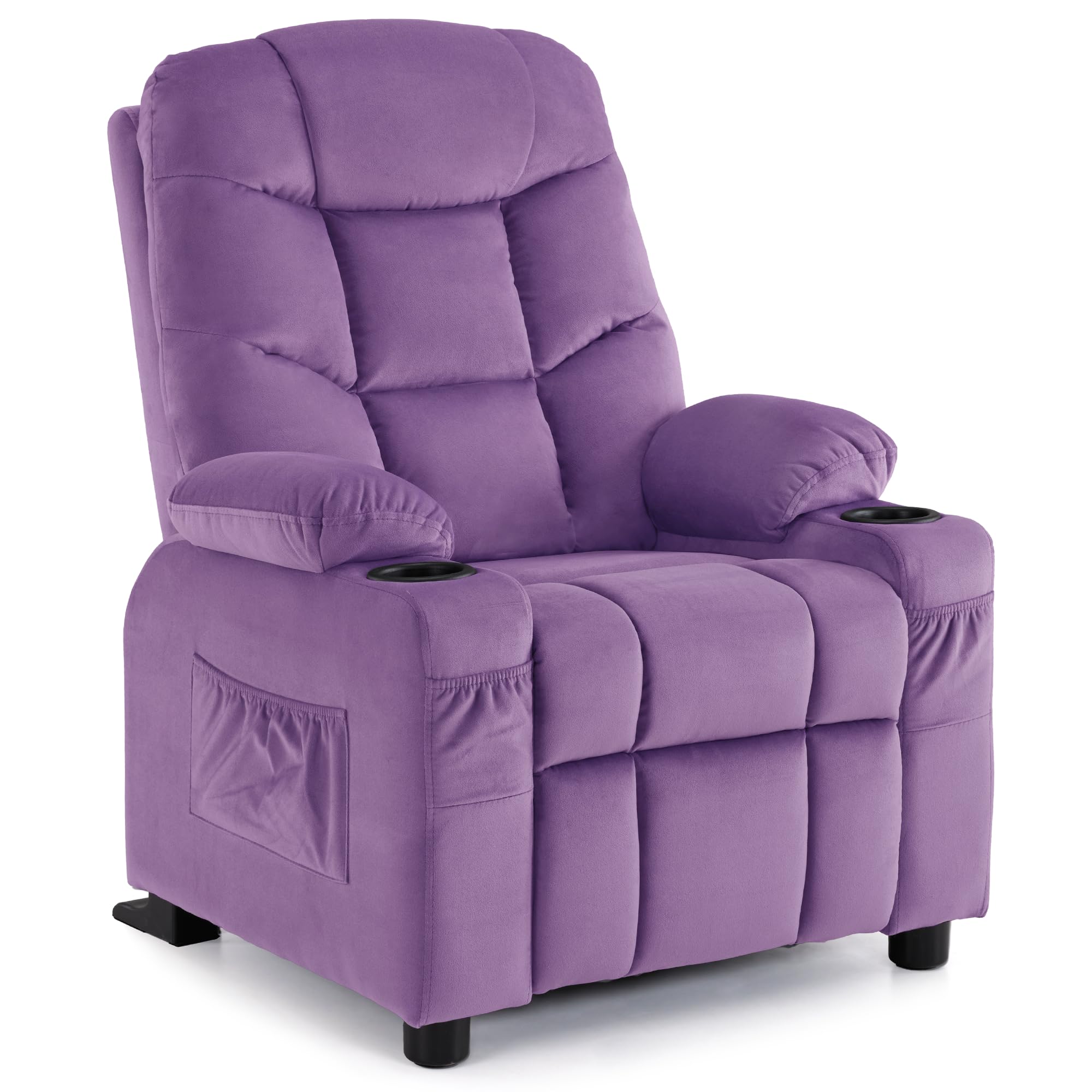
Fifty-one pounds is an odd place to start a chair review, but it is the number that settles this one for us. Every other pick on this page weighs between 21 and 39 pounds; the MCombo carries its weight in a wood-and-steel frame with four anti-slip feet, and that mass is what keeps a kids' chair from skating across a wood floor every time somebody flops into it. It also rates the frame to ASTM standards and backs it with a two-year warranty, the longest coverage here.

The seat is what makes it the long-haul pick. MCombo sizes it for ages three and up, 31 to 47 inches tall and 30 to 120 pounds, and the numbers underneath that are generous: a 17-inch seat depth, a 16-inch seat height and a 22-inch back. A four-year-old sits deep inside it, and an eight-year-old still fits. We like that there is no awkward middle year where a child has outgrown the chair they were given at two and is not ready for anything else.

Storage beats anything else here: two cup holders in the arms and four pockets along the sides and front. The push-back recline takes a firm shove rather than a fingertip, so lighter children may need a hand with it until the mechanism loosens up.

It is the most expensive chair in this group, and that is the honest trade. You are paying for the frame, the warranty and the years of fit rather than for styling. In a room where the chair gets climbed on every day, we think that is the right place to spend.

Bottom Line: We recommend it as the default: the heaviest, best-built frame in this group, sized to fit a child from preschool through the early grades.
#2

Best for Ages 3 to 12

Costzon PU Leather Kids Recliner

Costzon PU Leather Kids Recliner

9.4/10 Outstanding
  • Recline: Push-back to 130°
  • Storage: 2 cup holders, side pockets
  • Stated Fit: Ages 3–12
  • Weight Capacity: 120 lb
Check Price on Amazon

Pros

  • Widest stated age range here, 3 to 12
  • 32 lb, easy for one adult to move
  • Reclines to 130 degrees
  • Wipe-clean PU leather with two cup holders

Cons

  • Push-back recline is stiff when new

The distance between this Costzon and our top pick is nineteen pounds, and for a lot of families that is the whole argument. At 32 pounds it is a chair one adult can carry from the playroom to the living room without a second thought, and it still takes a 120-pound child and reclines to 130 degrees. We think movability is underrated in kids' furniture: a chair you can shift is a chair that gets used in the room where everyone actually is.

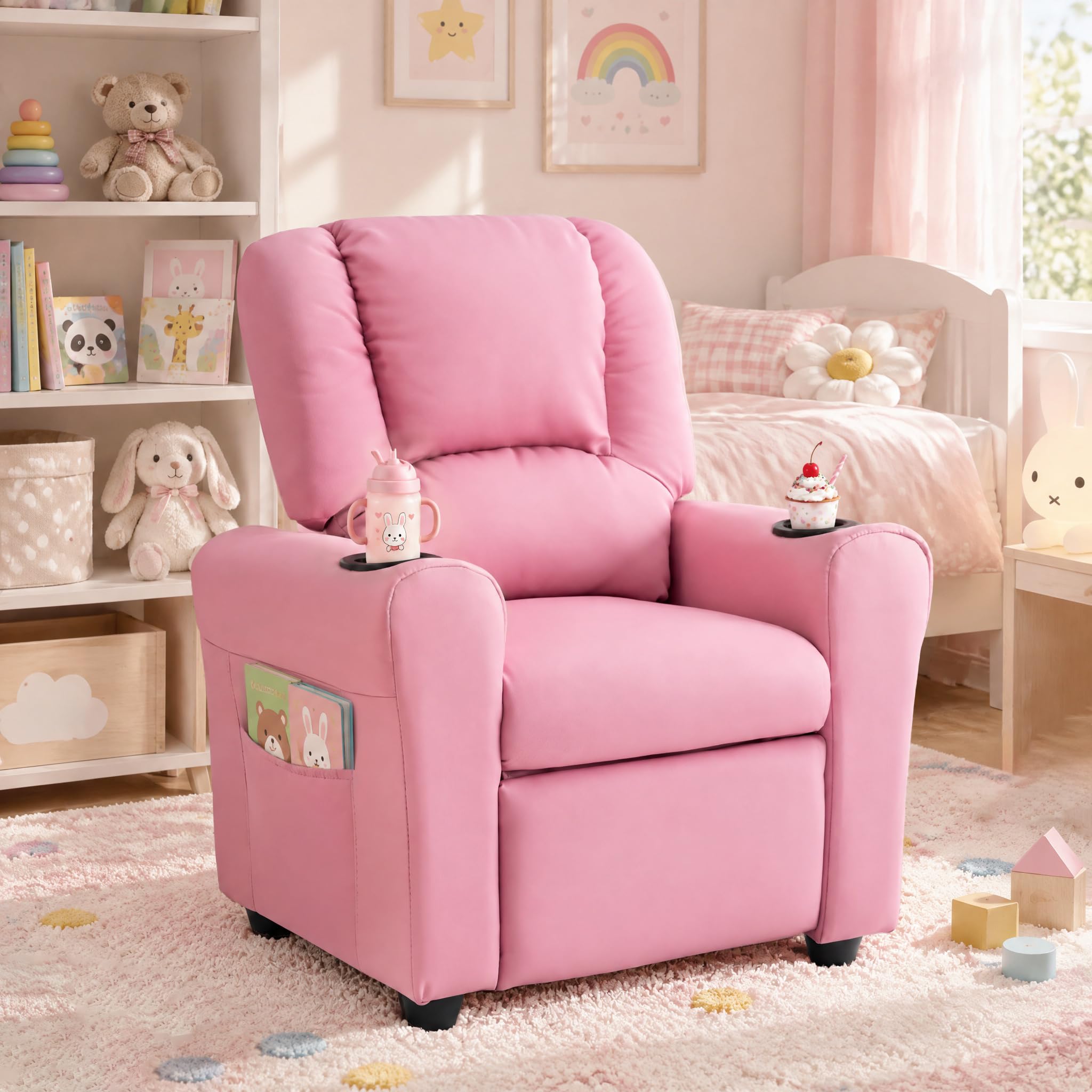
The seat is 16 inches deep and 16 inches high under a high back, and Costzon tags it for ages three to twelve, the broadest stated span on this page. PU leather is the practical side of that: it wipes clean in a pass, so a snack-heavy evening leaves no mark, and the two cup holders and side pockets keep the drink and the book within reach without a child getting up.

The reservation is durability. Backrest failures do happen, and they tend to follow a child who treats the chair as a launch pad. If that is your kid, price the protection plan in with the chair. If it is not, this is simply the best-value big-kid recliner here.

Bottom Line: We point most families here when the chair has to move around: nineteen pounds lighter than our top pick, the widest stated age range, and 120 pounds of capacity.
#3

Best for Toddlers

The Crew Traditional Kids Recliner

The Crew Traditional Kids Recliner

9.2/10 Outstanding
  • Assembly: None required
  • Stated Fit: Ages 1–5
  • Seat Height: 12.5 in
  • Weight Capacity: 110 lb
Check Price on Amazon

Pros

  • Ships fully assembled
  • Low 12.5-inch seat height for toddlers
  • Easy to keep clean
  • Budget price for a first recliner

Cons

  • No cup holder or side pockets
  • 90-day warranty is the shortest here

It turns up in one piece. No bolts, no allen key, no half hour of assembly while a toddler asks whether it is ready yet. The Crew ships fully built, and if the chair is a birthday gift or you are setting up a room the night before, that alone is worth something.

The dimensions are aimed at the smallest children here: a 12.5-inch seat height puts a two-year-old's feet on the floor, a 13.75-inch seat depth stops them sliding forward, and the 110-pound capacity should carry them to about five. The polyester linen is easy to keep clean with a damp cloth, and we like that it reads as furniture rather than as a piece of play equipment.

The footrest is the compromise. It pulls up by hand from the front of the seat, with no lever and no push-back, so a toddler cannot set it and even a five-year-old has to work at it. Treat this as a fixed chair with a footrest an adult opens, and it is a lot of chair for the least money on this page. If your child wants to run the recline themselves, one of the push-back designs above is the better buy.

Bottom Line: We like it as the toddler chair: it arrives fully assembled, sits low enough for a two-year-old to climb into, and costs the least here.
#4

Best for Older Kids

Bosmiller Push Back Kids Recliner

Bosmiller Push Back Kids Recliner

9.0/10 Outstanding
  • Recline: Push-back, 90° to 130°
  • Stated Fit: Ages 3 and up
  • Chair Weight: 38.8 lb
  • Weight Capacity: 120 lb
Check Price on Amazon

Pros

  • Reads as grown-up furniture
  • Deep, plush padding for long sitting
  • Room to grow to about eight or ten
  • Two cup holders and side pockets

Cons

  • Too big for a one- or two-year-old

This is the one that looks like a miniature of the recliner in the living room. The deep grey leather-look cover, the padded arms and the high back read as adult furniture rather than nursery kit, which is exactly what you want if the chair is going somewhere guests actually sit.

It is substantial: 38.8 pounds and 26 inches wide, with thick sponge padding under that cover, which is what makes it work for a double feature and the nap that follows. Two cup holders sit in the arms, side pockets take a book and a snack, and assembly is a few minutes' work.

The chair is aimed at three and up and behaves like it: a 16-inch seat depth and a 120-pound capacity let a seven- or eight-year-old settle in properly, while a two-year-old will rattle around in it. That is the line we draw. This is the chair for a child who has outgrown the toddler recliner, not for the one still using it.

Bottom Line: We suggest it for the living room: it looks like a scaled-down grown-up recliner, takes a 120-pound child, and has the deepest padding of these picks.
#5

Preschoolers

JC Home CANDY Kids Recliner

JC Home CANDY Kids Recliner

9.2/10 Outstanding
  • Storage: 2 cup holders, 2 pockets
  • Stated Fit: Ages 1–6
  • Seat Height: 14.6 in
  • Chair Weight: 21.2 lb
Check Price on Amazon

Pros

  • Smallest footprint here at 21 inches deep
  • 21.2 lb, easy to move one-handed
  • Two cup holders and two pockets
  • Tool-free assembly in 10 to 15 minutes

Cons

  • Recline stops well short of flat
  • 90 lb limit, among the lowest here

Twenty-one inches deep and 21.2 pounds: this is the chair that fits in the corner of a small bedroom and moves with one hand when the floor needs vacuuming. Of everything here it takes the least space and is the least trouble to shift, which counts for more than it sounds when a chair lives in a child's room.

For the size, you get a lot: two cup holders, two side pockets, a wipe-clean faux leather cover and an FSC-certified wood frame, all assembled in about ten to fifteen minutes with no tools. That last part makes it a realistic gift to send ahead to a grandparent's house.

The catch is scale. The seat is 12.6 inches deep and 14.6 inches high, which is toddler territory, and we think you should measure floor-to-knee height against that 14.6-inch seat before ordering if your child sits near the top of the stated one-to-six range. Where a five- or six-year-old is concerned, the MCombo and the Costzon earn their extra money.

Bottom Line: We recommend it for a toddler's bedroom: the smallest footprint and lightest chair here, with cup holders and a wipe-clean cover, though it will not last to six.
#6

Small children

Flash Furniture Vana Kids Recliner

Flash Furniture Vana Kids Recliner

9.1/10 Outstanding
  • Seat Depth: 11 in
  • Upholstery: LeatherSoft faux leather
  • Safety Recline: Only with weight in the seat
  • Weight Capacity: 90 lb
Check Price on Amazon

Pros

  • Safety recline needs weight in the seat
  • Wipe-clean LeatherSoft upholstery
  • Oversized padded headrest
  • Cup holder built into the arm

Cons

  • Recline takes a firm push from a child
  • Needs 36.5 inches of depth reclined

The detail we did not expect to care about: the Vana will not recline unless there is weight in the seat. It is a small piece of engineering with a real payoff. The footrest cannot be left standing open as a trip hazard, and a child who climbs onto the arm does not send the back folding. For a chair that lives in the middle of family life rather than in a bedroom, that is the sort of thing that stops an accident before it happens.

The cover is the other argument for it. LeatherSoft wipes down in a single pass, and the oversized padded headrest gives a small napper somewhere to land. There is a cup holder in one arm, and a 15.5-inch seat height that keeps it in toddler territory. The 11-inch seat and the 90-pound limit put a ceiling on it, generous at three or four and cramped at seven, but for the years it covers it is a well-sorted little chair, and a damp cloth is the whole maintenance routine.

Bottom Line: We point to it for a small child in a shared room: a generous headrest, a wipe-clean cover and a recline that only works with someone in the seat.

How We Tested 11 Kids Recliners

We started by pulling every kids recliner we could find from the major retailers and cutting the list down by weight limit, seat height, frame material, and price — the chairs that survived ranged from around $60 to just under $300. That left 11 we bought ourselves and brought home.

Every chair arrived flat-packed, so assembly was the first real test. I timed each build using only the tools in the box, noted where the instructions went vague or the hardware felt flimsy, then did what a kid does: flopped into the seat, shoved back hard on the arms, and rocked on the rear legs to see whether the frame flexed, creaked, or shifted.

For the recline, we pushed each chair through its full range and checked where it stopped, whether the mechanism pinched a finger, and whether the seat felt tippy at its furthest position. Size got measured rather than guessed — seat height from the floor, seat depth, armrest height — then compared against a 3-year-old, a 5-year-old, and an 8-year-old who climbed in and out unsupervised for weeks.

The longest test was just living with them: after-school cartoons, bedtime stories, a few sleepovers, and spills wiped up with a damp cloth. We watched whether the upholstery pilled, seams held, and legs loosened over six months, and whether the price felt earned next to the chairs that cost half as much.

How to Choose the Right Kids Recliner

Start with the recline mechanism

Two designs dominate. A push-back chair reclines when a child leans into the back; it needs body weight, which is why a light three-year-old may need help until the mechanism breaks in. A hand-pulled footrest, like the one on The Crew chair, needs a reach down to the front of the seat and a firm tug, so it is an adult's job.

Match the mechanism to the child: push-back for a five-year-old who wants to run it alone, hand-pull for a toddler whose recline you will set anyway. If you can, have the child try the chair before you commit, because effort is the one thing a spec sheet never lists.

Fit the seat to the child, not the age on the box

The stated age range is a rough guide at best. Seat height and seat depth decide whether a child actually sits properly. Seat heights among these picks run from 12.5 to 17 inches, and the low end is what lets a two-year-old climb in and put both feet on the floor. Seat depth runs from 11 to 17 inches; too deep and a small child's legs stick straight out, too shallow and a taller one is perched on the edge.

Sit the child down and check that the back of the knee meets the edge of the seat cushion. Expect to buy again around age seven unless you choose a big-kid model, and measure floor-to-knee height before ordering rather than trusting the number on the box.

Weight capacity tells you how long it lasts

Every chair here is rated between 90 and 120 pounds, and that number, not the age range, is the realistic ceiling. A 90-pound chair is a toddler-to-early-school chair; a 120-pound one can carry a nine-year-old. If your child is four and 40 pounds, a 90-pound chair has years left in it; if they are seven and 60, it does not.

The MCombo and the Costzon both go to 120 pounds, and that is a large part of why they sit at the top of this page. The Flash Vana and the JC Home stop at 90.

Cleaning, cup holders, and the room it lives in

Faux leather wipes clean in a pass and suits a child who eats in the chair; velvet and linen need spot cleaning and hold a mark longer. Cup holders sound like a gimmick until a cup goes over on the sofa cushion, and side pockets keep books and tablets off the floor, so a chair with two holders and some pockets is genuinely easier to live with.

If the chair is going into a shared living room, lean toward the leather-look covers and the adult-looking shapes. In a bedroom none of it matters, and a lighter, smaller chair that fits the corner is the better buy.

Leave room behind the chair

A recliner's footprint grows when it opens. Where a listing gives both positions, the chair runs 14 to 15 inches deeper reclined than closed; the Flash Vana reaches 36.5 inches, which is more than many bedroom gaps allow. Measure from the wall to the front of where the chair will sit, not just the chair itself, and keep the back clear of curtains and radiators.

Heavier chairs stay where you put them on hardwood, and the lightest ones here will slide, so plan a rug or felt pads under the feet.

Frequently Asked Questions

Final Verdict

For most families, the MCombo is the chair to buy: a wood-and-steel frame that weighs as much as some adult chairs, a two-year warranty, and a seat that fits a three-year-old and still fits at eight. If the chair has to move between rooms or the budget is tighter, take the Costzon PU Leather: nineteen pounds lighter, the same 120-pound capacity, and a stated range that runs to twelve.

For a two-year-old, The Crew's low seat and no-assembly delivery are the simpler answer, as long as you accept setting the footrest yourself.