Kids & Nursery

Best Toddler Bed Frames of 2026

A toddler bed has to do a lot: look at home in a small room, assemble without an all-day project, and stay solid when a kid flops onto it. Over eight months, we tested 12 toddler bed frames through bedtime, naps, sheet changes, and midnight climbs. We measured footprints and mattress gaps, timed assembly, and watched how finishes held up. The right one makes the crib-to-bed switch feel less like a leap: lower to the floor, easy to climb in and out of, and steady enough that you are not tightening bolts every week.

What surprised me is how much the small stuff matters. A friendly-looking frame helps a toddler want to sleep in it, but a sharp edge or wobbly rail can turn bedtime into a negotiation. Fit is the quiet make-or-break: the mattress should sit flush, the footprint should leave a path to the door, and the height should let a small kid climb in without a boost. We also weighed value, and the picks below are the ones that made the cut.

#1

Best Overall

Dream On Me Finn

Dream On Me Finn

9.0/10 Outstanding
  • Mattress Size: Full-size crib
  • Weight Capacity: 50 lb
  • Assembled Dimensions: 53 x 30 x 24.5 inches
  • Safety Certification: GREENGUARD Gold, BSA
Check Price on Amazon

Pros

  • Low pine frame with center-leg support
  • GREENGUARD Gold and BSA certified
  • Straightforward assembly and a calm look

Cons

  • 50-pound weight limit caps the useful years

The Finn's low-to-floor pine frame is the first thing that makes sense about it: a toddler can step in and out without a stool, and the center legs keep the mattress platform from feeling like it is suspended in the air. That combination is why it is our top pick. It does the unglamorous part of a toddler bed well, with a 24.5-inch height and a footprint that still fits a standard crib mattress.

What we appreciate most is how little the Finn asks of the room. The slatted headboard and footboard look calm rather than themed, and the New Zealand pine frame comes with a non-toxic finish and GREENGUARD Gold plus BSA certification. The two side rails are attached, not propped on, and the center legs give the mattress support a more substantial feel than a bare slat frame.

Setup is straightforward as these things go, and the simplicity carries into daily use: sheets go on without a fight, the low rail is easy to reach over, and there is enough space underneath for a small storage bin. The finish wipes clean, and the frame stays simple to live with. We kept coming back to how little maintenance it asks for, which matters more than a theme when bedtime is already a negotiation.

Bottom Line: For most toddlers, we recommend the Finn: its low pine frame, attached rails, and center support make the crib-to-bed move feel stable without turning the room into a theme.
#2

Best for Heavier Kids

Delta Children Fancy

Delta Children Fancy

9.0/10 Outstanding
  • Mattress Size: Full-size crib
  • Weight Capacity: 150 lb
  • Assembled Dimensions: 55.25 x 30 x 26.5 inches
  • Safety Certification: JPMA certified
Check Price on Amazon

Pros

  • 150-pound stated weight capacity
  • Traditional wood frame with guardrails
  • JPMA certified and low to the floor

Cons

  • Costs more than the simpler wood picks

The number that stands out on the Fancy is the 150-pound weight capacity, and it changes who this bed is for. A parent can sit on the edge for stories without treating the frame like it might fold, and a heavier or taller toddler gets more room to grow before the move to a twin. That is the role it earns here: the wood toddler bed for a family that wants a little more built-in margin.

We like the traditional shape, too. The bell-shaped headboard and straight footboard give it more presence than the average transition bed, and the grey finish should sit easily in a room that is not themed around a character. It takes a full-size crib mattress, includes guardrails, and is JPMA certified, so the basics are covered. The low-to-floor height keeps it accessible without making it look like a mattress on the floor.

What we do not like is the assembly experience. It is a piece of furniture with a lot of parts, and the instructions can leave you sorting pieces by eye; a quiet hour with a screwdriver turns into a longer project. That is the trade-off for the more substantial look, and it is worth knowing before the box arrives. If you want a bed that goes together quickly and disappears into a small room, the Finn is the easier choice.

Bottom Line: We recommend the Fancy when you want a wood toddler bed with a 150-pound stated capacity and a more furniture-like look; it suits heavier kids and parents who sit bedside.
#3

Best Budget Character Bed

Delta Children Minnie Mouse

Delta Children Minnie Mouse

9.3/10 Outstanding
  • Mattress Size: Standard crib
  • Weight Capacity: 50 lb
  • Assembled Dimensions: 53.94 x 29.13 x 26.18 inches
  • Safety Certification: JPMA certified
Check Price on Amazon

Pros

  • Budget character bed with two guardrails
  • Steel frame and wipe-clean plastic
  • Friendly assembly for a toddler bed

Cons

  • Decals can lift in humid rooms

If your toddler is set on a character bed, the Minnie is the easiest yes in this group: it is the budget option, and it still brings two attached guardrails, a steel frame, and a 50-pound weight limit. The plastic body wipes clean, the decals do the work of making bedtime feel like a treat, and you are not paying wood-furniture money for a bed that will be outgrown.

We were struck by how much of the appeal is simple rather than clever. The low height and 15-month starting age suit the crib-to-bed jump, and a standard crib mattress drops in without a special purchase. Assembly is on the friendly side, with the frame and guardrails going together in a way that does not demand a dedicated afternoon.

The thing to check before you commit is the side-rail fit. A crib mattress can fit the opening perfectly while a rail attachment feels fussy, so test both rails and the mattress together before the return window closes. The bed is at its best when the mattress sits flush and the rails lock down without force; if either feels off, sort it out before the first night. For a character-bed buyer, that check is the difference between a fun purchase and a daily annoyance.

Bottom Line: We think the Minnie is the right call for a character-led room on a tight budget, as long as you check the rail fit before the return window closes.
#4

Daybed-style rooms

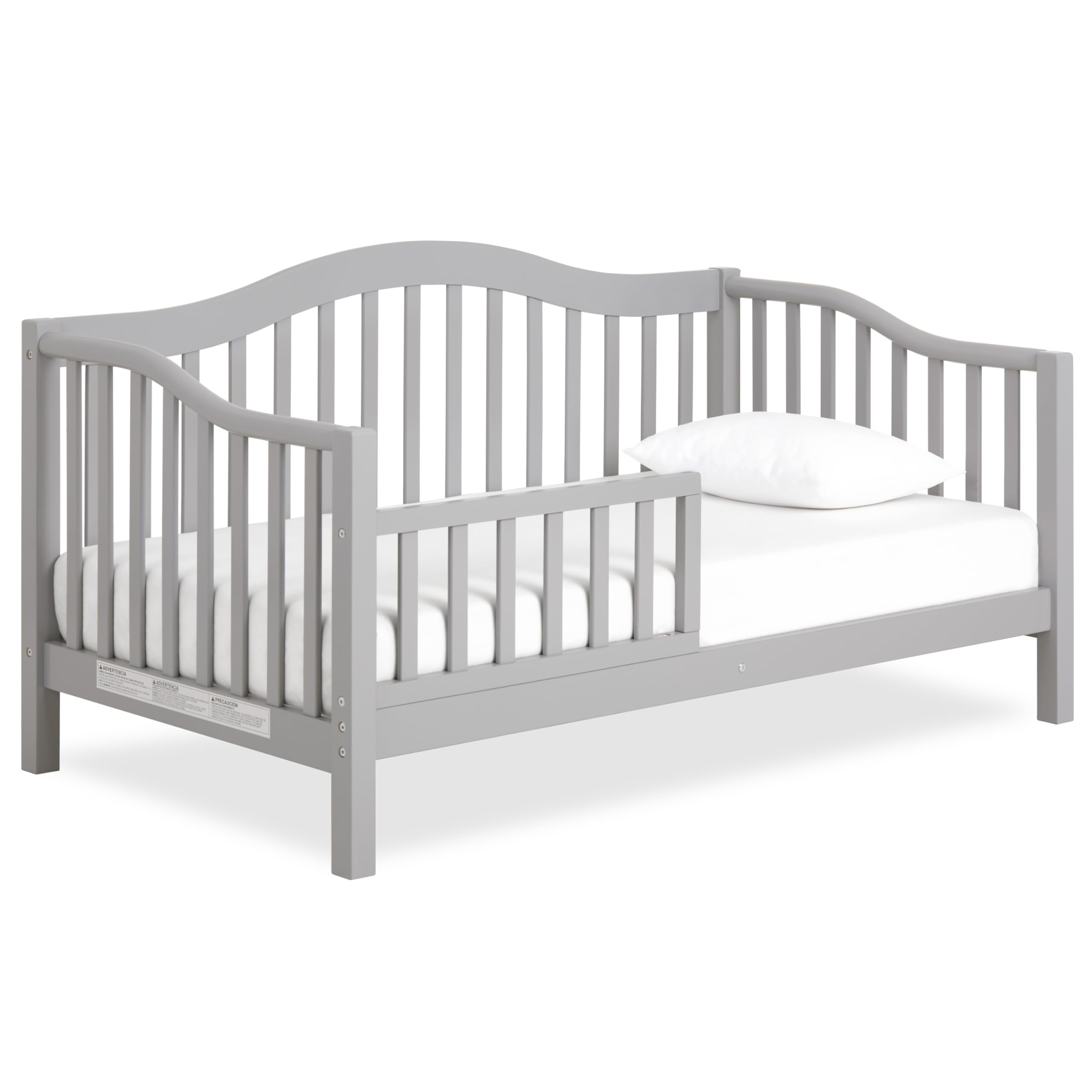
Dream On Me Austin

Dream On Me Austin

9.1/10 Outstanding
  • Mattress Size: Full-size crib
  • Weight Capacity: 50 lb
  • Assembled Dimensions: 54 x 29.8 x 28.8 inches
  • Safety Certification: BSA, ASTM/CPSC
Check Price on Amazon

Pros

  • Daybed silhouette with curved headboard
  • Pine construction and GREENGUARD Gold/BSA
  • Low height and removable guardrail

Cons

  • Some units have missing or misaligned holes
  • Panels can arrive dented or rough

The Austin's high curved headboard and open daybed profile are the reason to look at it: it reads more like a small piece of bedroom furniture than a plastic transition bed. The shape gives a toddler room a little polish without turning the bed into a theme piece, and the low-to-floor build keeps it practical.

We appreciated the details that support the look: solid New Zealand pine, a non-toxic finish, a removable guardrail, and mattress support rails that mean no box spring. It takes a standard crib mattress and is rated for 50 pounds, with a stated range of 18 months to 5 years. The Austin is a good fit for a grandparent's spare room or a child who is ready for a more grown-up bed but not a twin.

The open rail side can feel wide for a very active sleeper. If your child rolls hard or moves around a lot, the more enclosed Finn is the better default; the Austin rewards a child who sleeps relatively still. Otherwise, this is a daybed-shaped toddler bed that makes a small room feel considered rather than cluttered. The low frame also makes it easy to change sheets without hauling the mattress up and over a high rail.

Bottom Line: We like the Austin for a small room that needs a daybed look, with a low pine frame and a removable guardrail that keep it practical.

How We Tested Toddler Bed Frames

We started by pulling together current frames in the toddler-bed category, then narrowed the list by mattress compatibility, footprint, assembly requirements, finish options, and price band. That left 12 frames, which we built and lived with for eight months. We assembled each one solo with a stopwatch running, counted the hardware and tools needed, and noted where the instructions stalled or a step required a second person. We also measured the assembled footprint and checked the gap around a standard crib mattress at the head, foot, and sides.

In the room, we watched the things a spec sheet cannot show. At bedtime and nap time, I noted whether my toddler wanted to climb in or treated the frame as a hurdle, how hard they flopped onto the mattress, and whether they used the rails or headboard as a handhold; we listened for creaks and felt for wobble at the corners. During weekly sheet changes, we checked whether the mattress corners were easy to reach and whether the frame could be moved for vacuuming without scraping the floor. We also lived with the appearance, watching how the finish looked against real bedroom walls and how it held up to sticky hands and the occasional marker smudge.

After eight months, we inspected joints, slats, and finish for loosening, chipping, or scuffs, and compared that wear to what each frame asked for at checkout. We ranked value by what came in the box, how sturdy it felt after months of use, and how easily it fit a small room without blocking a dresser or doorway. The frames that scored best were the ones that stayed quiet, looked intentional, and made the bedtime routine easier rather than adding another task.

How to Choose Toddler Bed Frames

Start With the Mattress

A toddler bed frame is usually built around a standard crib mattress, not a twin. A standard crib mattress runs about 52 by 28 inches, so measure the one you own and compare it with the frame opening before you order. The mattress should sit inside the rails with no wide gaps at the sides or ends. If you are buying a new mattress, stay with the size the frame names rather than sizing up for longevity; a too-large mattress can push against the rails and leave the corners unsupported.

Low Frames and Rails That Attach

Low-to-floor is more than a style choice: it lets a toddler climb in and out without a step, and it shortens a fall if they roll out. We look for two attached guardrails and a frame that does not flex when you push on a corner. Check that the rails lock into their brackets, that every slat is seated, and that center legs reach the floor. A daybed-style frame can work, but only when it includes a guardrail and the open side is not too wide for a restless sleeper.

Wood, Plastic, and Weight Limits

Wood frames feel more like furniture and tend to suit a room that will later become a big-kid room; plastic character beds are lighter, wipe clean, and often cost less. Neither material is automatically safer. Look for a stated weight limit that gives your child room to grow, and be honest about whether you plan to sit on the bed for stories. A 50-pound frame is a normal toddler-bed limit; the Delta Children Fancy lists 150 pounds, which is the outlier here if you want more margin.

Assembly and Hardware

Assembly is where a simple purchase can turn into an afternoon. Before you start, inventory the screws, dowels, and panels, and read the instructions through once. Leave the bolts loose until the frame is square, then tighten gradually; forcing a misaligned hole can crack a board. Keep the packaging and the return window until both rails and the mattress are in place. If a hole is missing or a panel is damaged, stop and ask for the part rather than drilling into the frame.

Room Fit and the Style You Can Live With

Measure the floor space, then leave clearance for a child to step in and out and for a parent to kneel beside the bed. A standard frame is roughly the footprint of a crib; a daybed or canopy adds visual height rather than much extra floor space. Character decals and canopies are fun, but check that they attach firmly and stay upright. If a canopy will not hold its shape, the bed loses the feature you paid for, no matter how cute the frame looks.

Frequently Asked Questions

Final Verdict

We recommend the Dream On Me Finn as the default toddler bed frame. It gets the daily essentials right: a low pine frame, two attached rails, center support, and GREENGUARD Gold certification, without asking you to build the room around a character. For a heavier child or a parent who sits on the bed, the Delta Children Fancy has the higher stated capacity. If the budget is tight or the character matters, the Minnie is the practical buy; the Austin is the daybed-shaped alternative.