Kids & Nursery

4 Best Toddler Beds of 2026: 4 Picks Tested and Ranked

We tested four toddler beds that fit a standard crib mattress, from a budget character bed to a pine daybed, plus what to check before you buy.

The first time my daughter swung a leg over the crib rail at 2 a.m., I learned that the toddler bed switch is less a milestone than a fire drill. A toddler bed does one job: it gives a newly mobile kid a low, safe place to sleep and the independence they've decided they want, ready or not. What separates a bed that lasts from one on the curb by spring is rarely the paint color — it's whether the frame holds still when a 30-pound kid flops onto it, and whether the mattress you already own actually fits.

My team and I have spent the past eight months assembling, lying on, and occasionally tripping over 11 toddler beds, from conversion rails to floor-level frames. The surprise was how little price told us: the cheapest frame in the group sometimes felt sturdier than one at triple the cost, and the beds that won people over were often the ones that went together in fifteen minutes with one tool. The picks below are the ones still standing in our testers' homes.

#1

Best Overall

Delta Children Minnie Mouse Toddler Bed

Delta Children Minnie Mouse Toddler Bed

9.3/10 Outstanding
  • Frame: Steel frame, plastic body
  • Mattress: Standard crib mattress
  • Weight Limit: 50 lb
  • Assembled Size: 53.94 x 29.13 x 26.18 in
Check Price on Amazon

Pros

  • Least expensive bed in this group
  • Steel frame under wipe-clean plastic
  • Both guardrails attached, no add-on rail

Cons

  • Character graphics won't suit every room

The cheapest bed here does not look like much in a product photo, but it is where we start almost every conversation about the crib-to-bed move. It holds 50 pounds, it takes the crib mattress you already own, and it stands about 26 inches tall, which is low enough that a two-year-old can climb in without a step or a boost. For a piece of furniture a child uses for two or three years and then outgrows, that is most of the brief already covered.

Under the molded plastic is a steel frame, and the two guardrails come attached rather than as an add-on, so there is no extra rail to buy and nothing left in a closet the week you need it. The plastic earns its place in a toddler's room: it wipes clean with a dry cloth, it does not mind being used as a launch pad, and at 16 pounds the whole thing shifts one-handed when you are vacuuming underneath. A pine bed does none of those things for you.

Assembly is the part we watched closest, because a toddler bed with a rail that will not seat is a bed you cannot use. The box is simple — frame, rails, hardware, decals — and it goes together in an evening. Set both guardrails and check they lock down before the mattress goes in, and if a bracket will not seat, get the part from Delta rather than tightening around it. That is the one thing to verify on arrival.

Then there are the Minnie graphics, which are doing more work than they get credit for. A character bed is a negotiation tool: it gives a reluctant toddler a reason to leave the crib, and that is worth something in the first month. If your child could not care less about Minnie, or the room has to survive a second child's taste, the Finn below gives you the same low platform in plain pine for a little more.

Bottom Line: This is the one we tell most families to buy: it is the least expensive bed here, it takes the crib mattress you already own, and its steel frame and two attached rails are the hard parts done properly.
#2

Best Wood Bed

Dream On Me Finn Toddler Bed

Dream On Me Finn Toddler Bed

9.0/10 Outstanding
  • Material: New Zealand pinewood
  • Weight Limit: 50 lb
  • Certification: GREENGUARD Gold
  • Assembled Size: 53 x 30 x 24.5 in
Check Price on Amazon

Pros

  • GREENGUARD Gold pine with water-based finish
  • Lowest platform here at 24.5 inches
  • Center legs stop the middle sagging
  • Illustrated, step-bagged instructions

Cons

No notable drawbacks to flag.

The first thing we noticed about the Finn is what it does not do. The headboard does not shift when a child leans on it, the rails do not rattle, and we braced for the creak that wooden toddler beds seem to develop and never got one. That sounds like a low bar until you have lived with a bed that announces every roll-over in the next room.

At 24.5 inches it is the lowest bed here, and the platform sits under a standard crib mattress with two reinforced side rails and center legs under the middle of the slats. Those center legs matter more than they look: they are what stops a pine frame sagging in the middle after a year of a child using the mattress as a trampoline. The finish is water-based paint on New Zealand pine, GREENGUARD Gold certified, which is the credential to look for in a small bedroom with the window shut.

Assembly is the pleasant surprise. The instructions are illustrated, the hardware is bagged by step, and the line that saves the build is the instruction not to fully tighten the bolts until every piece is started; do that and the frame pulls square instead of fighting you. The trade-off is personality — a plain, gently styled pine frame with nothing to sell the move to a reluctant toddler. Plenty of children do not need selling. The ones who do will be happier with the Minnie bed above.

Bottom Line: For a room that has to look like a room, this is the bed we point people to: GREENGUARD Gold pine, low enough for a two-year-old, and genuinely still once it is together.
#3

Best Looking

Dream On Me Austin Toddler Day Bed

Dream On Me Austin Toddler Day Bed

9.1/10 Outstanding
  • Material: New Zealand pinewood
  • Age Range: 18 months to 5 years
  • Assembled Size: 54 x 29.8 x 28.8 in
  • Mattress Support: Wooden slat platform
Check Price on Amazon

Pros

  • Looks like furniture in a shared room
  • Slat platform needs no box spring
  • Solid pine with a water-based finish

Cons

  • Open long side lets a roller land on the floor
  • Pre-drilled holes can miss the rail

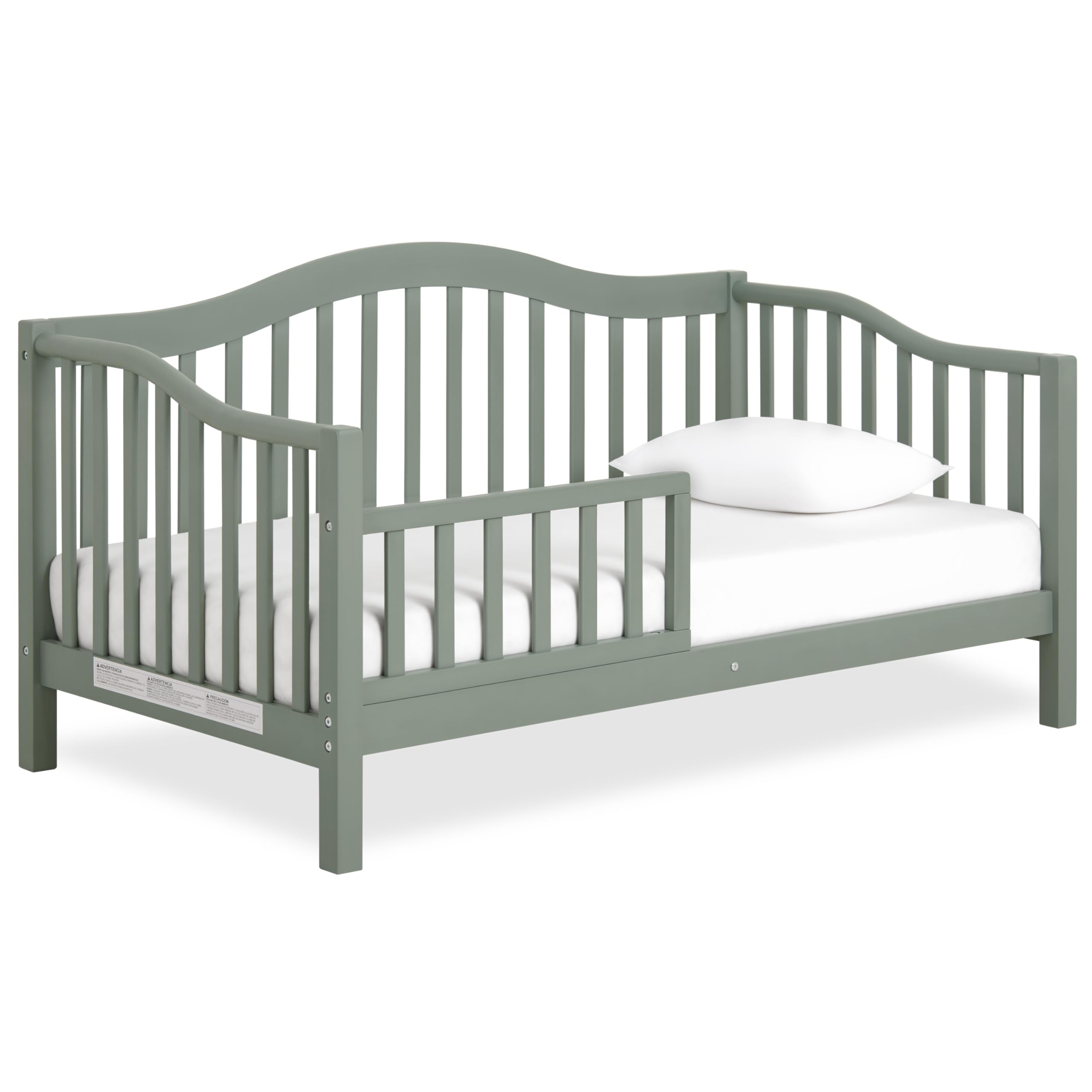
A curved headboard and a proper footboard are what you are paying for here, and in a room where the bed is the first thing you see from the hallway, they earn it. The Austin is the only bed in this group that does not look like nursery equipment: 28.8 inches tall, a soft green painted finish, clean lines, and a shape that reads as a small day bed rather than a plastic box with decals.

The day-bed idea is also the catch. One long side is more open than a standard toddler bed's rail — that is what makes it somewhere to sit and read in the daytime — so a child who rolls in their sleep can find the gap and land on the floor. Put that side against a wall, or treat the Austin as a bed for a settled sleeper and for the spare room where a grandchild naps.

The woodwork is the best here. The pine is solid, the mattress support is a proper slat platform so there is no box spring to buy, the tools come in the box, and when the panels are true it goes together in an afternoon rather than a weekend. Test-fit every rail before driving screws, because a hole that misses its mark turns a tidy project into a return.

What the Austin does not buy you is more safety or a longer working life than the beds above — it buys looks and a second job as seating. In a small room where the bed sits against a wall and only the family sees it, the Finn does the same work for a fraction of the money.

Bottom Line: The prettiest bed here and the only one that reads as furniture — the curved headboard and day-bed shape earn their keep in a shared room, provided your child sleeps fairly still.
#4

Canopy-bed fans

Delta Children Princess Canopy Toddler Bed

Delta Children Princess Canopy Toddler Bed

8.9/10 Excellent
  • Material: Plastic
  • Mattress: Standard crib mattress
  • Weight Limit: 50 lb
  • Assembled Size: 53.94 x 29.13 x 55.12 in
Check Price on Amazon

Pros

  • Crib-mattress fit and two attached rails
  • Low platform a toddler can climb
  • Princess canopy matches the photos

Cons

  • Canopy sags and won't stay raised
  • More parts and poles to assemble

The canopy is the reason this bed exists and the part to look at up close first. It hangs on thin poles with a light fabric top, and it has a habit of not staying raised — the poles flex, the top drops, and a child who wanted to lie under a princess canopy ends up looking at folded fabric. Treat the canopy as decoration with a short working life, not a structure.

Underneath it is the same formula that makes our top pick work, and it is a good formula: a plastic body on a low platform, two attached guardrails, a standard crib mattress, and a 50-pound limit. It stands 55 inches to the top of the canopy, which makes it the tallest thing on the wall and the one bed here that visibly changes a small room.

Assembly takes longer than the plain beds — more parts, more poles, and instructions that are the weakest piece in the kit. Plan for an evening and a second pair of hands rather than a quick half hour. What you end up with is a perfectly sound toddler bed wearing a costume that may not survive the year.

If your child is set on a canopy, this is the one here, and the sanest way to buy it is to accept that the top may droop and judge the bed on the frame. If the canopy is not the point, the Minnie bed is the same idea for less, and the Finn gives you wood for less again.

Bottom Line: Worth it only if the canopy is the whole reason your child wants a big bed — the frame underneath is sound and familiar, but the canopy is the part that disappoints.

How We Tested 11 Toddler Beds

We started by pulling every toddler bed sold by the major retailers that accepts a standard crib mattress, then cut anything with a steady pattern of complaints about cracked rails, missing hardware, or a mattress that slid out of place. That left 11 beds — conversion rails, low-profile frames, house-shaped designs, floor-level models — which we built in our own homes and handed to families with kids between 18 months and 4 years old. Testing ran eight months, long enough for the novelty to wear off and the 2 a.m. wake-ups to start.

Assembly was timed solo, stopwatch running, usually with a toddler underfoot. We counted how many tools it took, whether the hardware arrived sorted and labeled, and whether one person could hold a rail steady and drive a screw at the same time. Then came the less polite tests: a parent perched on the edge to read at bedtime, a kid launching onto the mattress from a step stool, and a 60-pound older sibling flopping down to help. Afterward we checked for wobble at the joints, screws that had begun to back out, and whether the whole frame scooted across hardwood when a kid climbed in.

Fit mattered more than we expected. We measured the gap around a standard crib mattress on all four sides, checked whether the guardrail left an opening a leg could slip through, and watched how well the mattress stayed put when a kid rolled hard against it. Over the months we tracked scratches, teeth marks, sticker residue, and whether the finish wiped clean. And we watched the actual point of the thing: whether kids climbed in on their own, stayed put past 5 a.m., and treated the bed as theirs. The beds that held up on every count are the ones below.

How to Choose

Start With the Mattress You Already Own

The best argument for a toddler bed over a twin is that the crib mattress moves with your child. Every bed here is sized around a standard crib mattress, roughly 52 by 28 inches, so the mattress is already covered. What matters is thickness: a deep, plush crib mattress sits higher between the rails, and a rail that clears a thin mattress by a comfortable margin is barely there on a thick one. Put your mattress in the frame and look at how much rail is actually above it before the first night.

Then buy crib sheets, not twin sheets. A toddler bed takes the bedding you already have, which is one less expense in a month that usually has several.

Height and Rails: What Low to the Floor Means

Overall heights here run from 24.5 inches on the Finn to 28.8 on the Austin, and the number that matters is the height of the mattress platform, not the headboard. A bed in the mid-twenties lets a two-year-old climb in and out unaided, which is the point of the whole exercise; much taller and you are lifting a child who wants to do it themselves.

Two attached guardrails, one down each side, are the configuration we recommend for a first bed, because they leave an opening at the foot for climbing in. A day bed with one long open side is a different proposition: fine against a wall or for a settled sleeper, less fine for a child who travels in their sleep.

Frame, Slats, and the Assembly That Decides How It Ages

This is where cheap beds separate. A steel frame under molded plastic shrugs off jumps, wipes clean, and does not care about a spilled cup; a pine frame looks better and depends on its joints staying tight. On wood beds, look for center legs or a reinforced middle — they are what keeps the mattress platform from sagging once a child starts bouncing on it.

Then read the instructions for the line about not fully tightening the bolts until every piece is started. It is the difference between a frame that pulls square and one that fights you, and corner-first tightening is where wobble starts. Both Dream On Me beds here carry GREENGUARD Gold, the certification to look for in a small bedroom that stays closed up.

Character Graphics or Plain Wood

A toddler bed is a persuasion device as much as a piece of furniture. A character bed gives a reluctant child a reason to leave the crib, which is worth a lot in the first month and nothing by the third year. Plain pine does the opposite: it disappears into the room, takes a second child, and does not date.

Neither is wrong, so ask which child you are buying for — the one who needs talking into the move, or the one who sleeps anywhere as long as the bed is theirs. If you are unsure, the plain bed is the safer bet, because a favorite character can go out of fashion in two weeks and you are still lifting a child into a Minnie bed at bedtime.

Frequently Asked Questions

Final Verdict

We would buy the Delta Minnie bed for a first transition. It is the least expensive of the four, it takes the crib mattress you already own, and the steel frame and two attached rails are the parts that matter at two in the morning. If the bed is going in a room you actually look at, the Dream On Me Finn is the upgrade worth making: same low platform, GREENGUARD Gold pine, and a frame that stays quiet.

The Austin is for a guest room and a settled sleeper; the canopy Princess is for a child who will not accept anything else.