Kids & Nursery

Best Toddler Floor Beds of 2026

A toddler floor bed looks like the simplest piece of furniture in the nursery, but the details do the work: how low the mattress sits, how wide the frame spreads across the room, and whether the whole thing stays put when a 2-year-old uses the rail as a launchpad. I learned that the hard way while helping friends transition their kids out of cribs—a bed that looked charming online could be a wobbly, finger-pinching headache by bedtime. The right floor bed gives toddlers the independence to climb in and out on their own while giving parents one less thing to worry about at 2 a.m.

Over eight months, we tested 10 toddler floor beds in real nurseries, from compact corners to shared bedrooms, and the differences came down to assembly, size, and how sturdy each frame felt once a toddler actually used it. We paid attention to the height of the sleeping surface, the quality of the finish, and whether the instructions made sense without a second adult. Value and appearance mattered too—but not at the expense of stability or durability. The picks below are the ones that held up to daily life, not just a staged photo.

#1

Best Overall

Ocodile Toddler Floor Bed

Ocodile Toddler Floor Bed

8.9/10 Excellent
  • Guardrails: Full length, middle rail removable
  • Assembled Size: 55 x 29.5 x 15.4 in
  • Weight Capacity: 50 lb
  • Crib Mattress Fit: 51 ⅝ x 27 ¼ in, up to 6 in thick
Check Price on Amazon

Pros

  • Reuses the standard crib mattress
  • Low 15.4-inch frame a toddler can climb
  • Full-length rails with a removable middle rail
  • Labeled parts and included hardware

Cons

  • Slats on some beds arrive too short for the screw holes

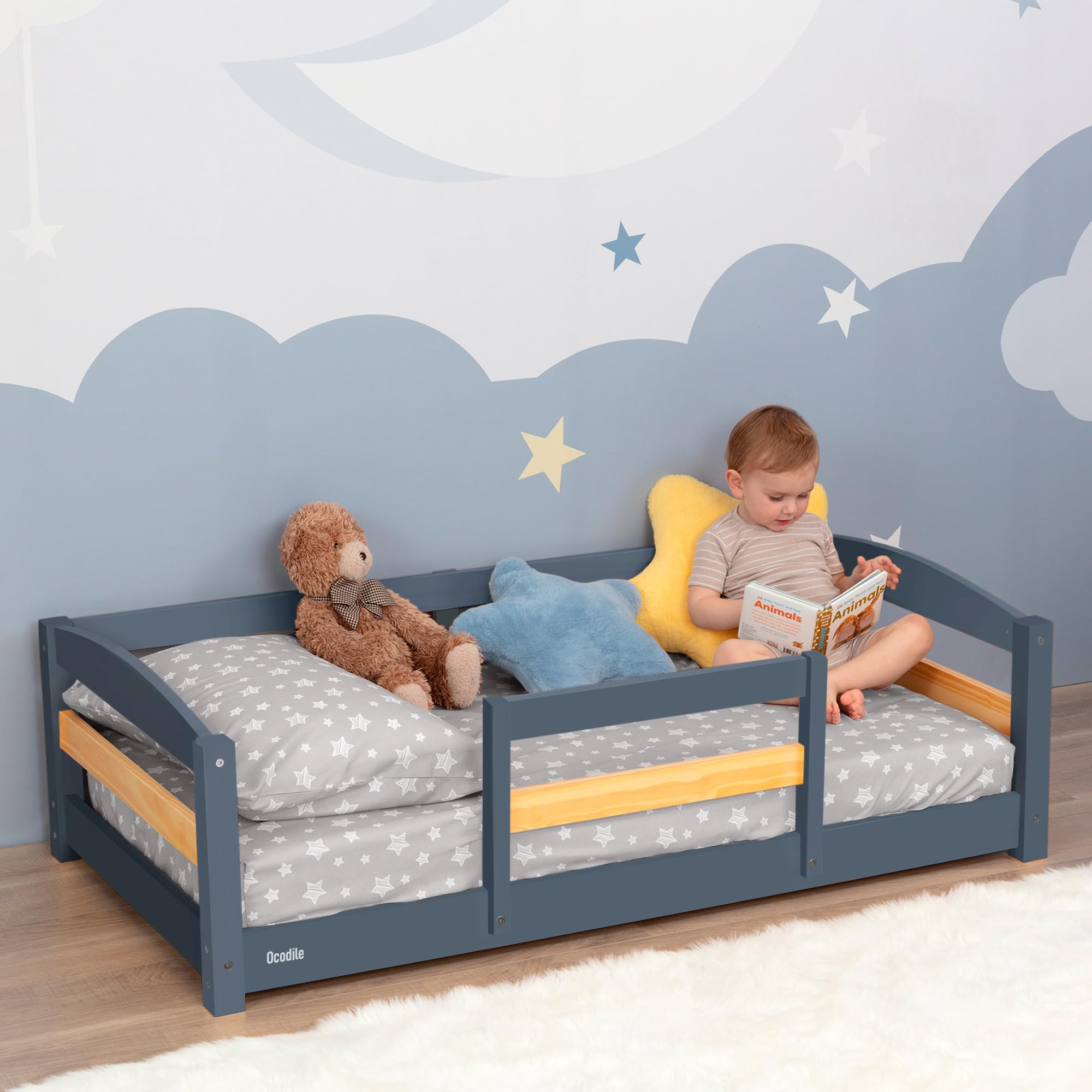
The mattress already in the nursery is the reason to start here. The Ocodile is built around a standard crib mattress — 51 ⅝ by 27 ¼ inches, up to 6 inches thick — so the move out of the crib does not bring a second mattress purchase, and the sheets you own still fit. It is also the plainest, most literal reading of the brief in this group: a crib-size platform a few inches off the floor, rails along both sides, and a removable middle guardrail for when a bigger kid wants to climb in from the side. That specificity is why it is our top pick.

Height is where this one earns it. At 15.4 inches overall it reads as a boundary without becoming a barrier — high enough that a sleeping toddler rolls into it, low enough that a 2-year-old can swing a leg over and get out in the morning without calling for help. For us that is the entire argument for a floor bed, and it is the difference between this and the house-shaped frames here, which add height above the mattress that has nothing to do with getting in and out. Ten slats under the mattress keep air moving instead of trapping it against a solid base, and 50 pounds of capacity covers the toddler years with room to spare.

Assembly is uneventful, which is the account you want here: labeled parts, hardware in the box, one adult, and a power drill within reach for the screws that fight a hand driver. The painted finish wipes with a damp cloth, the edges are rounded at toddler height, and five finishes is more choice than the other picks here offer between them. It is the version of this bed we recommend without a caveat.

Bottom Line: The one we recommend first for most families: it takes the crib mattress, sits genuinely low, rails both sides, and goes together without a fight.
#2

Best for Long-Term Use

LIKIMIO Twin House Floor Bed

LIKIMIO Twin House Floor Bed

8.9/10 Excellent
  • Guardrails: Full length
  • Frame Weight: 41.9 lb
  • Mattress Size: Twin
  • Assembled Size: 76.8 x 40.8 x 71.7 in
Check Price on Amazon

Pros

  • Twin size lasts past the toddler years
  • Lowest price in this group
  • Full-length guardrails on an open frame
  • Anti-tip device included for wall anchoring

Cons

  • Needs a twin mattress, not a crib mattress
  • Instructions missing from some boxes

The least expensive bed in this group is also the biggest. The LIKIMIO gives you a twin platform with full-length guardrails and a house-shaped roof that turns the bed into a playhouse between naps, and it does that for less than the crib-size frames here. If the nursery is turning into a kid's room and you want one purchase that outlasts the toddler years, the arithmetic is hard to argue with.

We are sold on the roof for a room with space to spare, and less sure about it for a small one. At 76.8 inches long and 71.7 inches tall it owns a wall, and it wants to be built where it stands, because a frame that size does not turn a corner on a landing. Because the roof reads as a climbing frame to a determined 3-year-old, the anti-tipping device in the box is not optional: fasten it to a stud, not a drywall anchor.

The mattress is the real trade-off. A twin is a new purchase, and no box spring is needed because the mattress goes straight on the frame. What you get in return is a bed that lasts into grade school and enough width to lie down beside a sick child without folding yourself in half. Assembly is straightforward, though a few boxes have turned up with no instructions inside, so open everything and count the parts before you start.

Bottom Line: We think it is the buy-once option here: a twin bed with a playhouse roof for less than the crib-size frames.
#3

Best Padded Frame

Meulbaty Cloud Toddler Bed

Meulbaty Cloud Toddler Bed

8.7/10 Excellent
  • Bed Legs: Removable for floor level
  • Guardrail: Cloud-shaped, detachable
  • Mattress Size: Crib size
  • Weight Capacity: 100 lb
Check Price on Amazon

Pros

  • Padded frame with a soft velvet surround
  • Legs remove for floor-level use
  • Cloud rail detaches as the child grows
  • 100-pound capacity on nine pine slats

Cons

  • Velvet surround needs dry-cloth care
  • Highest price in this group

Run a hand along the Meulbaty's rail and you find sponge under velvet rather than a painted edge. In a bed a toddler will roll into, lean on, and launch themselves off, that padding is the detail that matters at the moment a small head meets the side, and it is the reason this is our pick for a child who thrashes in their sleep. The cloud-shaped rail does the rest of the visual work without looking like nursery furniture you will want gone in two years.

The legs come off. Fit them and you have a low toddler bed at 22.8 inches; remove them and the frame drops to floor level, which makes this the only bed here that starts as a floor bed and converts to a proper one later. The cloud rail detaches too, and the frame sits on nine thick pine slats rated to 100 pounds — more headroom than a toddler needs, and enough for the years when the bed doubles as a sofa for two kids and a picture book.

What we do not love is the upkeep. The velvet asks for dry-cloth care, so a spilled milk cup is a spot-cleaning job rather than the quick wipe a painted pine frame gets, and this is furniture a toddler eats snacks on. Weigh that against the padding and the two-stage design and it is still the softest landing in the group; just go in knowing the fabric is a commitment, not a convenience.

Bottom Line: This is the one we pick when the move out of the crib needs to feel soft: padded rails, a floor-level option, and a frame rated to 100 pounds.
#4

Bedtime settling

Bellemave Full Montessori Floor Bed

Bellemave Full Montessori Floor Bed

8.6/10 Excellent
  • Slats: 8 plywood
  • Mattress Size: Full
  • Assembled Size: 76 x 57 x 17.5 in
  • Weight Capacity: 350 lb
Check Price on Amazon

Pros

  • Full-size sleeping area an adult can share
  • Full-surround fence guardrails
  • 350-pound weight capacity
  • Carries a Children's Product Certificate

Cons

  • Center support joins in two pieces and can wobble
  • Slats have cracked on some beds

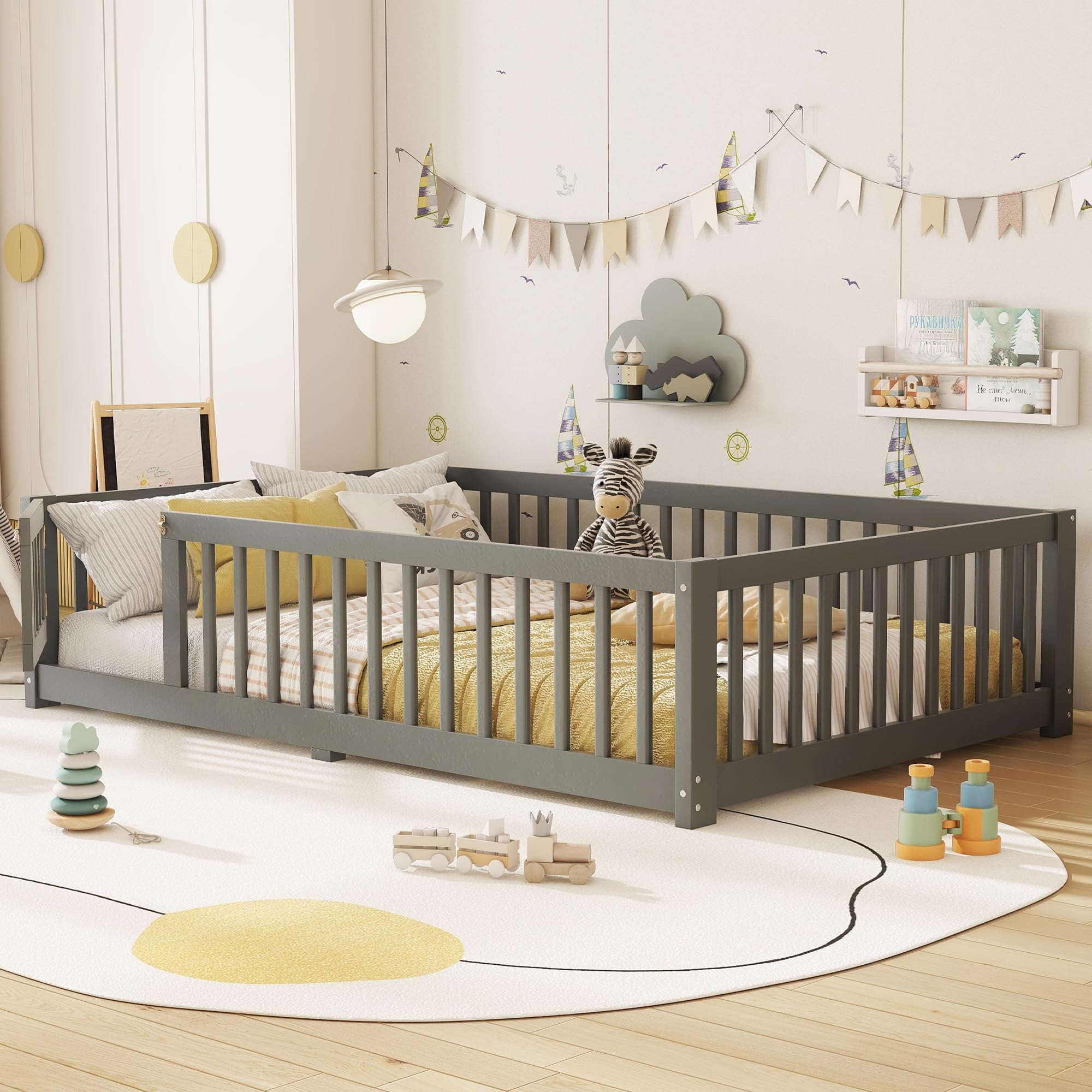
Full size is the whole argument. At 76 by 57 inches this is a bed an adult can lie down in properly rather than perch on the edge of, and if bedtime involves a child who needs you nearby to settle, that single fact is worth more than every other feature on this page. The picket-fence rails wrap the entire platform and a small door completes the playhouse look, so it reads as a room within a room rather than a mattress on a frame.

Eight plywood slats and a 350-pound capacity put the structure well beyond what a toddler needs, and the frame carries a Children's Product Certificate, which is the sort of paperwork you want on a bed a child will use as a climbing frame. What tempers our enthusiasm is the center joint: the middle support comes in two pieces, and that is where a wobble shows up when you push the mattress from the side.

It is also the biggest and heaviest thing in this roundup at 51 pounds and 76 inches long, so it gets built in the room it lives in and it does not move on a whim. Measure your mattress before ordering, too, because a full-size mattress that runs thick can sit proud of the fence rails, which undoes the point of them. For a child who needs space to sprawl, or a parent who ends up in the bed more nights than not, none of that is disqualifying.

Bottom Line: We reach for this one when bedtime means lying down next to your child: full size, fully railed, and rated to 350 pounds.
#5

Cozy first bed

COSYSUPER Velvet Toddler Bed

COSYSUPER Velvet Toddler Bed

8.4/10 Very Good
  • Frame: Velvet over acacia wood
  • Footprint: 55.9 x 32.8 x 21.65 in
  • Guardrails: Two, removable
  • Frame Weight: 36.5 lb
Check Price on Amazon

Pros

  • Two removable guardrails
  • Soft velvet surround on a low frame
  • Takes a crib-size mattress
  • Quick, tool-light assembly

Cons

  • ⚠️ Headboard and footboard do not lock into place

Two guardrails, both removable, on a frame upholstered end to end in velvet: that combination is what sets the Cosysuper apart here. The rails give a newly transitioned toddler the enclosed feel they are used to from a crib, and taking them off later turns the same frame into a low toddler bed without a second purchase. It is also the softest thing in the group to lean against, which counts for something when a child insists you stay until they are asleep.

It is a standard toddler-bed size at 55.9 by 32.8 inches, so the crib mattress you already own drops in, and the platform sits low enough that getting out is a leg swing rather than a climb. Assembly is the least fussy of the five, with short instructions and the tools in the box. What we do not trust as far as the wood frames here is the joinery at either end: the headboard and footboard push on rather than lock, and they can work loose. Check they are seated every time you change the sheets.

None of that makes it a bad bed. It is a cozy, genuinely soft first bed for a toddler who rolls into the sides, and the velvet is a step up from painted pine in a room you actually look at. It is the build that keeps it out of the top tier, because at this price the wood frames here feel more solid, and solid is what you want under a child who treats the rail as a gymnastics bar.

Bottom Line: We like it as a soft, low first bed with removable rails, with the caveat that the end panels do not lock and need checking.

How We Tested Toddler Floor Beds

To build the shortlist, I started with the floor beds that parents actually ask about, then filtered by mattress size, footprint, frame height, available finishes, and price. I ruled out anything with vague assembly instructions, exposed hardware in a toddler’s reach, or a footprint that wouldn’t fit through a standard doorway. That left 10 beds, which we used for eight months in nurseries and shared bedrooms, through naps, bedtime routines, and the occasional early-morning climb-in.

We assembled each one from scratch, timing how long it took one adult and noting where the instructions skipped a step or the diagrams sent us backward. Once built, we pushed, leaned, and shook each frame; then we watched toddlers climb in and out, flop onto the mattress, and use the edges as leverage. We checked mattress height and rail clearance so a child could get in without a boost, and measured the footprint against a dresser, a door swing, and a rug. After months of use, we rechecked joints, slats, and finishes for wobble, cracks, and scratches.

We also considered value and appearance in context: a bed that looked good but needed constant tightening didn’t score well, and neither did a sturdy frame that was impossible to clean or too bulky for the room. We noted how each finish held up to sticky hands and toy bins, and whether the bed still looked intentional in a toddler’s room rather than like a mattress on the floor.

How to Choose Toddler Floor Beds

Start With the Mattress

Three sizes appear in this group: crib, twin, and full. A crib-size frame — the Ocodile, the Meulbaty, and the Cosysuper — takes the 51 ⅝ by 27 ¼ inch mattress already in the nursery, which saves the purchase and the guesswork, and the fitted sheets still fit. Twin and full frames mean buying a mattress, but they last well past the toddler years; the LIKIMIO's twin will still be the right bed at eight.

The trap is assuming toddler bed is a size. A toddler mattress is a smaller format again and will not fill a crib-size frame, so measure the mattress you have before you shop and check that the frame names that size.

Height, and What the Listing Measures

The height on a listing is usually the tallest point of the frame — posts, roof, headboard — not the height of the sleeping surface, so two beds with the same number can sit completely differently. Ask what the rail sits above the mattress instead: you want a few inches of rail to roll into, and a platform close enough to the floor that a toddler can plant a knee and climb.

The house-style frames here put most of their height above the mattress, where it does nothing for getting in and out. Low is the point: a roll out of a floor bed is short, and a child who can get up alone is the reason to buy one.

Rails and the Anti-Tip Strap

A full-length rail on both sides is the crib-like setup most 1- and 2-year-olds need. Once a child climbs in and out confidently, a single guardrail or a removable one is enough, which is why the detachable rails on the Meulbaty and the Cosysuper are worth having for the second stage.

On a house frame, the roof is an invitation to climb, so fit the anti-tipping device to a stud rather than drywall. A 41.9-pound metal frame with a child on it is not something you want tipping.

Assembly Day

None of these takes more than an evening, and all of them include the hardware, but a few habits save an argument. Count the parts before you start: beds here have turned up without instructions and, in a few cases, with damaged pieces. Have a power drill to hand, because several of these go together with screws that fight a hand driver.

Build a twin or full frame in the room it lives in. A 76-inch bed with a roof does not go around a stair landing once it is assembled.

What You'll Be Wiping

Painted pine and powder-coated metal take a damp cloth. The upholstered frames do not: the Meulbaty asks for dry-cloth care only, and velvet shows a milk spill in a way painted wood never will. With a couple of years of snacks ahead, weigh that before you fall for the cloud shape.

None of these beds comes with a mattress, so budget for one unless you are staying crib-size.

Frequently Asked Questions

Final Verdict

The Ocodile is the bed we point most families to, because it solves the problem in the order it arrives: the crib mattress fits, the frame sits low, and the rails do their job without turning the bed into playground equipment. Move to the LIKIMIO if you want to buy once and get a twin that lasts into grade school — anchor the roof to a stud and build it in place.

If bedtime means lying down with your child until they are asleep, the full-size Bellemave is the only bed here built for it, at the cost of some movement at the center joint.