Kids & Nursery

Best Toy Storage Organizers of 2026

Toy storage comes with a built-in tradeoff: the open bins a toddler can reach alone tend to look like a small landfill by Wednesday, and the tidy lidded kind is the kind nobody bothers to open. I've lived on both sides of that in my own playroom, and the organizers that actually work sit somewhere in between — simple enough for a four-year-old to use unsupervised, sturdy enough to survive being used as a step stool. Over the past six months we assembled and lived with 12 of them, from cube shelves and rolling bins to zippered fabric bins and a couple of wooden benches.

One thing I'd tell any first-time buyer: measure the wall and the baseboard before you fall for a unit online, because depth is where these go wrong — a deep shelf can block a doorway or leave a gap you'll stare at for years. What separated the keepers was assembly that didn't need a second adult, bins that slide out one-handed, and hardware that stays tight. The picks below are built for real playrooms with real messes, not for a photo shoot.

#1

Best Overall

Humble Crew 16-Bin Organizer

Humble Crew 16-Bin Organizer

9.4/10 Outstanding
  • Bins: 16 (12 standard, 4 large)
  • Frame: Engineered wood with steel dowels
  • Width: 42 in
  • Weight Capacity: 20 lb per tier
Check Price on Amazon

Pros

  • 16 bins in two useful sizes
  • Wood-and-steel frame with stabilizing braces
  • Wall anchor kit included
  • Removable bins are easy for kids to handle

Cons

  • 42-inch width needs a dedicated wall
  • 20-pound-per-tier limit rules out heavy books

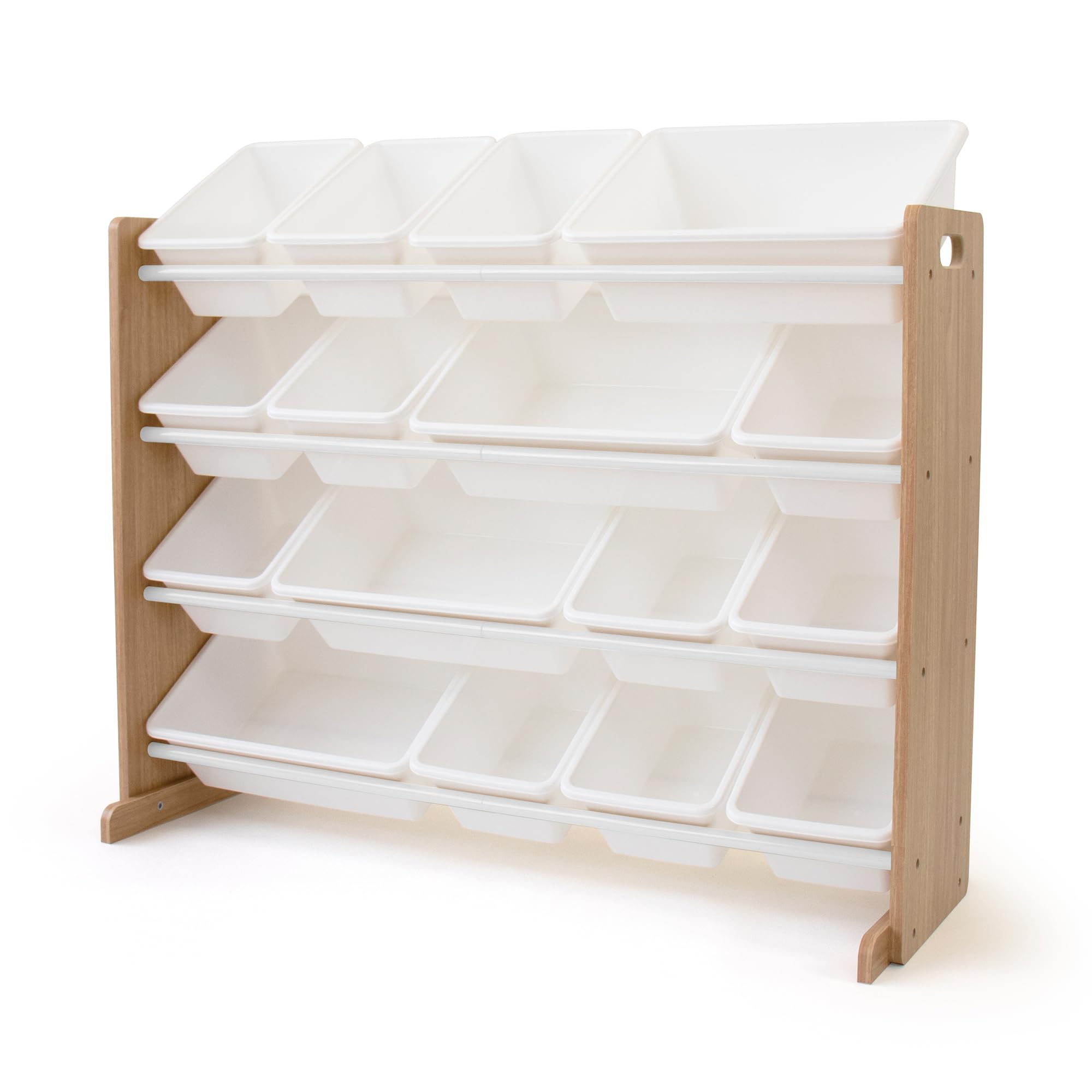
The first thing that sold us on the Humble Crew 16-bin organizer is the mix of bin sizes: twelve standard bins for the small stuff and four larger ones for the toys that never fit anywhere. That sounds like a small detail until you are staring at a pile of blocks, pretend food, and one very large stuffed octopus. The 42-inch frame is wide, but it uses the wall efficiently, and the engineered-wood-and-steel construction with stabilizing braces feels like furniture rather than a plastic tower. The 20-pound-per-tier rating is the number to respect; this is a shelf for toys, not a bookcase.

We especially like that the bins are removable and sized for a child's hands. A toddler can pull one out, carry it to the rug, and put it back without dismantling the whole system. The open front also means toys stay visible, which is the difference between a cleanup routine and a daily negotiation. Assembly is required, and the wall anchor kit is not optional in a room where kids climb; we treat that as part of the purchase, not an accessory.

The main trade-off is the footprint. At 42 inches wide, it wants a dedicated playroom wall, and the standard bins will not swallow oversized ride-on toys. If you have a long wall and a mix of small and medium toys, that is an easy exchange. The 16-bin layout is the rare organizer that still has a place for the random party-favor junk.

Bottom Line: For most playrooms, the Humble Crew 16-bin is the organizer we recommend: generous bin storage, a sturdy wood-and-steel frame, and a sensible mix of sizes.
#2

Best Large Playroom Organizer

SpaceAid 12-Bin Organizer

SpaceAid 12-Bin Organizer

9.0/10 Outstanding
  • Bins: 12 (4 large, 8 small)
  • Frame: Solid pine
  • Width: 52.3 in
  • Shelves: 6
Check Price on Amazon

Pros

  • Six shelves plus 12 bins
  • Solid pine frame with rounded edges
  • Slim 13.6-inch depth
  • Side shelves hold books and puzzles

Cons

  • Needs a long, dedicated wall
  • Premium price for the size

If your playroom has a long empty wall, the SpaceAid 12-bin organizer turns it into a proper storage wall rather than a row of plastic tubs. The 52.3-inch frame combines six shelves with twelve bins, and the side shelves give books and puzzles a home instead of letting them pile on top of the toy bins. It is the widest unit here, and it looks the most like a piece of furniture.

We recommend it for the playroom that also needs a library: the four large and eight small bins handle the toy mix, while the open shelves keep favorite books in rotation. Solid pine is a step up from the composite frames on most of these picks, and the rounded edges and extended front base are thoughtful details in a room where kids move fast. The trade-off is that the long span needs a flat wall and careful loading; it is not the unit for a tight bedroom.

The bins are smaller than the overall footprint suggests, so this is not the answer for a mountain of oversized stuffed animals. It is also more expensive than the compact Humble Crew units, and assembly is a real project. What you get for the space and money is a storage wall that can grow from toys to books to art supplies.

Bottom Line: The SpaceAid is our large-playroom pick when you need a long wall of toy bins and book shelves in one solid-pine piece.
#3

Best Colorful Bins

Amazon Basics 12-Bin Organizer

Amazon Basics 12-Bin Organizer

9.4/10 Outstanding
  • Bins: 12 plastic bins
  • Frame: Composite wood with metal dowels
  • Width: 33.6 in
  • Weight Capacity: 22.4 lb
Check Price on Amazon

Pros

  • Bright multicolor bins
  • FSC-certified wood frame
  • Wall-mount design adds stability
  • Compact 33.6-inch width

Cons

  • 22.35-pound total weight limit
  • Four fewer bins than the top pick

The Amazon Basics 12-bin organizer is the one we choose when the room needs a lift as much as a system. The bright multicolor bins against the natural wood frame make sorting look like play, and the 12-bin layout is easy for a toddler to understand. At 33.6 inches wide, it fits a shared kids' room or a bedroom wall without dominating the space. We recommend it for families who want visible, cheerful storage and are willing to keep heavy books elsewhere.

The frame is composite wood reinforced with metal dowels, and it is FSC-certified, which we appreciate in a category full of anonymous panels. The 22.35-pound total weight capacity is the catch: this is not a shelf for a full set of hardback books or a heavy board-game collection. Keep the heavier items low and the stuffed animals high, and it does its job. The wall-mount design is a plus for stability, but it also means you need to commit to a spot.

Compared with the Humble Crew 16-bin, you give up four bins and a higher per-tier capacity, but you get a more compact footprint and a more playful look. The bins are not as generous for big toys, and the frame is not solid wood. For a first organizer in a colorful room, those are fair trades.

Bottom Line: The Amazon Basics 12-bin organizer is our pick for a cheerful shared kids' room, as long as you keep heavy books off its 22.35-pound frame.
#4

Best for Small Spaces

Humble Crew 9-Bin Organizer

Humble Crew 9-Bin Organizer

9.1/10 Outstanding
  • Bins: 9 plastic bins
  • Frame: Engineered wood with steel dowels
  • Width: 25.6 in
  • Weight Capacity: 20 lb per tier
Check Price on Amazon

Pros

  • Compact 25.6-inch width
  • Toddler-height three-tier access
  • Nine removable bins
  • Wall anchor and rounded corners

Cons

  • Small bins suit small toys only
  • Lightweight frame needs anchoring

The Humble Crew 9-bin organizer is what we choose when the playroom is really a corner of the living room. At roughly 26 inches wide, it tucks against a short wall and keeps a small footprint, but the three tiers put nine bins within a toddler's reach. The top row is low enough that a small child can see what is there and pull a bin down without asking for help.

We recommend it for a first organizer or a small bedroom, with one clear caveat: the bins are small. Each one is about 12 by 9 by 6 inches, so this is a small-toy organizer, not a place to dump a ride-on or a giant plush. The engineered wood and steel frame is rated for 20 pounds per tier, and the wall anchor kit is included. The anchor is not optional; a lightweight unit with a child pulling on the bins needs to be fixed to the wall.

The compact size is the point. It will not organize a whole playroom of bulky toys, but it gives a toddler a system they can actually use. For a small room, that is worth more than another wide shelf that nobody can reach.

Bottom Line: For a small bedroom or a playroom corner, the Humble Crew 9-bin gives toddlers reachable storage without taking over the room.
#5

Best Solid Wood

EXPERLAM 12-Bin Organizer

EXPERLAM 12-Bin Organizer

9.0/10 Outstanding
  • Bins: 12 (4 large, 8 small)
  • Frame: Solid pine
  • Width: 42 in
  • Shelves: 3 open shelves
Check Price on Amazon

Pros

  • Solid pine frame
  • 12 bins in two sizes
  • Open shelves for books and puzzles
  • Rounded kid-friendly edges

Cons

  • More assembly than simple units

The EXPERLAM 12-bin organizer is the wood-first choice: a solid pine frame, rounded edges, and a natural finish that looks at home in a bedroom rather than a dedicated playroom. At 42 inches wide and 11 inches deep, it is narrower than the SpaceAid but still substantial, and the three open shelves give books and puzzles a place beside the bins.

The 12-bin split is useful: four large bins for trucks, dolls, and dress-up pieces, and eight small bins for the little things that otherwise migrate across the floor. We like the open side shelves because they keep favorite books visible without adding another piece of furniture. The pine frame is the reason to pay more than the composite options, and the rounded edges matter in a room where kids move fast.

The trade-off is assembly. This is not a pop-together unit; the solid frame takes more screw work than the simplest organizers, and the bins need to be seated properly on their supports. We recommend it for a bedroom or a playroom where the storage is part of the decor, not for a tight corner or a household that wants the fastest possible setup.

Bottom Line: The EXPERLAM is our solid-wood pick for a bedroom or playroom where the storage should look like furniture, not a bin rack.
#6

Best Soft Toy Chest

YOLOXO Soft Toy Box

YOLOXO Soft Toy Box

9.1/10 Outstanding
  • Closure: Flip-top lid
  • Capacity: 82 L
  • Material: Fabric and cardboard
  • Dimensions: 26.8 x 13.8 x 16 in
Check Price on Amazon

Pros

  • 82-liter capacity
  • Soft sides with no hard corners
  • Removable divider
  • Side handles for carrying

Cons

  • Lid lifts off completely
  • Sides can bow when overstuffed

A soft-sided toy box is the right answer when the goal is scooping, not sorting. The YOLOXO chest is 26.8 inches long and 82 liters, so it swallows a rug full of stuffed animals, dress-up clothes, and blocks in one pass. The lid hides the mess, and the side handles let you drag the whole thing out of the living room when guests arrive.

We like the removable divider because it keeps a big box from becoming a single landfill. One side can hold the big stuff, the other the smaller toys, and you can pull the divider out when the collection changes. The fabric-and-cardboard body has no hard corners, which is the reason we keep this one in rooms where toddlers are still falling into things.

The trade-offs are real: the lid lifts off completely rather than hinging, so it is one more thing to set down, and the soft sides can bow if you overstuff it. It is not a seat or a climbing step. For a living room or a nursery where toys need to disappear quickly, we recommend it as the fast, forgiving option.

Bottom Line: The YOLOXO soft toy box is our quick-cleanup pick: a large 82-liter bin that hides the mess and has no hard corners for toddlers.
#7

Small toy pieces

OPELETNNT Toy Storage Bags

OPELETNNT Toy Storage Bags

9.2/10 Outstanding
  • Closure: Zipper
  • Dimensions: 11.8"L x 3.9"W x 8.66"H
  • Pack Count: 6 bags
  • Load Capacity: 50 lb
Check Price on Amazon

Pros

  • Six clear bags with labels
  • 50-pound load capacity
  • Zipper closure keeps pieces contained
  • Stackable and easy to carry

Cons

  • Too small for large toys
  • Zipper quality is the weak point

Loose Lego sets, puzzle pieces, and tiny action figures are a different storage problem from stuffed animals. The OPELETNNT bags are six clear, zippered pouches with labels, sized at 11.8 by 8.66 by 3.9 inches, and they are the sorting layer we add inside a shelf or toy box rather than a replacement for one.

We appreciate that kids can see what is inside without dumping a bin on the floor. The labels help keep sets from merging, and the 50-pound load rating means a bag can hold a surprising amount of small toys. The PVC is thick enough to feel purposeful, and the handles make it easy to carry a set to the table.

The limitations are size and zippers. These bags are for small pieces, not a stuffed bear or a board game box, and the zippers are the part to check before handing a full bag to a child. The bags stack neatly on a shelf, but they are not rigid, so they will slump if you pack them unevenly.

We recommend them for families who already have a shelf or bin system and need to contain the little sets inside it. They are not the whole organizer; they are the thing that stops the little pieces from becoming floor litter.

Bottom Line: The OPELETNNT bags are our pick for corralling small toy sets: six clear, labeled bags that let kids see and grab the right pieces.
#8

Extra-large soft storage

SoftOwl Extra-Large Toy Box

SoftOwl Extra-Large Toy Box

8.8/10 Excellent
  • Capacity: 4.8 cubic feet
  • Material: Oxford fabric
  • Dimensions: 37"L x 14"W x 16"H
  • Compartments: 3
Check Price on Amazon

Pros

  • 4.8-cubic-foot capacity
  • Three separate compartments
  • Soft fabric with no hard edges
  • Side mesh pockets

Cons

  • Three-piece lid is fussy
  • Not rigid enough to sit on

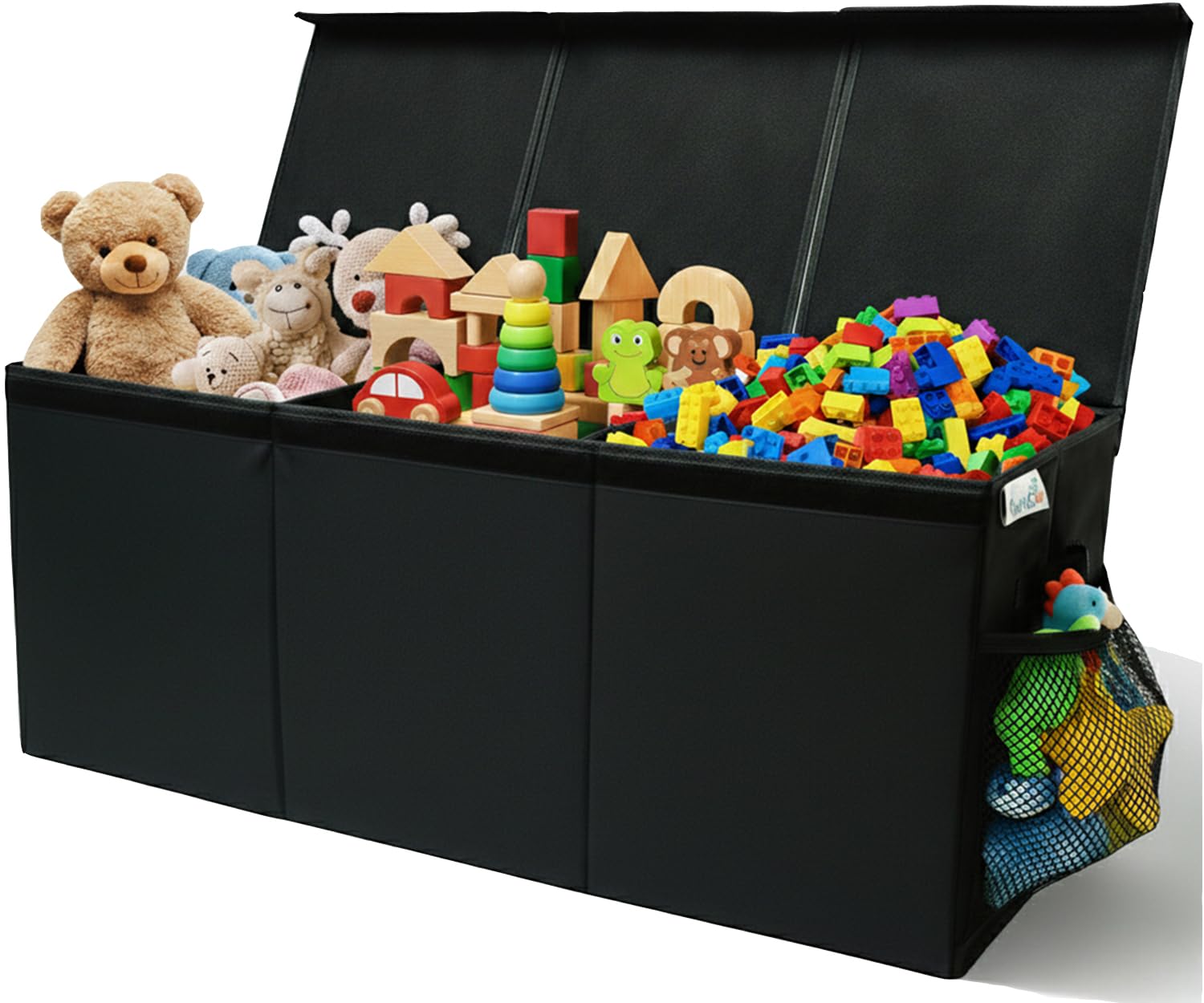
The SoftOwl extra-large toy box is the soft chest we choose when one open bin is not enough. At 37 inches long and 4.8 cubic feet, it has room for bulky toys, and the three separate compartments let you split dolls, dress-up clothes, and books without adding another shelf. The Oxford fabric body is collapsible, so it can fold away when the toy collection shrinks.

We like the side mesh pockets for small items and the lid that keeps dust off the contents. The 60-pound weight recommendation is generous for a fabric box, but it is still a soft box: it will not hold its shape like a wooden shelf, and it is not a seat. The three compartments are the real selling point; they turn a big open chest into something closer to a sorting system.

The lid is the fussy part. It comes in three separate panels, so opening the whole box takes a little more work than flipping one hinged lid. The upside is that you can lift only the section you need, which is handy when the dress-up corner is the only thing being used.

We recommend it for a nursery or playroom with a large pile of soft toys and a need to keep categories apart. It is not the right pick for heavy books or for a child who wants a rigid surface to lean on, but for bulky toys it earns the floor space.

Bottom Line: The SoftOwl is our extra-large soft chest: three compartments and 4.8 cubic feet swallow bulky toys, though the three-piece lid takes getting used to.

How We Tested (and Lived With) 12 Toy Storage Organizers

We started by pulling every organizer we could find that was in stock and sized for a normal room, filtering by footprint, bin count, material, and whether replacement bins could be bought separately. From that pool we ordered 12 and built each one in the same playroom, on Saturday mornings, timed solo with only the tools in the box.

Assembly was the first filter. I timed each build from box to finished unit, noted whether the instructions were mostly pictures or mostly guesswork, and whether one person could hold the frame and drive the screws at the same time. Then came the weight: we loaded shelves with what a household actually accumulates — board books, wooden blocks, a 100-piece train set, dress-up clothes — and watched for sag, wobble, and whether the whole thing shifted when a kid leaned on the top tier to reach the highest bin.

For six months those units stayed in rotation: bins pulled out and shoved back daily, small pieces sorted into categories and then dumped into one heap, a juice spill wiped up, one organizer moved from the playroom into a bedroom. We cycled the zippers on the soft bins dozens of times, tugging them the way a child does, and retired the ones whose pulls separated or whose fabric stretched at the seam. Capacity was counted in objects rather than liters — how many board books fit before a bin refused to slide back in — and we measured each footprint against a baseboard to see what sat flush and what left a gap. Value came down to what the money bought: fabric thickness, solid wood versus particleboard, hardware included or sold as an extra.

How to Choose Toy Storage Organizers

Start with the toys, not the bin count

A high bin count can look impressive and still leave nowhere for a stuffed dinosaur. Look for a mix of large and small bins, then measure the biggest toy you need to store. The Humble Crew 16-bin and EXPERLAM 12-bin both split their bins into larger and smaller sizes; a nine-bin unit with small bins can be enough for a room dominated by little pieces. If most of your toys are bulky, fewer large bins beat a wall of tiny ones.

Match the footprint to the room and the child

Width is the first thing to check. A 52.3-inch shelf like the SpaceAid can turn a long wall into a storage wall, but it needs a dedicated stretch of wall and a flat floor. A compact unit such as the Humble Crew 9-bin, at roughly 26 inches wide, fits a corner or a short bedroom wall. Height matters just as much: a toddler-height top row lets a child help, while an adult-height shelf keeps small pieces out of reach. Anchor anything tall.

Choose open bins, a closed chest, or labeled bags

Open bins keep toys visible and let kids help themselves; closed chests hide the mess and make quick cleanup easier. Soft-sided boxes such as the YOLOXO and SoftOwl are for scooping and hiding, not for precise sorting, and their soft walls will not hold a stack of books. Clear zippered bags are the opposite tool: they contain small sets inside a shelf or chest. We use bags for the pieces that otherwise migrate, and bins for the toys a child chooses every day.

Check the frame and the daily load

Frame material and weight capacity decide how the organizer ages. Engineered wood with steel dowels is the practical middle ground; solid pine looks better and feels sturdier, but it costs more and usually takes longer to assemble. Check whether the weight limit is per tier or for the whole unit: the Humble Crew 16-bin is rated at 20 pounds per tier, while the Amazon Basics organizer is rated at 22.35 pounds total. Fabric and cardboard boxes are for soft toys, not books. Anchor tall units.

Frequently Asked Questions

Final Verdict

For most families, the Humble Crew 16-bin organizer is the one to buy: it has the right mix of bin sizes, a wood-and-steel frame, and a wall anchor kit at a midrange price. If your playroom has a long wall and you need book storage too, the SpaceAid is the upgrade. In a small bedroom, the Humble Crew 9-bin keeps everything within a toddler's reach. Start with the room, not the bin count.