Kitchen

Best Kitchen Carts with Storage of 2026

A kitchen cart only earns its footprint if it stands still. Each one trades floor space for work surface, and the wrong pick — a frame that racks when you lean on it, casters that skid mid-chop — leaves you worse off than the empty corner you started with. The right one buys you a second counter, a permanent home for the stand mixer, and somewhere to put the potatoes besides the floor.

I once wedged a cart between a fridge and a doorway in a kitchen with exactly one drawer of counter space, so I know the difference between storage that swallows things and storage that only looks like it should. Over the past six months, my team and I assembled 12 carts in our own kitchens, wheeled them around, and loaded them past the point of politeness. One thing worth knowing before you shop: the listed dimensions rarely match what the cart actually occupies once the handle and casters are on, so measure your gap twice. The picks below are the ones that held up.

#1

Best Overall

Amazon Basics 3-Tier Cart

Amazon Basics 3-Tier Cart

9.3/10 Outstanding
  • Top: 1.5-inch wood
  • Shelves: 2, adjustable 1-inch
  • Assembly: No tools needed
  • Total Capacity: 175 lb
Check Price on Amazon

Pros

  • Top sits at counter height, not shelf height
  • Shelves adjust in 1-inch steps
  • No-tool assembly a single person can finish
  • Hooks keep utensils off the shelves

Cons

  • Wobbles when the load is stacked high

A cart that meets your counter does more work than one that does not. This one stands 36.7 inches tall, close enough to a standard 36-inch counter that the wood top reads as extra work surface rather than a shelf parked in the middle of the floor — and that single measurement is why it is the cart we recommend first.

Below the top are two chrome shelves, each adjustable in 1-inch steps and rated for 50 pounds, with 175 pounds across the frame. That is a microwave up top and an air fryer, Instant Pot, or mini fridge underneath, with four chrome hooks for the utensils and oven mitts that never have a home. We dropped the lower shelf two notches for a stockpot and still had clearance above it.

Assembly needs no tools — the frame slots together — and at 25.7 pounds we had ours standing and loaded alone, without hunting through the drawer for a screwdriver. Two of the four casters lock, and the cart rolls easily enough on tile and low-pile carpet that pulling it out to sweep underneath is not a chore.

Open shelving is the honest limitation: nothing is hidden, and the top measures about 21 by 15 inches, which takes a cutting board rather than a rolling butcher block. Want doors, drawers, and an outlet instead? That is the HOOBRO further down.

Bottom Line: We recommend this one to most kitchens: a wood top at counter height, two shelves that adjust to whatever appliance you are parking, and no tools needed to build it.
#2

Best Value

Simple Houseware 3-Tier Cart

Simple Houseware 3-Tier Cart

9.4/10 Outstanding
  • Tiers: 3 metal baskets
  • Casters: 4, 2 locking
  • Capacity: 220 lb
  • Dimensions: 12.5"D x 17"W x 31.5"H
Check Price on Amazon

Pros

  • 220 pounds of capacity across three baskets
  • Mesh sides keep contents visible
  • 2-inch casters with two locks

Cons

  • Wheel mounts are the weak point under a dragged load

Three mesh baskets, no flat work surface, and a footprint of 12.5 by 17 inches: this is the plainest cart in the guide, and for plenty of kitchens the plain version is the right one. At 31.5 inches tall it slides under a window or sits beside the fridge without cutting the room in half.

What we liked is how much it swallows for the size. The 220-pound rating covers produce, baking clutter, and the case of seltzer that never gets put away, and the mesh sides mean you can see what is on a tier without pulling the cart out. The 2-inch casters, two of them locking, cross a kitchen threshold more easily than the price suggests.

The catch sits at the top. The third basket is smaller than the two beneath it, so cereal boxes and tall bottles only fit down low and anything you want at eye level has to be short. If that is a dealbreaker, the Amazon Basics cart gives you a flat, adjustable top for more money.

Bottom Line: If you want rolling storage and nothing fancier, this is the one we point people to: three deep baskets, casters that lock, and a frame that takes a surprising amount.
#3

Best With an Outlet

HOOBRO Rolling Island

HOOBRO Rolling Island

9.0/10 Outstanding
  • Top: 15"D x 26"W
  • Wheels: 4, 2 lockable
  • Drawers: 2 plus cabinet
  • Capacity: 55 lb
Check Price on Amazon

Pros

  • Outlets built into the top
  • Drawers, cabinet, and spice rack together
  • Narrow 28.5-inch footprint for the storage it offers

Cons

  • Cabinet doors and drawer fronts feel light
  • 55-pound limit rules out heavy appliances

A power strip built into the top is the reason to choose this cart over anything else here. Put a coffee maker, a kettle, or a phone charger on it and the cart can live wherever the cord reaches a wall socket — the answer to an older kitchen with two outlets and no free counter.

The rest is compact: a 15-by-26-inch top, two drawers, a cabinet with an adjustable shelf behind doors, and a spice rack, all on four casters with two locks. It stands 33.8 inches, so it sits below counter height and will not block a window.

Its footprint of 28.5 by 14.8 inches is the smallest of the cabinet-style carts here, which is the other half of the appeal. The top takes a small coffee maker or a compact microwave; a full-size microwave will overhang the edges.

Bottom Line: Buy this if the cart is going to be a coffee or appliance station away from the wall — the built-in power is genuinely useful, and the compact footprint fits where a full island will not.
#4

Best for Heavy Loads

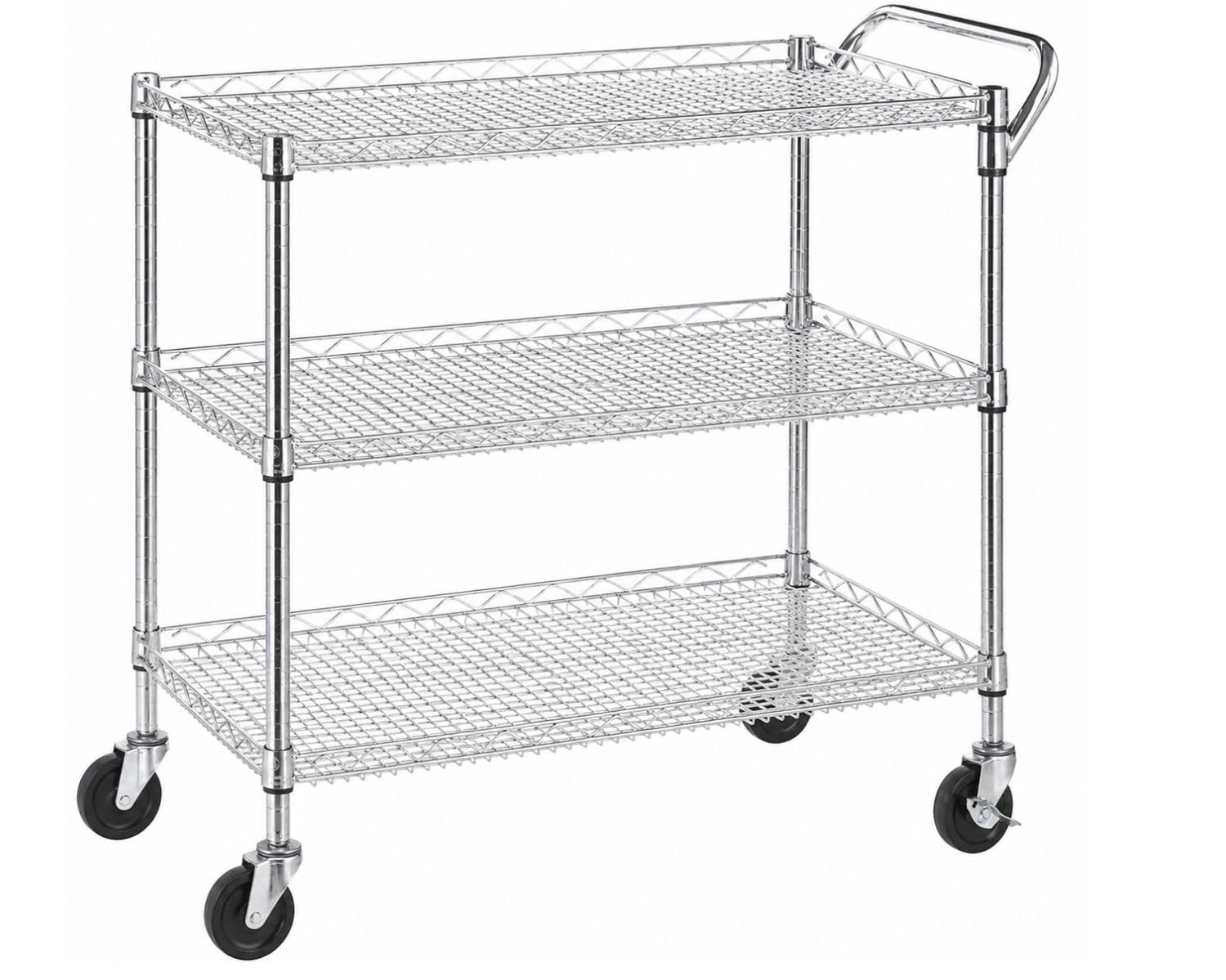
Commercial Wire Cart

Commercial Wire Cart

9.4/10 Outstanding
  • Shelves: 3, adjustable
  • Capacity: 600 lb
  • Shelf Size: 36" x 17.5"
  • Certification: NSF certified
Check Price on Amazon

Pros

  • 600-pound capacity on three shelves
  • NSF-certified commercial steel frame
  • Large rubber casters and a push handle
  • Shelves adjust in 1-inch increments

Cons

  • Open wire shelves let small items tip through

Three wire shelves, 36 by 17.5 inches and adjustable in 1-inch steps, on four large rubber casters with a push handle at each end. Nothing about this cart is domestic: it is the same one you see moving stock in a stockroom.

That is the appeal. The rating is 600 pounds evenly distributed, it is NSF certified, and it is the cart here that takes a full load without us thinking about the frame. If your kitchen has a wall that could be a pantry and no closet to match, this turns it into one.

It is a lot of cart, though. Thirty-six-inch shelves make it the broadest thing in this guide, and in a galley kitchen it reads as furniture whether you want it to or not. Give it a wall rather than a corner.

Bottom Line: For bulk pantry overflow or anything you would otherwise carry by hand, this is the cart we reach for — 600 pounds across three wire shelves, and it still rolls loaded.
#5

Best for Narrow Gaps

OKZEST 5-Tier Cart

OKZEST 5-Tier Cart

8.8/10 Excellent
  • Tiers: 5
  • Baskets: 4 pull-out with liners
  • Capacity: 210 lb
  • Dimensions: 12.6"D x 16.5"W x 35"H
Check Price on Amazon

Pros

  • Five tiers in a 16.5-inch width
  • Pull-out baskets with liners and chalk labels
  • 210-pound capacity on lockable casters

Cons

  • Too narrow for any appliance

Sixteen and a half inches wide and 12.6 deep, this is the cart for the strip of floor between the fridge and the wall — the one you keep meaning to do something with. It stands 35 inches tall, so it spends its space upward.

Five tiers, four of them pull-out baskets with rigid liners and chalk labels, plus a walnut top. The liners do more than they sound: onions, potatoes, and loose fruit sit in them instead of dropping through the wire, and pulling a basket out to the counter beats digging into a deep shelf. The labels are a small thing we ended up using more than we expected.

Our advice is to load it from the bottom up. A tall, narrow cart with a full top tier is a cart that leans, and this frame is light enough that you will notice; keep the heavy produce low and the snack baskets high and it behaves. That is the trade for turning 16 inches of floor into a pantry.

Bottom Line: A pantry that rolls: five narrow tiers of pull-out baskets that hold produce and snacks without burying them, and it slips into a gap a fridge-width cart cannot use.
#6

Best Budget Microwave Cart

ThreeHio Microwave Cart

ThreeHio Microwave Cart

8.8/10 Excellent
  • Top: 23.62"W x 15.75"D
  • Tiers: 3
  • Wheels: 4, 2 lockable
  • Capacity: 210 lb
Check Price on Amazon

Pros

  • Flat 23.6-inch top for a microwave
  • Lockable casters and four hooks included

Cons

  • Small casters catch on rugs and thresholds
  • Sways when a microwave door is pulled

Thirty inches tall is the number that decides this cart. That is a full six inches below a standard counter, so whatever sits on top — a microwave, a coffee maker, an ice maker — ends up below your work surface and below eye level.

Everything else is sensible for the money: three tiers on a metal frame with wood panels, a flat 23.6-by-15.75-inch top, four casters with two locks, and four S-hooks. It is rated for 210 pounds, which covers a microwave plus the clutter that gathers around one.

Assembly is the usual panel-and-screw session and takes a sitting. Nothing about it is difficult, but nothing about it is quick either.

Buy it for a rental kitchen, a dorm, or a break room, or anywhere an appliance needs a home and the cart has to fit a tight spot. If you want something that reads as furniture rather than a stand, the wood-topped carts here are worth the step up.

Bottom Line: The value pick for a microwave: a flat top, hooks, and lockable wheels for very little, as long as you do not need it at counter height.
#7

Tight spaces

YASONIC 3-Tier Cart

YASONIC 3-Tier Cart

9.2/10 Outstanding
  • Tiers: 3 metal baskets
  • Extras: 2 cups, 3 hooks
  • Wheels: 2-inch, 2 locking
  • Capacity: 110 lb
Check Price on Amazon

Pros

  • 11.45-inch frame fits gaps nothing else will
  • Rolls smoothly on 2-inch casters
  • Hooks and cups add storage off the shelves

Cons

  • 110-pound limit caps what it carries
  • Baskets too narrow for appliances or boxes

Eleven and a half inches wide — that is the whole argument. This cart fits beside the fridge, between the washer and dryer, or in the sliver at the end of a counter run where nothing else goes. Fifteen inches deep, 30 tall, 8 pounds empty, on 2-inch casters.

You get three metal baskets, two hanging cups, and three hooks. Assembly is 12 identical screws and two simple tools, and it is the kind of build you finish before the packaging is off the floor. The casters roll easily and two of them lock.

It is the cart we hand someone with a 12-inch gap and a list of small things to store: cans, cleaning supplies, root vegetables, coffee pods. The cups and hooks take the odds and ends that otherwise colonize the counter, and the whole thing lifts with one hand when you want to sweep.

Bottom Line: The narrow one: at 11.45 inches wide it slips into the sliver beside the fridge or between the washer and dryer, and it is the budget buy of the group.
#8

Serving and storage

Leteuke Rolling Cart

Leteuke Rolling Cart

9.0/10 Outstanding
  • Extras: 5 hooks, 2 liners
  • Shelves: 3, 2 adjustable
  • Certification: NSF certified
  • Shelf Capacity: 110 pounds each
Check Price on Amazon

Pros

  • Removable top doubles as a serving tray
  • NSF-certified steel frame
  • Casters and leveling feet both included

Cons

  • Top tray sits loose on the frame
  • Shelf clips can slide on the poles

A chrome three-tier cart with a wood top that lifts off and doubles as a serving tray — that is the trick, and it is a good one. Carry the tray to the table with the snacks, set it back, and the cart goes back to being storage.

The frame is carbon steel and NSF certified, with two adjustable shelves, five S-hooks, and two PP shelf liners that stop small items dropping through the wire. It ships with both casters and leveling feet, so it can roll or stay put.

It is the heaviest cart here at 26 pounds, and it feels it: the steel is noticeably thicker than the budget carts, and the chrome finish is the sort you expect on restaurant equipment.

For serving, it is the best of the group — the tray, the chrome, the hooks for a towel, and wheels that let you set up a drinks station wherever people are standing. That is a narrow job description, but no other cart here does it as well.

Bottom Line: Worth it if you want a cart that doubles as a serving trolley: the wood top lifts off as a tray, and the whole thing is NSF-rated steel.

How We Tested Kitchen Carts With Storage

We started by pulling every cart we could find that promised real storage rather than a decorative shelf, then cut anything with a footprint too deep for a standard galley gap, casters that didn't lock, or a weight capacity that suggested dorm-room duty. That left 12 carts, from flat-pack budget models to solid butcher block, and we kept a running note of what each one cost relative to what it actually did. Then we lived with them for six months.

Each cart was assembled solo, with only the tools in the box, and we timed it and wrote down where the instructions lost us — one set of drawer slides went in backward twice before we figured out the diagram. We measured actual counter height, true depth with the handle attached, and the clearance between shelves, then tried to fit the things we already owned: a stand mixer, a slow cooker, a stack of sheet pans, a five-pound bag of onions.

Then we loaded them wrong on purpose. The bottom shelf got 20 pounds of potatoes and canned goods, the top got a mixer running through stiff dough, and we watched for racking, shelf sag, and drawers that crept open once the cart was rolling. Every one was pushed across a threshold, over a rug, and tight against a baseboard, with the casters locked on a slightly uneven floor to see whether it stayed put. We wiped up spills on the top and checked the seams months later for swelling, since durability tends to show up late.

How to Choose Kitchen Carts with Storage

Measure the Gap, Then the Counter

Widths in this group run from 11.45 inches to 28.5, and that range is the whole decision. A cart only earns its floor space if it fits the slot beside the fridge, the wall by the back door, or the strip between the counter and the table — and depth matters just as much, because a cart deeper than the counter juts into the walkway.

Height is the second measurement. Standard counters sit at 36 inches and these carts run from about 30 to 36.7, so a short one puts your microwave below eye level while a tall one lines up with your prep space. Check the swing of the fridge door too; a cart that blocks it will be the cart you stop moving.

Pick the Storage Format That Matches the Load

Open mesh baskets let you see everything and take produce, cleaning supplies, and awkward boxes; they also let small items drop through, which is why basket carts increasingly ship with liners. Flat wire shelves hold appliances and stack boxes squarely but hide nothing. Drawers and cabinet doors tidy the mess away, at the cost of weight, money, and an evening of assembly.

Decide what the cart will hold before you decide how it looks. A cart of loose vegetables and a cart holding a stand mixer are different pieces of furniture.

Read the Rating per Shelf, Not Just the Total

A 175-pound cart with two shelves and a work top is carrying about 50 pounds a shelf plus whatever sits on top, and that arithmetic decides whether a microwave belongs up there. Per-shelf figures are the ones to look for; the big number on the box describes the whole cart and nothing else.

Caster size matters as much as capacity. Small 2-inch wheels roll on tile and catch on rugs and thresholds, while the large rubber casters on the commercial cart here move a full load over a doorway. Locking casters are not optional if the cart doubles as a work surface.

Decide Whether You Need a Work Surface or an Outlet

A flat wood or MDF top roughly 15 inches deep gives you somewhere to set a cutting board; wire shelves give you somewhere to set a microwave. If you want to chop, choose a cart with a fixed top, because a removable tray top belongs to serving, not knife work.

Power is its own category. The HOOBRO is the only cart here with outlets built in, and it is worth the premium if your kitchen's sockets are already spoken for. Just remember the cart still plugs into the wall — you are gaining a convenient socket, not a new circuit.

Budget Time for Assembly

Chrome utility carts slot or screw together without tools, and one person can manage them before the kettle boils. Panel-built cabinet carts arrive as a flat pack with cam locks and doors that need aligning, and they are heavy and awkward enough that standing one upright is easier with a second pair of hands.

If a panel arrives damaged, photograph the box before you build it. That is the difference between a replacement and an argument.

Frequently Asked Questions

Final Verdict

For most kitchens the Amazon Basics cart is the one to buy: it meets your counter at the right height, adjusts to whatever appliance you are parking, and goes together without a screwdriver. Spend more only for a specific job.

If the cart is a coffee station away from the wall sockets, the HOOBRO's built-in power is worth the premium. If what you have is a 16-inch strip of floor and no more, the OKZEST turns it into a pantry.