Kitchen

Best Kitchen Islands of 2026

Kitchen islands are sold as extra counter space, but the wrong one can turn a good kitchen into an obstacle course. I learned that in a narrow galley where a fold-out cart blocked the dishwasher every time someone opened it. What a good island actually fixes is the daily pileup: the cutting board with nowhere to live, the stand mixer that never gets put away, and the spot where everyone crowds in to chop and chat.

Over the past nine months, my team and I assembled, loaded, and rolled 12 kitchen islands through real homes, from tight apartments to open-plan kitchens. Some wobbled, some swallowed every pot I own, and a few were a genuine pain to put together. The keepers shared sturdy materials, sensible storage, and casters that lock hard enough to keep the island still while you knead. Value mattered as much as looks. The picks below earned their floor space.

#1

Best Overall

Yaheetech Rolling Kitchen Island

Yaheetech Rolling Kitchen Island

9.0/10 Outstanding
  • Height: 36 inches
  • Storage: 3 drawers, 1 cabinet, 2 side shelves
  • Load Rating: 507 lb
  • Counter Size: 46"W x 22"D
Check Price on Amazon

Pros

  • 22-inch depth leaves room to actually prep
  • Three drawers, a cabinet and two end shelves
  • Soft-close hinges are rare at this level
  • Hidden casters keep it looking built in

Cons

  • Caster brakes do not hold all four wheels
  • Flat-pack build takes an evening

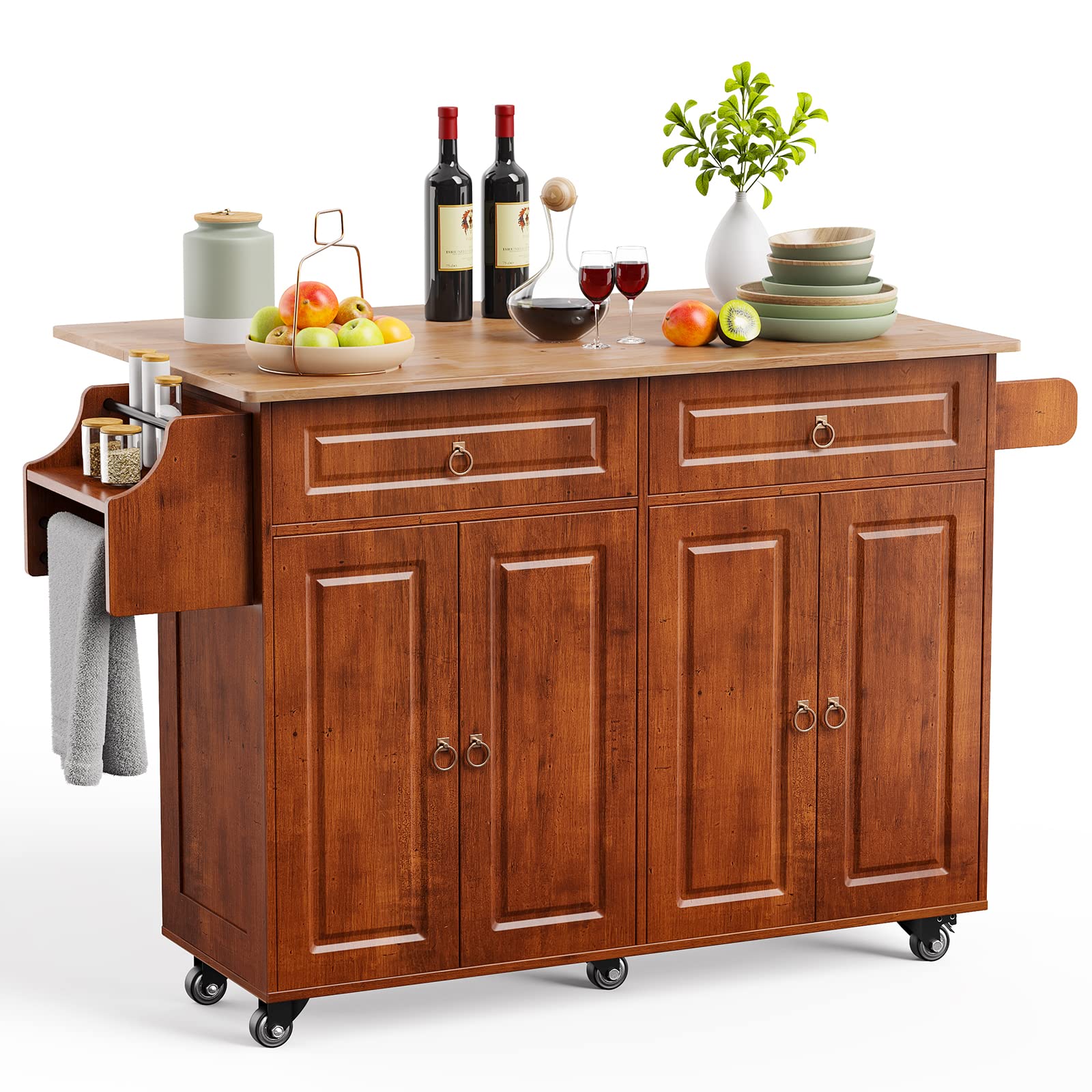
Twenty-two inches of counter depth is what settled this one for us. Most of the rolling carts in this group run 17 to 18 inches front to back, which is enough for a plate and a mug and not much else. This one measures 46 inches wide, 22 deep and 36 tall, so the work surface sits level with standard counters and there is room for a board, a bowl and whatever is going into the pan.

The storage backs the surface up. Three drawers, a double-door cabinet with an adjustable shelf, and an open shelf at each end, so the everyday things stay out and the rest disappears behind a door. We were struck by the soft-close hinges at this level: a door that eases shut instead of banging matters when someone is working right beside it.

The 507-pound rating is high enough that a microwave and a stand mixer do not make you think twice. And the casters tuck under the base rather than sitting on display, so from across the room it reads as a cabinet that happens to move, which is the whole point of a rolling island in a room you also live in.

The back panels are the weak point, thin sheet goods that flex under a hand. Against a run of cabinets that never comes up. In the middle of a room, where the back is on show, think about what faces it before you assemble, because you will not want to take it apart again.

Bottom Line: For most kitchens this is the island we recommend: 22 inches of counter depth, three drawers and a cabinet, and casters tucked out of sight.
#2

Best for a Breakfast Bar

Homestyles Dolly Madison Island

Homestyles Dolly Madison Island

9.1/10 Outstanding
  • Height: 36 inches
  • Storage: 3 drawers, 2 adjustable shelves
  • Drop Leaf: Folds up for a breakfast bar
  • Counter Size: 53"W x 18"D
Check Price on Amazon

Pros

  • Drop leaf adds a breakfast-bar surface
  • Three drawers plus two adjustable shelves
  • Casters let a 134-pound island move
  • Instructions people get through without swearing

Cons

  • 134 pounds, so it rarely moves once placed
  • The drop leaf is the first part to sag

A drop leaf is what separates an island that eats floor space from one that pays rent. Folded, this is a 53-inch cabinet run sitting against a wall. Lifted, it becomes a breakfast bar with room for a plate, a laptop or the serving dish you have nowhere else to put. The leaf is the design here, not an accessory bolted on afterwards, and that shows in how the whole piece hangs together.

Behind it you get three drawers, two adjustable shelves, a spice rack and a towel bar on the ends, all on four swivel casters. In off-white with a natural wood top it is the most traditional island in this group and the one that best pretends to be built in. If the island has to earn its keep at breakfast as well as at dinner, this is where we point you.

It is a project to build. There are a lot of parts, the instructions ask you to read before you start, and two people turn it into an afternoon rather than an ordeal. Check the box before the first screw goes in: a door that will not hang flush is far easier to sort out while the cabinet is still flat on the floor. And keep weight off the leaf edge once it is up, because an extended leaf is always the part that sags first.

Bottom Line: Buy this one if the island doubles as a place to eat: the drop leaf earns its keep, and there are three drawers and two shelves behind it.
#3

Best Value

VASAGLE Kitchen Island

VASAGLE Kitchen Island

9.3/10 Outstanding
  • Height: 35.4 inches
  • Storage: 3 open shelves
  • Load Rating: 66 lb
  • Counter Size: 47.2"W x 23.6"D
Check Price on Amazon

Pros

  • Largest worktop here at the lowest price
  • Counter height with adjustable feet
  • Steel frame and three deep shelves
  • Straightforward assembly with labelled parts

Cons

  • 66-pound maximum limits what stays on it
  • Open shelves leave everything on display

Forty-seven inches wide, 23.6 deep and 35.4 tall: on paper this is the biggest work surface in the group, and it is also the least expensive thing here. The frame is steel, the shelves are particleboard, and adjustable feet take up the wobble on a floor that is not quite level, which is the sort of detail that saves an argument.

What the money does not buy is a door. Three open shelves and a top, so every bag of flour and every appliance is on display, and a set of baskets is the fix if that wears thin. The load rating is the other number to know: 66 pounds, which covers a stand mixer and not a great deal more. If the top is where a microwave lives, one of the heavier-rated picks will suit you better.

None of that changes what it is: the cheapest way to get a counter-height worktop that two people can stand at. For a first apartment, a rental kitchen or a basement prep area it does the job and leaves budget for a stool. Inspect the top before you build, because the flat-pack arrives with the surface exposed and a marked top is much easier to sort out before assembly than after.

Bottom Line: The cheapest route to a full-size, counter-height worktop. We recommend it for first apartments and tight budgets, provided open shelves suit you.
#4

Best Expandable Counter

Qsun Rolling Kitchen Island

Qsun Rolling Kitchen Island

9.0/10 Outstanding
  • Casters: 5 wheels, 2 with brakes
  • Storage: 2 drawers, 2 double-door cabinets
  • Counter Size: 45.5"W x 17.5"D
  • Expandable Top: Rubberwood leaf extends the counter
Check Price on Amazon

Pros

  • Expanding rubberwood top handles big jobs
  • Five casters, one centred for stability
  • Two drawers and two double-door cabinets
  • Water- and stain-resistant work surface

Cons

  • 17.5-inch depth leaves little prep room
  • Sparse picture-only instructions

At 17.5 inches deep, this cart asks you to give something up. A cutting board fits. A board plus a bowl plus the thing about to go in the pan does not. If your kitchen is a corridor and the island's job is to add a landing strip rather than a second range, that trade is the right one, and this is the cart we point to for that kitchen.

The top is rubberwood, finished to shrug off water and stains, and it extends when a batch of dough or a birthday cake needs more room than the base allows. Five casters, one of them set in the middle of the base, keep it from rocking. Inside there are two deep drawers and two double-door cabinets, with a spice rack and a towel bar on the ends, which is a lot of storage in a shallow footprint.

Once it is together it reads as furniture rather than a cart, and the wood-and-brown finish is the reason. Set aside an afternoon for the build and keep the installation video to hand, because the diagrams carry most of the information and the video fills in the rest. Do not start it at nine in the evening expecting to be finished by ten.

Bottom Line: We like this one for a narrow kitchen: 17.5 inches deep, an expanding top, and five casters so it tucks away between uses.
#5

Best Stainless-Steel Top

Boraam Sonoma Kitchen Cart

Boraam Sonoma Kitchen Cart

9.2/10 Outstanding
  • Height: 35.75 inches
  • Storage: 2 drawers, 1 shelf
  • Counter Size: 45"W x 20.5"D
  • Top Material: Stainless steel
Check Price on Amazon

Pros

  • Barnwood finish and stainless top look expensive
  • Drawer section arrives pre-assembled
  • 64 pounds moves easily on its casters
  • 200-pound cart rating and 50-pound shelves

Cons

  • Stainless top marks and scratches
  • One shelf behind two drawers

Barnwood wire-brushed sides and a stainless-steel top: of everything here, this is the piece that looks least like flat-pack. It is 45 inches wide, 20.5 deep and 35.75 tall, with two drawers, a shelf underneath and a towel bar on the end, and at 64 pounds one person can move it without clearing the room first.

That combination is why it earns a place. If the island sits where guests see it, this is the one we point to, and the wire-brush finish hides the everyday scuffs a painted cart shows. The trade is the top. Stainless marks and scratches and does not pretend otherwise, so put a board under the knife and accept that a working surface will look worked on. Storage is the other compromise: one shelf behind two drawers goes less far than the three-drawer carts here, which makes this a surface-first island.

Bottom Line: Our pick when the island is visible from the sofa: the barnwood finish and stainless top carry a room, and 64 pounds means you can shift it.
#6

Best for Tight Kitchens

Casual Home Kitchen Island

Casual Home Kitchen Island

8.9/10 Excellent
  • Height: 36.5 inches
  • Storage: 1 drawer, 2 shelves
  • Counter Size: 40"W x 20"D
  • Top Material: Solid American hardwood
Check Price on Amazon

Pros

  • 40 inches wide fits a tight run
  • Solid hardwood top at a budget price
  • 38 pounds, so one person can move it
  • Stated limits for top, shelf and drawer

Cons

  • Finish chips and scratches with use
  • Drawer rated for only five pounds

Forty inches is the number that matters. Every other full-height island in this group runs 45 inches or more, so this one slots into a run where the others would block a doorway or trap a cupboard. At 38.2 pounds it is also the lightest of the full-size picks, which means one person can slide it out when the floor needs sweeping.

The top is solid American hardwood, which is unusual at this end of the range, and the base is painted white around a single drawer and two shelves. The capacity is spelled out plainly for once: 100 pounds on the top, 50 on a shelf, 5 in the drawer.

For a small kitchen this is the sensible buy, and the honest caveat is the finish. Painted board and a wood top both chip and scratch, and a kitchen island takes knocks from saucepans and chair backs and keys. The drawer is the other small thing: five pounds is a cutlery tray, not a junk drawer. Neither is a reason to walk away at this size, but know both before the first scratch appears rather than after.

Bottom Line: Forty inches wide is the reason to buy it: this is the island for a kitchen that cannot spare a foot, and the hardwood top is a real one.
#7

Best with Built-In Power

IRONCK Kitchen Island

IRONCK Kitchen Island

8.6/10 Excellent
  • Power: 1 AC outlet, 2 USB ports
  • Height: 35.05 inches
  • Drop Leaf: 11.4-inch extension
  • Counter Size: 47.25"W x 15.35"D
Check Price on Amazon

Pros

  • Built-in outlet and two USB ports
  • 11.4-inch drop leaf adds surface
  • Three drawers plus a door cabinet
  • Wheels make it easy to reposition

Cons

  • 15.35-inch depth is the shallowest here
  • Drawers can bind on their runners

An outlet and two USB ports at counter height changes how a kitchen works: the blender, the Instant Pot and the phone charger stop competing for the socket behind the toaster, and nothing has to be unplugged to make room. No other island in this group has power built in, which is why it stays on the list despite a few rough edges.

The rest is built around a narrow footprint. The main counter is 35.4 inches wide and 15.35 deep, and a drop leaf adds 11.4 inches when you need it, enough for a serving dish or a laptop but not for a rolling pin. This is the shallowest island here, and that is exactly why it fits where a 22-inch-deep cart will not.

The build takes patience. Parts are labelled, the diagrams are not always clear, and how long it takes depends on the day, so plan an afternoon and a second pair of hands. Test the drawers in the first week: if one binds on its runner, deal with it while a return is still simple rather than after the packing has gone out with the recycling.

We recommend it for the kitchen where the island is also the appliance counter, whether that is a rental, a basement suite or a galley with two sockets to its name. The power is worth the compromises it costs. Strip the outlets out and this would be a middling cart with a narrow top; with them, it solves a problem the bigger picks ignore.

Bottom Line: It has an outlet and two USB ports, which no other island here does, and that alone justifies it in a kitchen short of sockets.
#8

Narrow dining rooms

FINETONES 52-Inch Kitchen Island

FINETONES 52-Inch Kitchen Island

8.9/10 Excellent
  • Casters: 5 wheels, 2 with brakes
  • Storage: 2 drawers, cabinets, side rack
  • Drop Leaf: Folding counter extension
  • Counter Width: 52.4 inches
Check Price on Amazon

Pros

  • 52-inch counter on five casters
  • Drawers, cabinets and a side rack
  • Folding leaf frees floor space
  • Spice rack sized for six jars

Cons

  • Only two of the five casters brake
  • Door magnets are a weak detail

Fifty-two inches of counter is a lot of island, and this one is aimed at the dinette or the long wall where a table would be too much. The folding leaf is the reason it works: up, it is a serving and prep run with space for dishes at one end; down, you get the floor back and the room stops feeling crowded.

Storage is generous at this price. Two wide drawers, shelves behind doors on both sides, a side rack with shelves at different heights, and a spice rack and towel bar on the ends. The green finish reads better than the board underneath it, which is the main thing you are paying for at this level.

The casters are the weak point. Two of the five brake, and on a hard floor the island can still pivot when you lean on a corner, so park it against something solid if you plan to chop on it. It is also a big body at 106 pounds, and it wants a wall rather than open floor.

As an also-consider it fills a gap nothing else here covers: a genuinely long counter that rolls. Check the door magnets when it arrives, because a door that swings open on its own is the kind of detail that nags for years. For a dinette that needs a sideboard, a prep surface and a bar in one footprint, it is a lot of furniture for the money.

Bottom Line: A 52-inch counter on casters for a dinette or a long wall, and the leaf folds away when the room needs the floor back.

How We Tested Kitchen Islands

We started by researching islands across sizes and configurations, then narrowed the field by footprint, counter height, storage layout, and materials. We ended up with 12 units and lived with each for several weeks over a nine-month testing period.

Every island arrived in boxes, so we noted the condition of the packaging and checked each part against the hardware list before assembly. We built each one solo with the included tools, timing the process and noting unclear instructions, missing pilot holes, and steps that really needed a second person. Once built, we loaded shelves and drawers with pots, small appliances, and pantry odds and ends, then measured how much clear counter remained for chopping. We checked the footprint against a normal walking path and whether the island left enough room for doors, drawers, and stools to open without trapping anyone.

We rolled each island across tile and wood, over thresholds, and through tight turns, noting whether the casters tracked straight and whether the weight made moving awkward. We tested wheel locks by leaning and kneading on top, and we wiped up oil, water, and red wine, set down hot pans on trivets, and checked edges and finishes after weeks of daily use for dents, scratches, swelling, or staining. At the end, we compared what each island actually offered against the rest of the field to judge value.

How to Choose Kitchen Islands

Height and depth come first

Standard counters are 36 inches, and the islands here run from 35.05 to 36.5, close enough that any of them lines up with your kitchen. Depth is where they part company. Under 18 inches you have a landing strip: a plate, a mug, the blender, nowhere to put a cutting board. Twenty inches and up is a surface you can stand at and work.

If the island will be the only place you prep, buy the depth and accept the floor it takes. If it is somewhere to put things down on the way past, a shallow cart keeps the room walkable, and that is a real trade rather than a compromise.

Decide what has to disappear

Drawers and doors cost more than shelves, and they are what stops a small kitchen looking like a shop. Count the things you want out of sight, the flour and the air fryer and the cables, and buy for that number rather than for the shelf count.

Open shelving is the cheaper buy and it works when you have baskets and the discipline to use them. If you do not, three drawers will make you happier than four shelves, and the difference in price is smaller than the difference in how the room feels.

Measure the run and the doorway

Width is where people get caught, because an island has to leave a walkway. Kitchen designers aim for roughly 36 to 42 inches of clear floor between an island and the counters; below that, two people cannot pass and the drawers cannot open.

Then measure the door. The heaviest island here is 134 pounds and the lightest is 38, and a flat carton that size does not go up a narrow stair without a plan.

What caster brakes actually do

Most carts here brake two of their wheels, which stops the island rolling away but leaves it free to pivot when you lean on a corner. On tile or wood you notice that the moment you start chopping.

If the island lives in one place, park it against a cabinet run and treat the wheels as a way to pull it out for cleaning. If it moves daily, put it back against something before you put weight on the edge.

Budget an evening for assembly

Flat-pack is the norm, and the instructions are often pictures only. Two things make the job painless: check every part against the list before you start, and fit the drawers and doors last, with the unit already standing where it will live.

Allow an evening for a full-size island and an hour for a small cart. A cordless driver and a second pair of hands cut both times roughly in half.

Frequently Asked Questions

Final Verdict

Most kitchens should buy the Yaheetech. Twenty-two inches of depth is the difference between an island you prep on and one you pile things on, and the drawers, cabinet and soft-close doors make it a piece of furniture rather than a shelf on wheels.

If the budget is the binding constraint, the VASAGLE gives you the biggest worktop here for the least. If the island has to seat somebody at breakfast, the Homestyles Dolly Madison is built around that job in a way nothing else on this page is.