Kitchen

Best Kitchen Shelving Units of 2026

Open shelving is one of the few kitchen upgrades that looks good and actually earns its keep — the stand mixer, the cereal boxes, and the stack of sheet pans finally have somewhere to live that isn't the countertop. Then a shelf sags in the middle, or the whole unit wobbles when you pull a can off the top, and you remember why people hide their storage behind cabinet doors. A shelving unit isn't glamorous; it just solves a real problem: too much stuff, too few flat surfaces, and a gap against the wall that's narrower than you'd like.

I've measured more kitchen walls than I'd like to admit, and the units that hold up are rarely the prettiest ones — they're the ones sized correctly. Over the past eight months, my team and I assembled, loaded, and rearranged 12 shelving units, from slim metal towers to freestanding wood etageres, in galley kitchens and walk-in pantries alike. The most common mistake is reading a weight rating as a total; it's almost always per shelf, and it assumes the load is spread evenly. Start with your measurements, then work down the list.

#1

Best Overall

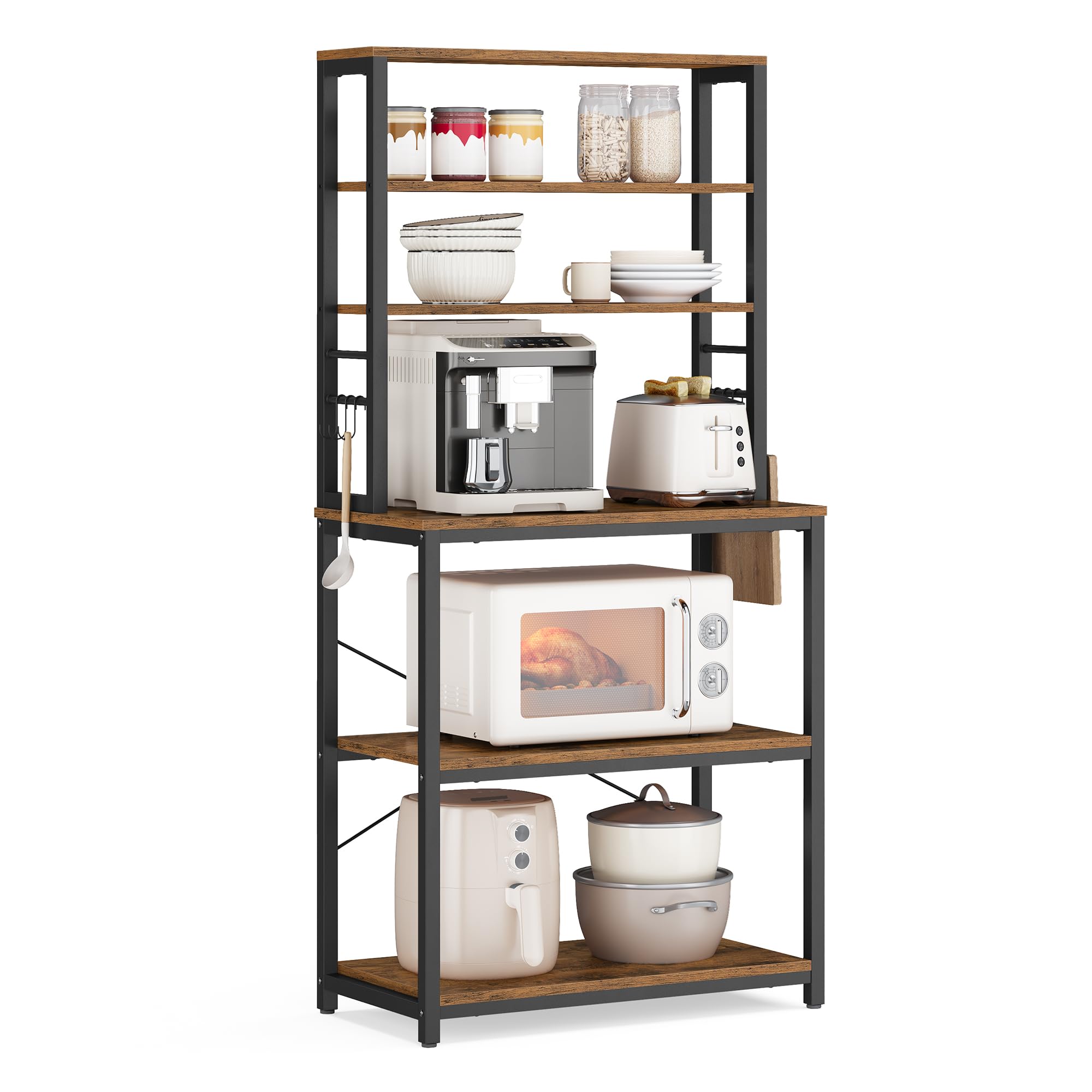
SUPERJARE 4-Tier Baker's Rack

SUPERJARE 4-Tier Baker's Rack

9.3/10 Outstanding
  • Hooks: 6 S-shaped hooks
  • Power: 2 outlets with air switch
  • Footprint: 16.5"D x 23.6"W x 50.6"H
  • Shelf Capacity: 80 lb
Check Price on Amazon

Pros

  • Two outlets and a switch on the frame
  • Fits a 23.6-inch wall strip
  • Shelf bays re-pin for tall appliances
  • Six hooks keep utensils off the shelves

Cons

  • Back-mounted outlet and short cord limit placement

Two outlets and a push-button switch are built into the back rail, and that single detail is why this rack tops our list for a kitchen. Counters fill with a coffee maker, a toaster, and an air fryer, while the wall socket sits behind the fridge or under the window where nothing useful reaches. Power on the rack moves the appliances to it instead of the other way round.

The footprint makes the second half of the case. At 16.5 inches deep, 23.6 inches wide, and 50.6 inches tall, it fits the strip of wall between a doorway and the fridge that nothing else uses, and it hands the counter back for chopping. We liked the shelf fixings more than we expected to: they pin at several set heights, and one bay can be left open so a mini-fridge or a tall mixer has room.

Six S-hooks hang off the frame, which reads as filler until you are using them daily for mugs, a ladle, and oven gloves. Assembly is quick, with numbered parts and a sequence that does not need interpreting. The load rating of 80 pounds per shelf covers a microwave, a coffee station, and jars of dry goods comfortably; cases of drinks want a heavier rack.

Bottom Line: For most kitchens this is the shelving unit we point people to: two outlets, shelf spacing that takes a real appliance, and a footprint that fits a wall strip you already have.
#2

Best for a Large Kitchen Wall

SUPERJARE 35.4-Inch Baker's Rack

SUPERJARE 35.4-Inch Baker's Rack

9.4/10 Outstanding
  • Power: 3 AC outlets plus on/off switch
  • Shelves: 7
  • Footprint: 15.6"D x 35.4"W x 60.4"H
  • Item Weight: 43.1 lb
Check Price on Amazon

Pros

  • Half again as wide as our top pick
  • Three outlets plus an on/off switch
  • Spice-height shelves over open appliance bays
  • Wood finish that reads as furniture

Cons

  • Needs about three feet of clear wall
  • 43-pound flat pack is best built in place

Half again as wide as our top pick, this is the rack for a kitchen with a genuinely empty wall. At 35.4 inches wide and 60.4 inches tall, it turns that wall into seven shelves of jars, pans, and machines, with three outlets and an on/off switch built into the frame.

The shape matters as much as the width. Two shallow upper shelves are sized for spice jars and mugs, and the open bays below take a microwave, an air fryer, and a toaster side by side — roughly what a small appliance counter holds. If the air fryer currently lives on the draining board, this is the piece that gets it off.

It is a two-person build. The unit ships at about 43 pounds and the frame goes together far more easily where it will stand than up a stairwell afterwards. Of the wide racks here it is also the best-looking, with the rustic brown boards doing most of that work.

Bottom Line: Buy this one when the wall is genuinely wide: it replaces a counter's worth of appliances and puts three outlets plus a switch where the machines stand.
#3

Best Budget Wire Rack

Amazon Basics 5-Shelf Steel Rack

Amazon Basics 5-Shelf Steel Rack

9.2/10 Outstanding
  • Footprint: 13.4"D x 23.2"W x 60"H
  • Shelf Capacity: 200 pounds, evenly distributed
  • Total Capacity: 1,000 pounds
  • Shelf Adjustment: 1-inch increments
Check Price on Amazon

Pros

  • 200 pounds per shelf, 1,000 total
  • No-tool assembly, about 15 pounds
  • Narrow 23-inch width fits odd gaps
  • Shelves adjust in 1-inch increments

Cons

  • No wall anchor in the box

Volume on a budget is this rack's whole argument. Five wire shelves, 13.4 inches deep and 23.2 inches wide, on a 60-inch frame that weighs about 15 pounds and goes up without tools — the leveling feet are the only hardware you touch.

Wire is the right surface for pantry overflow: you can see what is running low on the shelf above, air moves through, and 200 pounds per shelf is more than most kitchens will ever ask. The trade is that small jars need a tray, and anything that spills sifts down onto the shelf below. It is at its steadiest against a wall with weight on the lowest shelf, and the 1-inch steps let you keep the heavy rows down there.

Where it earns its place is the utility end of the kitchen — sacks, cans, the appliances that come out once a week — without a big spend. What it is not is a rack that feels rigid on its own; it wants a wall behind it and something heavy on the bottom shelf before it stops feeling springy.

Bottom Line: We recommend it for pantry overflow and utility corners: cheap, light, and rated for far more than most kitchens ever put on a wire shelf.
#4

Best Heavy-Duty

UltraDurable 5-Tier NSF Wire Rack

UltraDurable 5-Tier NSF Wire Rack

9.1/10 Outstanding
  • Footprint: 24" W x 18" D x 72" H (75" H with wheels)
  • Certification: NSF/ANSI Standard 2
  • Capacity On Feet: 800 pounds per shelf
  • Capacity On Wheels: 500 pounds total
Check Price on Amazon

Pros

  • NSF/ANSI 2 food-equipment certification
  • 800 pounds per shelf on leveling feet
  • 3-inch casters and a 10-year warranty
  • Shelves adjust in 1-inch steps

Cons

  • 18-inch depth takes more floor
  • Total load drops to 500 pounds on wheels

NSF certification is what separates this rack from every other wire unit here. It is certified to NSF/ANSI Standard 2 for food equipment in dry environments — the listing a restaurant supply house looks for — so it is built to hold food storage, not just garage boxes. On leveling feet it is rated for 800 pounds per shelf and 4,000 pounds for the whole unit.

We trust it with the heavy end of kitchen storage: cases of jars, cast iron, the stand mixer that never leaves the counter. The 3-inch casters are the best here by a distance, and a 10-year warranty is the longest in this group. Check the shelves for dents the day the box arrives, since heavy steel like this takes knocks in transit, and settle the feet-or-wheels question before you load a single shelf.

Bottom Line: This is the rack we trust with the heavy shelves: an NSF food-equipment listing and 800 pounds per shelf when it stands on its feet.
#5

Best Tall Narrow Rack

VASAGLE 6-Tier Coffee Bar

VASAGLE 6-Tier Coffee Bar

9.3/10 Outstanding
  • Shelves: 6
  • Included: 6 S-hooks, anti-tip kit
  • Footprint: 15.7"D x 23.6"W x 65.7"H
  • Max Weight Capacity: 85 lb
Check Price on Amazon

Pros

  • Six tiers on a 23.6-inch width
  • Anti-tip kit and six S-hooks included
  • Middle shelf adjusts to two heights
  • Assembly reported as quick and clear

Cons

  • Top tiers sit above eye level for shorter cooks

Sixty-five inches of rack on a footprint barely wider than a dishwasher door — that is the trade this one makes. It is 23.6 inches wide and 15.7 inches deep, so it goes in the slot beside the fridge or the gap at the end of a cabinet run, and it grows upward instead of out.

Six tiers give you more separate surfaces than anything else here at this width, and the middle lower shelf moves between two heights so a blender or an air fryer fits. The rustic brown boards on the black frame are why it reads as furniture in a kitchen rather than as utility shelving.

The listed maximum is 85 pounds, which puts it in light-duty territory: jars, boxes, mugs, and small appliances rather than cases of drinks. At this height the anti-tip kit in the box is not optional — fix it to the wall — and the adjustable feet take up the slope in an old floor.

What we appreciated most was how little fuss the build is: labeled parts, a clear sequence, and hooks already in the box for mugs and utensils. The two-position shelf and the anti-tip bracket are single lines on a specification sheet that change how the thing gets used, and that is more than most racks at this width manage.

Bottom Line: If your only free space is a narrow vertical slot, this six-tier rack earns it: anti-tip kit included, shelf spacing that takes a blender, and a finish worth showing.
#6

Best Shallow-Depth Pantry Rack

Sakugi 5-Tier Metal Shelf

Sakugi 5-Tier Metal Shelf

8.9/10 Excellent
  • Shelves: 5
  • Footprint: 12.6"D x 33"W x 72"H
  • Tube Diameter: 0.9 inches
  • Weight Capacity: 1,000 pounds total
Check Price on Amazon

Pros

  • Fits a 12.6-inch-deep wall strip
  • 1,000 pounds total capacity
  • Leveling feet handle uneven floors
  • Goes up rather than out at 72 inches

Cons

  • Fixed tier heights restrict tall items
  • Wobbles until loaded and leveled

At 12.6 inches deep, this rack goes where most shelving will not: the shallow wall beside a pantry door, the strip behind a utility room door, the closet that was never deep enough for a proper shelf. Thirty-three inches wide and 72 inches tall gives it a lot of surface for the floor it takes.

The frame is 0.9-inch steel tube with a 1,000-pound total rating, so it carries more than the depth suggests, and the leveling feet deal with a floor that slopes. Assembly is a one-person job with the supplied hardware and illustrated instructions.

We found it lands best as a pantry or utility rack rather than a display piece: the wire is fine enough that cans sit flat, the black finish disappears against a wall, and the height turns a strip of dead wall into five shelves. Measure your tallest box before the build, because on this one the tiers only go where the frame says they go.

Bottom Line: A shallow, tall rack for the strip of wall beside a pantry door: it holds far more than its depth suggests, as long as your tallest box fits the fixed gaps.
#7

Best for Tiny Spaces

Sakugi 3-Tier Metal Shelf

Sakugi 3-Tier Metal Shelf

9.1/10 Outstanding
  • Feet: Adjustable leveling feet
  • Shelves: 3
  • Footprint: 12"D x 18"W x 30"H
  • Shelf Capacity: 100 lb
Check Price on Amazon

Pros

  • Fits under a 36-inch counter at 30 inches tall
  • 100 pounds per shelf
  • Light enough to move assembled
  • Leveling feet for uneven floors

Cons

  • Three tiers only, so capacity is limited

Thirty inches tall and 18 inches wide, this is the rack we reach for when there is no wall left — beside the washer, under a window, in the corner where the bin used to live. Three wire tiers, 12 inches deep, leveling feet, and a flat pack you can carry in one hand.

Each shelf is rated to 100 pounds, enough for a row of appliances or a stack of laundry supplies, and the grid is dense enough that cans sit without tipping. Be clear about the scale before you order: 18 inches wide is narrower than most people picture, so tape the footprint on the floor first — and if the space turns out bigger, the five-tier Sakugi rack gives you two more tiers on the same 12-inch depth.

Bottom Line: For a nook, a laundry corner, or the gap beside a counter, this little three-tier rack does real work without claiming much floor.
#8

Kitchen overflow

Seville Classics 5-Tier Wire Rack

Seville Classics 5-Tier Wire Rack

9.2/10 Outstanding
  • Wheels: 1.5-inch casters, 2 locking
  • Footprint: 30" W x 14" D x 61.5" H
  • Shelf Capacity: 300 lb
  • Capacity On Wheels: 110 pounds total
Check Price on Amazon

Pros

  • 1,500 pounds total on leveling feet
  • Casters and leveling feet both included
  • 10-year limited warranty
  • 30-inch width suits tight runs

Cons

  • Narrow 14-inch shelves limit bulky items

The casters are the reason to look at this rack and the reason to read its rating twice. On leveling feet the unit carries 1,500 pounds; on its 1.5-inch wheels the total drops to 110 pounds. Roll it to the spot empty, drop the feet, then load it — that sequence is the whole trick.

Thirty inches wide and 14 inches deep, it slips onto a laundry wall or the end of a counter run where a deeper rack would block the walkway. Five shelves adjust in 1-inch steps and each is rated for 300 pounds on the feet, and the plated finish is the plain, bright kind that does not pretend to be furniture.

The 10-year warranty is the longest on this page, and both the casters and the leveling feet come in the box, so you choose at assembly. One person can put it together without tools.

Where it lands for us is kitchen overflow that has to move: the extra case of drinks, the bread maker, the vacuum sealer. It gives away load to the heavy-duty NSF rack and shelf count to the baker's racks, but it rolls, and in a kitchen that gets rearranged that counts for more than another hundred pounds of headroom.

Bottom Line: For kitchen overflow that needs to move, this is the rack: put it on its feet to load and keep the casters for the days you want the floor back.

How We Tested the Best Kitchen Shelving Units

We started with the specs that actually matter in a kitchen: listed width, depth, and height, per-shelf weight rating, material, and whether shelf spacing could be changed after assembly. From there we filtered down to 12 units that spanned the real range of what shoppers choose between — slim metal towers, modular cube systems, leaning ladders, and freestanding wood etageres — while keeping an eye on whether the price felt justified by what came in the box.

Every unit was assembled from scratch by one person using only the included hardware, with a timer running. We noted how long it took, whether the instructions held up past the halfway point, and whether the finished frame felt solid or shifty in the hand. Then we loaded them the way a kitchen actually loads things — a 12-place dinnerware set on one shelf, canned goods and a stockpot on another, nothing arranged neatly — and gave each one a firm nudge to see how much it moved.

Over eight months we adjusted shelf heights twice, slid heavy pans across the surfaces to check for chipping, and measured each unit's real footprint against its listed dimensions, since half an inch of depth is the difference between clearing a countertop overhang and not. We also watched how the finish held up to splashes and wipedowns, and whether the storage capacity we'd counted on paper survived contact with actual groceries.

How to Choose Kitchen Shelving Units

Start with the footprint, not the shelf count

Width and depth decide whether a rack is useful at all. Tape the footprint on the floor, then open the fridge, the oven, and the pantry door across it. A rack two inches too wide is one you walk around for years. Depth matters just as much in a kitchen: 12 to 14 inches suits cans and small appliances, while 18 inches — the depth of our heavy-duty pick — starts to crowd a walkway.

Then measure the tallest thing that will live on it. A stockpot, a stand mixer, and a microwave each set a different gap, and the gap is what makes a shelf usable or decorative.

Wire shelves or solid shelves

Wire is cheaper per shelf, lets light and air through, and suits pantry stock because you can see what is running low. It is worse for small jars, which tip and drop through the gaps, and for anything that spills. Solid shelves — wood-topped racks and laminated metal units — give you a work surface and hide clutter, at the cost of more weight and a wipe-down.

Read the load rating properly

Per-shelf ratings assume weight spread evenly, and the total rating is the number that matters once all five shelves are full. Casters are where the arithmetic gets rude: our Seville rack carries 1,500 pounds on its feet and 110 pounds on its wheels.

Buy for what you will realistically store. Jars and boxes weigh less than people assume; the heavy items are appliances, drinks, and bulk dry goods. Leave margin, and treat any per-shelf figure as a ceiling rather than a target.

Height, reach, and anchoring

A tall rack adds storage without adding floor, which is why a 72-inch unit on a 12-inch depth can be the most efficient thing in a small kitchen. The cost is reach: the top shelf becomes storage for the things you use monthly, not daily.

Anything much over five feet on a narrow base needs fixing to the wall. Some racks here include an anti-tip kit or wall bracket; the rest expect you to supply a strap, so check the box contents before you decide where it goes.

Decide whether you want power on the rack

An outlet strip in the frame is worth paying for when the rack will hold the coffee maker, the toaster, and the air fryer and the nearest wall socket is behind the fridge. Two checks before you buy: the cord has to reach a socket without an extension lead across a doorway, and a unit with a power box on the back sits a little off the wall. If the appliances live in a pantry and come out to the counter, skip the outlets and spend the difference on capacity.

Frequently Asked Questions

Final Verdict

The SUPERJARE rack with the built-in outlets is the one we recommend first, because it answers the two problems a kitchen actually has: nowhere to stand the appliances and nowhere to plug them in. Its 23.6-inch footprint fits a wall strip you probably already have.

If your free wall runs wider than three feet, the 35.4-inch version of the same design buys considerably more shelf surface and a second and third outlet. And if the job is pantry volume rather than appliances, the Amazon Basics wire rack does it for less, against a wall, with the heavy rows kept low.