Living Room

Best Accent Cabinets of 2026

An accent cabinet gives a dead corner a job — the bar setup that isn't a full bar, the spot by the door where keys and mail land instead of the kitchen counter. It's also where furniture shopping gets quietly frustrating. The listing photo shows two perfectly gapped doors and a styled top; what arrives is 60 pounds of panels and a bag of hinges, and the first door you hang sits a quarter inch low. A good one solves both halves at once: the storage you were missing and a room that finally looks finished.

Eight months of assembling, loading, and living with 12 of them made the gap between a great cabinet and a merely fine one obvious. One thing to know before you shop: measure the wall, then measure what has to go inside. A 14-inch-deep cabinet looks tidy in a listing and then won't swallow a record sleeve or a stack of dinner plates, and no amount of styling hides that. The picks below are the ones that held up in real rooms.

#1

Best Overall

HOSTACK Farmhouse Accent Cabinet

HOSTACK Farmhouse Accent Cabinet

9.2/10 Outstanding
  • Storage: 1 drawer, 2 doors, adjustable shelf
  • Assembly: Flat-pack, numbered parts
  • Top Load: 150 lb
  • Footprint: 15.6" D x 30" W x 33.3" H
Check Price on Amazon

Pros

  • Wide drawer takes real clutter
  • Adjustable shelf behind two doors
  • 150 lb top suits a coffee bar
  • Looks costlier than the price tier

Cons

  • Flat-pack build takes an evening

Thirty inches of width is the reason this HOSTACK is the cabinet we point most people to first. That is the size that fits an entryway wall or the short end of a dining room without crowding either, and at 33.3 inches tall and 15.6 inches deep it stands like a small sideboard rather than a cabinet pushed up against a wall. Behind the two barn doors there is an adjustable shelf; across the top, a full-width drawer.

The drawer is what sells it. It is wider and deeper than the shallow drawers on most cabinets this size, so it takes rolled placemats, napkins and the cord tangle beside the coffee machine in one sweep, and the dark brown finish with quiet grey pulls reads better in a hallway than the product photos suggest. The engineered wood top is rated to 150 pounds, which covers a coffee machine, a grinder and a mug tree with room to spare.

Assembly is flat-pack and does not pretend otherwise: numbered panels, illustrated steps, an evening's work rather than twenty minutes. Build it where it will live, because a 30-inch carcass is awkward to carry once the frame is together. If you want one cabinet that handles an entryway, a dining room or a coffee bar without looking like a compromise, start here.
Bottom Line: We think this is the one to buy first: 30 inches wide, a genuinely useful drawer, and a finish that holds its own in a dining room.
#2

Best for a Long Wall

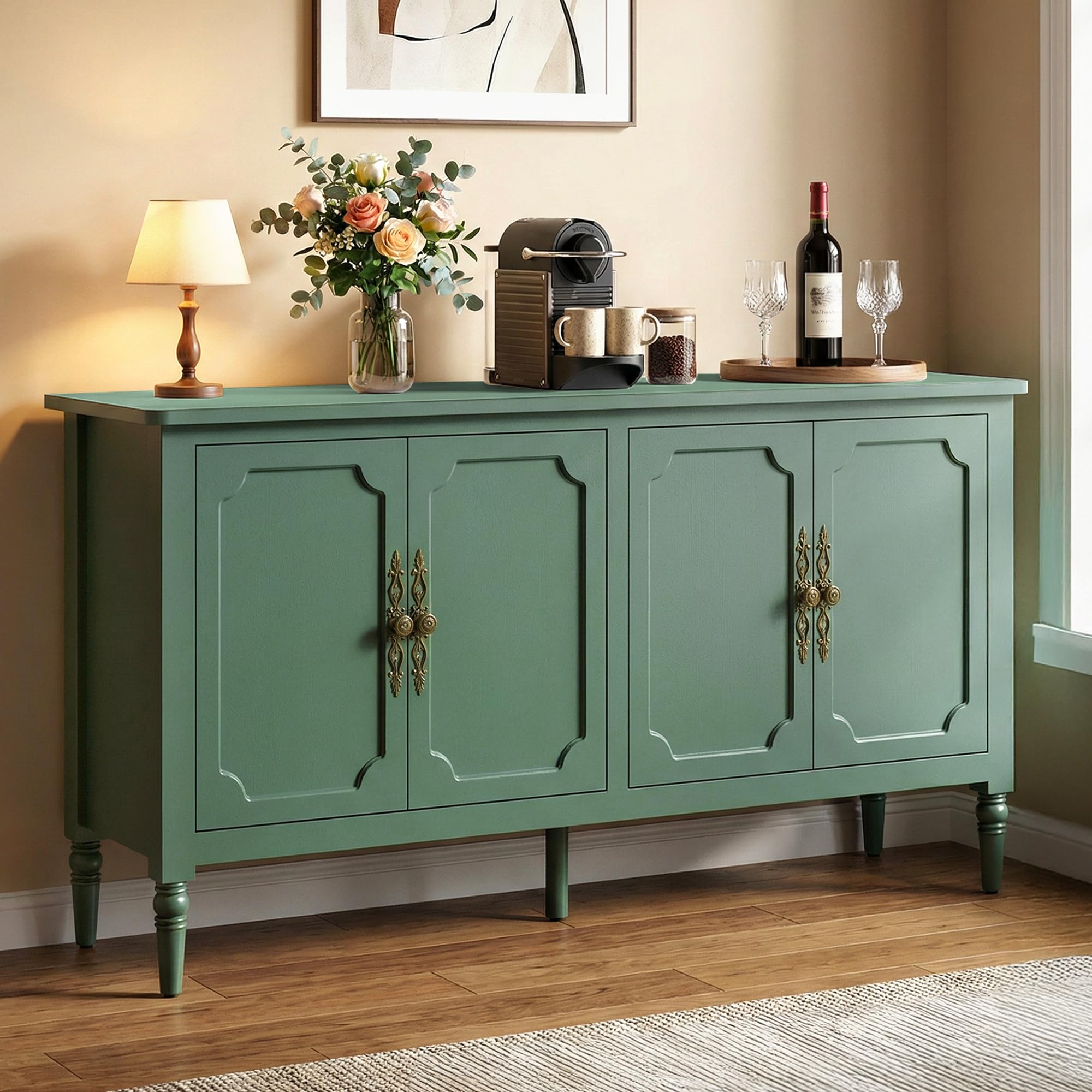
RoyalCraft 59" Buffet Cabinet

RoyalCraft 59" Buffet Cabinet

8.6/10 Excellent
  • Finish: Painted forest green, bronze handles
  • Storage: 4 doors, 2 adjustable shelves
  • Top Load: 200 lb
  • Footprint: 16" D x 58" W x 31" H
Check Price on Amazon

Pros

  • 58 inches fills a long wall
  • 200 lb top rating
  • Green paint and bronze handles
  • Center leg supports the span

Cons

  • Doors can need hinge adjustment

Fifty-eight inches is a commitment, and it is the first thing to settle about the RoyalCraft. Against a dining room wall it behaves like a proper sideboard: four doors, a serving-height top, and enough length that you stop needing a second piece of furniture. At 16 inches deep and 31 inches tall it is a buffet in the traditional sense, not a decorative accent you tuck into a corner.

Inside, two adjustable shelves break the run into four usable bays, and the top is rated to 200 pounds, which is more than anything short of a full bar setup will ask of it. We like the painted forest green best of the finishes here: flat and even, with bronze handles and solid wood legs doing the dressing. A center leg carries the span, so a row of cookbooks will not bow the middle.

It arrives as 76 pounds of flat-pack, and the instructions take studying rather than skimming. Build it in the room and get a second pair of hands for the last stage — a 58-inch carcass is not something to flip over alone on a hard floor. Give the doors a look once it is upright and square rather than judging them on a half-built frame.

Where the wall allows the length, this is the piece that fills it properly, and it does more for a plain dining room than any amount of wall art. Measure those 58 inches twice before you commit; nobody should buy this one hoping it fits.

Bottom Line: This is the one we point to when the wall is long: 58 inches of painted green that makes a bare dining room look finished.
#3

Best for Small Entryways

Ahokua Vintage Accent Chest

Ahokua Vintage Accent Chest

9.1/10 Outstanding
  • Storage: 5 drawers, 1 door
  • Assembly: Arrives assembled, legs only
  • Footprint: 12" D x 22" W x 30.75" H
  • Materials: Pine, MDF, gold hardware
Check Price on Amazon

Pros

  • Arrives assembled apart from the legs
  • Five drawers plus a cabinet door
  • 22-inch width fits tight hallways
  • Sage green, walnut and gold finish

Cons

  • Shallow 12-inch depth limits what fits
  • Premium price for a small cabinet

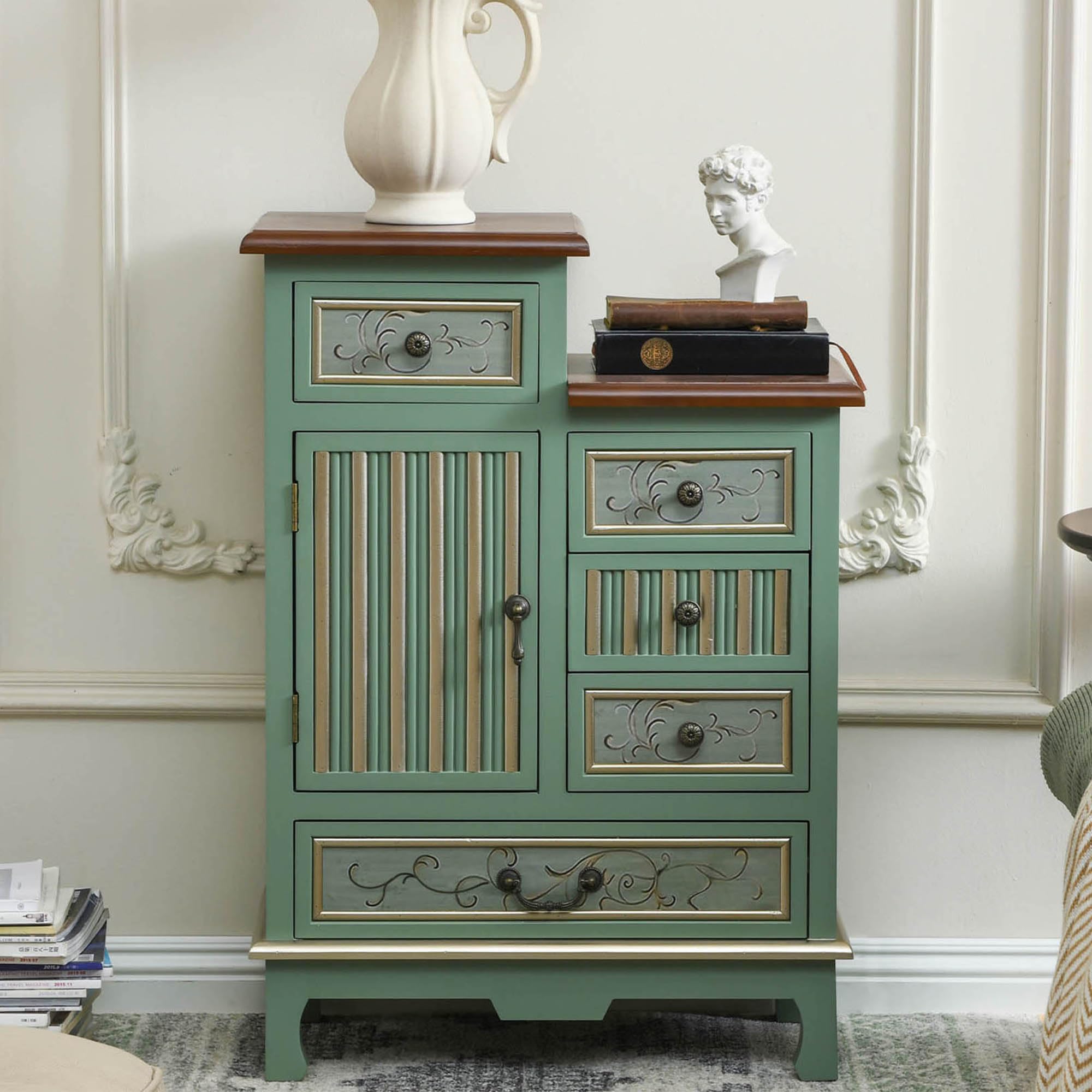
The Ahokua is the one that is finished before you start. It ships assembled apart from the four legs, so unpacking is the whole job — and once it is standing, the sage green body, walnut top and thin gold stripe do something none of the flat-pack pieces here can manage. Five drawers and a single door give it a chest-of-drawers logic: small things up top, bulkier things behind the door. We recommend it for an entryway where 22 inches is all the wall you have and you would rather not spend a Saturday with an Allen key.

The catch is depth. At 12 inches front to back it holds keys, sunglasses, gloves, mail, chargers and a folded throw, but not a stack of dinner plates or a coffee machine. Treat it as an accent piece with a job rather than a sideboard. It is also the smallest cabinet in this guide by a wide margin — measure those 22 inches against the wall before you fall for the finish, because plenty of people are surprised by how compact it looks in a room.

Bottom Line: We recommend it for anyone with 22 inches of hallway and no patience for flat-pack: it arrives built, and five drawers swallow the entryway clutter.
#4

Best for Tight Hallways

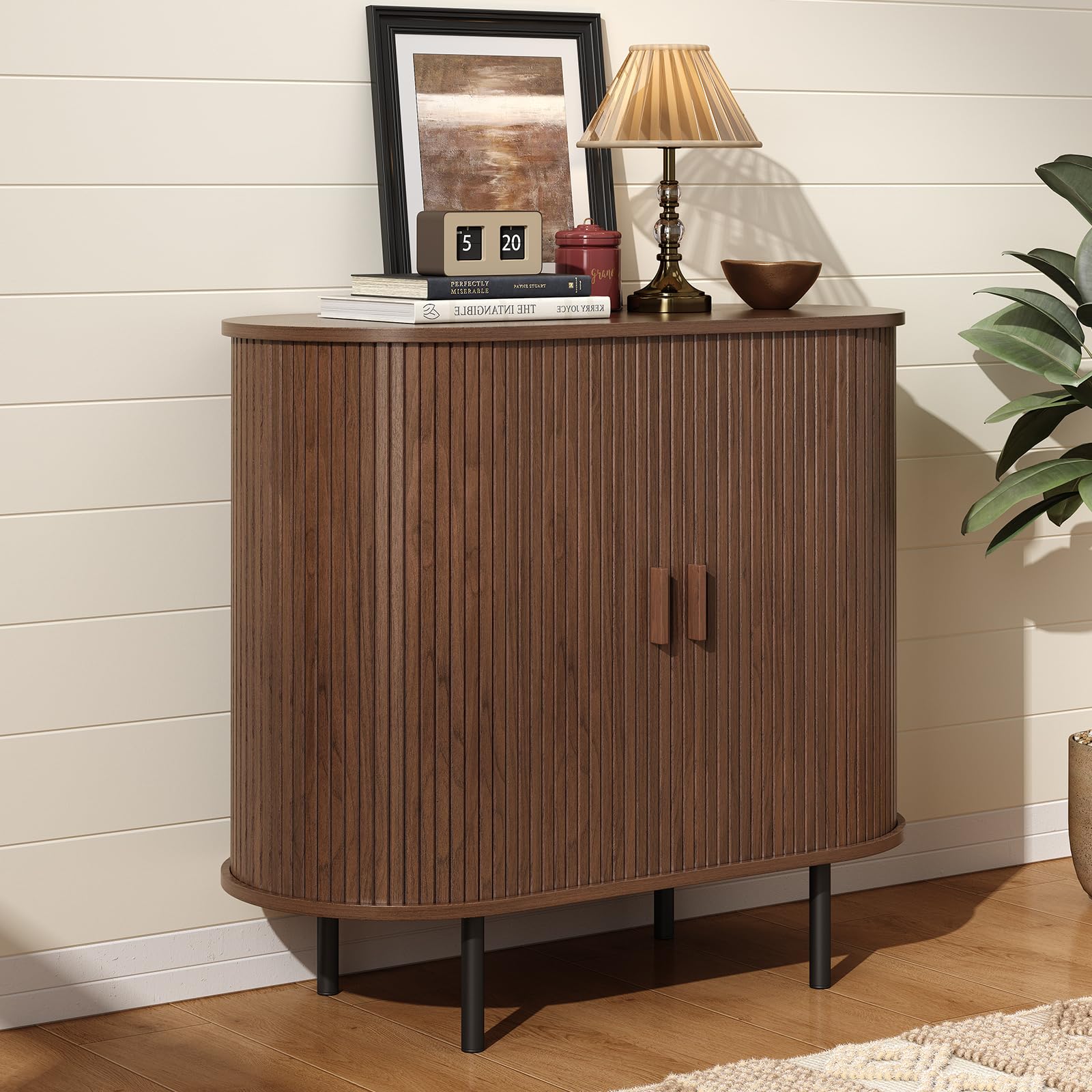
ONBRILL Sliding Door Sideboard

ONBRILL Sliding Door Sideboard

9.0/10 Outstanding
  • Doors: Sliding, curved edges
  • Finish: Walnut, mid-century
  • Storage: 2 compartments, adjustable shelf
  • Footprint: 15.75" D x 31.5" W x 29.53" H
Check Price on Amazon

Pros

  • Sliding doors need no clearance
  • Low 29.5-inch height fits under windows
  • Adjustable shelf and two compartments
  • Walnut finish with curved edges

Cons

  • Sliding doors can drag on the track

A hallway is where doors go to cause trouble. The ONBRILL solves that the simple way: its panels slide in a groove instead of swinging out, so you can park it beside a doorway, a closet or the end of a sofa and still reach everything inside. Curved edges and a walnut finish keep it from looking like a utility solution.

At 31.5 inches wide, 15.75 deep and 29.53 tall, it is the lowest cabinet we recommend here — which is exactly why we like it under a window, beneath a stairwell, or anywhere a 34-inch cabinet would block the light. Inside, two compartments and an adjustable shelf take the usual entryway mix of shoes, bags and umbrellas, and the shelf is deep enough that a wine rack slides in behind the doors.

The trade-off runs the other way too: at just under 30 inches it sits lower than a standard counter, so it is a poor choice as a coffee station where you want the machine at hip height. As a hallway or media cabinet, the low line is the point.

Bottom Line: For a hallway where a swinging door would be a nuisance, we keep coming back to this sliding-door sideboard.
#5

Best Mid-Century Style

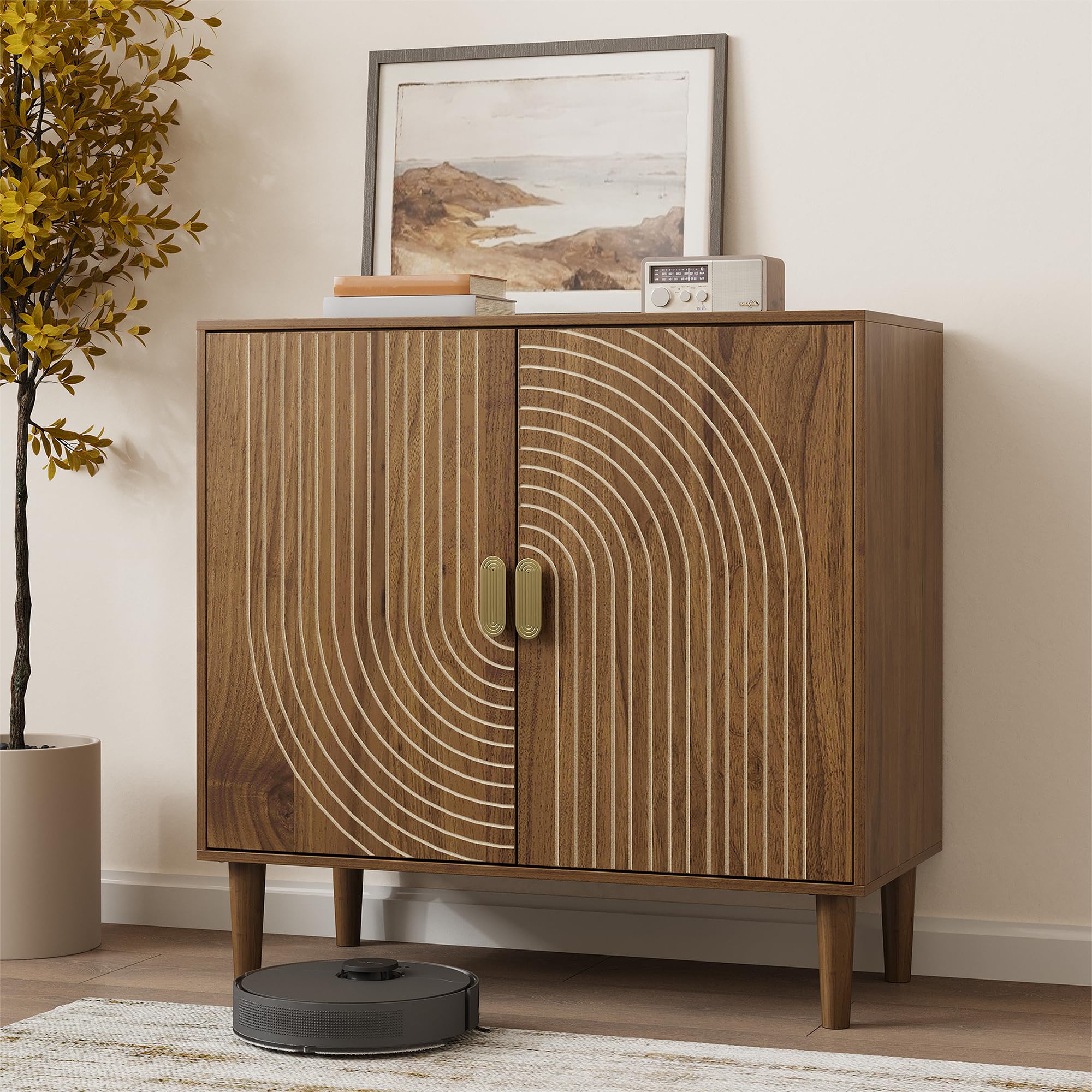
Smuxee Walnut Sideboard

Smuxee Walnut Sideboard

8.9/10 Excellent
  • Doors: Line-groove panels
  • Shelf: Adjustable to 3 heights
  • Material: MDF, walnut finish
  • Footprint: 14.9" D x 31.5" W x 30.6" H
Check Price on Amazon

Pros

  • Line-groove doors look costly
  • Shelf adjusts to three heights
  • Two can combine into a long credenza
  • Scratch- and water-resistant finish

Cons

  • No drawers for small items

The doors are the whole argument for the Smuxee. Vertical grooves are pressed into each panel, and at an angle they pick up light and shadow in a way flat doors at this price never do. Walnut finish, slim gold pulls, simple legs: it reads mid-century without turning into a costume.

At 31.5 inches wide, 14.9 deep and 30.6 tall it is a compact sideboard, and the inside is more flexible than the outside suggests — the divider adjusts through three heights, so tall bottles and stacked bowls can share the space. The MDF is finished to resist scratches and water, and the top is best used for a lamp and a tray rather than a full coffee station.

We like it most as a pair. The listing points out that two can be pushed together into a long credenza, and at this width that is a genuinely useful answer to a wall that is too long for one cabinet and too short for a proper buffet.

What it does not give you is drawers. Everything lives behind those two doors, so small clutter needs baskets to stay tidy and there is no top drawer to sweep the day's mail into. If open storage and a strong face are what you want, this is the best-looking cabinet in the group for the money.

Bottom Line: Our favorite walnut look here: the line-groove doors read far above the price, and the shelf adjusts to three heights.
#6

Utility storage

Iwell Storage Cabinet

Iwell Storage Cabinet

8.7/10 Excellent
  • Storage: 4 shelves, 7 compartments
  • Top Load: 200 lb
  • Warranty: 18 months
  • Footprint: 11.8" D x 35.4" W x 31.7" H
Check Price on Amazon

Pros

  • 11.8-inch depth hugs the wall
  • Seven compartments on four shelves
  • 200 lb top and 18-month warranty
  • Anti-tip hardware included

Cons

  • Shelves only, no drawers

Eleven and a half inches of depth is the number that decides the Iwell. That is how close it stands to the wall, which means it barely intrudes into a narrow hallway or a small dining room — and it also means anything much deeper than a cereal box will not go inside. Platters, stockpots and coffee machines with a hopper on top are out.

What you get instead is length and shelves. Thirty-five inches wide, four shelves, seven compartments, a 200-pound top rating and an 18-month warranty: this is the cabinet you buy when the goal is to make a wall of clutter disappear. The white painted finish is plain in a good way, and anti-tip hardware is included, which matters on a freestanding piece this light.

We think of it as the storage-first choice. Nobody will ask where you got it, and there is nowhere to hide a pair of gloves or a set of keys except a shelf. But if your entryway is a pile of shoes and dog leads rather than a decorating opportunity, this handles the job for about as little as anything here.

Bottom Line: A plain white workhorse we recommend when the job is hidden storage and the room already has enough going on.
#7

Statement hallways

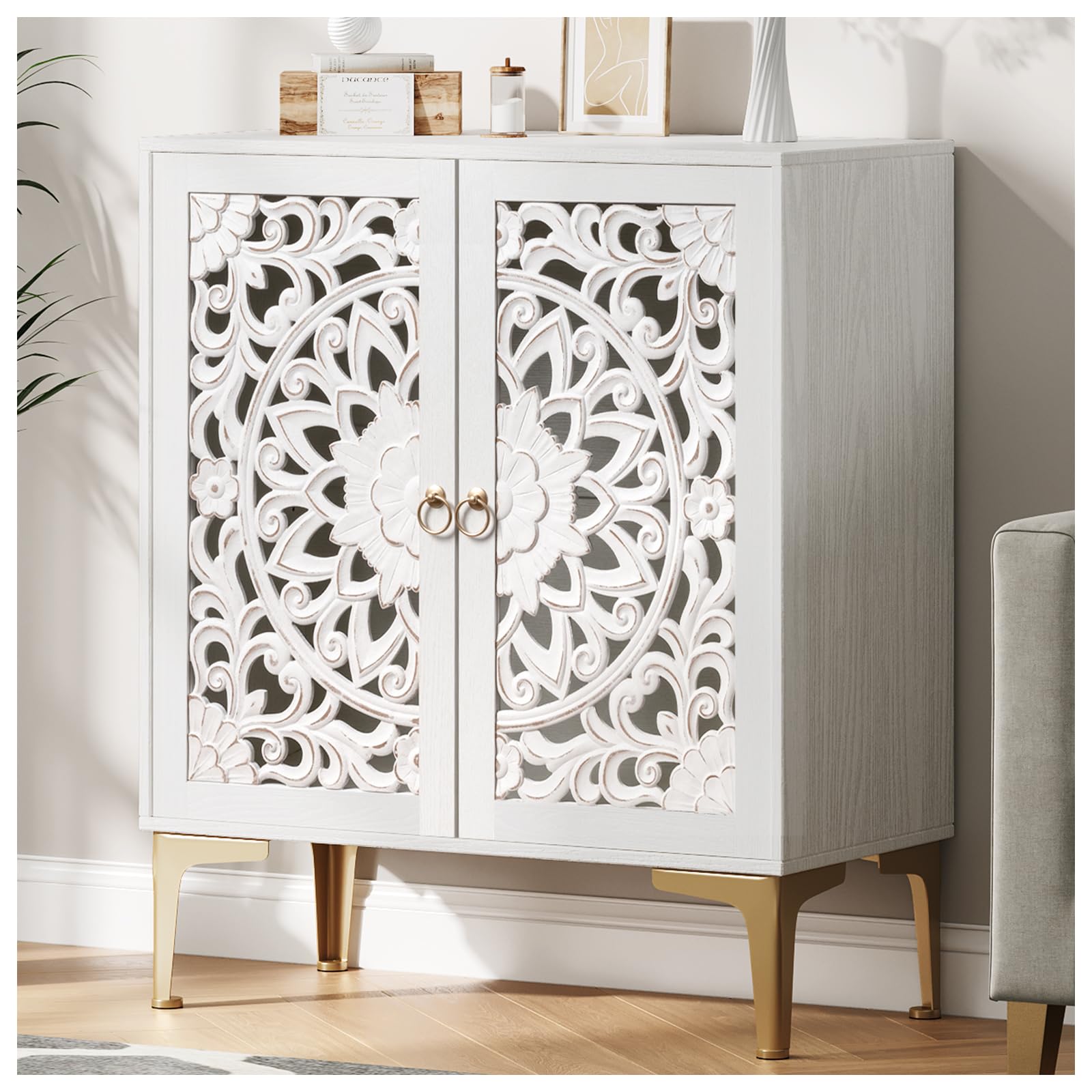
JOINICE Carved Door Accent Cabinet

JOINICE Carved Door Accent Cabinet

8.8/10 Excellent
  • Doors: Carved through-panels, soft-close hinges
  • Material: FSC-certified wood
  • Top Load: 100 lb
  • Footprint: 13.78" D x 31.5" W x 37" H
Check Price on Amazon

Pros

  • Carved through-doors pass light
  • Soft-close cushioned hinges
  • 37-inch height lifts it off the floor
  • Three-level adjustable shelf

Cons

  • Door magnets do not always catch
  • Tall body will not tuck under a window

At 37 inches the JOINICE stands a few inches taller than everything else we recommend, and that changes where it goes. It is too tall to tuck under a window and too short to work as a dresser, which puts it in hallways, at the end of a landing, or beside a sofa where a lower cabinet would vanish.

The doors are the reason to look. Two carved floral panels in a white wood-grain finish, set on gold legs, and the carving is cut clean through — light passes into the cabinet, so the inside does not read as a black hole when the doors are shut. What surprised us is how much that detail does for a dark corner. Soft-close hinges keep the doors from banging, and the middle shelf adjusts through three positions.

Assembly takes an evening and the alignment of those carved panels is the fiddly part. Expect to loosen, shift and retighten the hinges before the gaps look right, and plan the job for a Saturday morning rather than the night before guests arrive.

The bigger caveat is the magnets. They are meant to hold the doors shut, and on some units the pair does not quite meet, leaving a door drifting ajar. Test the closure as soon as it is built, before the shelves are full, and check that the hinges are pulling each door squarely against its catch. If the carved look is what you want, it is worth the effort. If you simply need doors that stay shut, the HOSTACK is the safer buy.

Bottom Line: We like this for a hallway that needs something to look at: carved doors, soft-close hinges and a taller 37-inch body.
#8

Small modern rooms

REHOOPEX Black Accent Cabinet

REHOOPEX Black Accent Cabinet

8.6/10 Excellent
  • Doors: Flat panel, gold handles
  • Storage: 2 compartments, 2 shelves
  • Footprint: 14.6" D x 30.3" W x 31.3" H
  • Load Rating: 65 lb
Check Price on Amazon

Pros

  • Black and gold finish stands out
  • Soft-close doors
  • 30-inch width suits small rooms
  • 15mm MDF frame feels substantial

Cons

No notable drawbacks to flag.

Black with gold pulls is the look, and the REHOOPEX does it without fuss: flat panel doors, slim gold handles, a matte black finish and legs that lift the whole thing off the floor. In a room with pale walls it gives the eye something to land on, which is most of what people want from an accent piece.

At 30.3 inches wide, 14.6 deep and 31.3 tall it sits in the same size class as our top pick, and for a small room that is the right company to be in. The hinges are soft-close, the interior splits into two compartments with a shelf in each, and the 15mm MDF gives the frame more heft than the price suggests. Our hesitation is the top: it carries the lowest load rating in this group, so a microwave or a row of heavy lamps asks more of it than we would.

Used as a TV stand for a smaller screen, or as hallway storage in a dark room that needs something graphic against the wall, it earns its place. Weigh what you plan to put on it before you decide between this and the HOSTACK, which carries well over twice as much.

Bottom Line: The black-and-gold pick we recommend for small rooms on a budget, as long as nothing heavy goes on top.

What Eight Months With 12 Accent Cabinets Taught Us

We started with a list of roughly 40 cabinets from brands we've bought and assembled before, then cut it down using the measurements a listing tends to bury: actual footprint, interior depth, number of shelf positions, whether the frame is solid wood or veneer over MDF, and whether it ships flat or fully built. That left 12, ranging from budget flat-packs to a couple of pieces that cost as much as a decent sofa.

Assembly came first, because it tells you most of what you need to know. Each cabinet was built by one person using only the included tools, with a stopwatch running and the hardware counted out on the floor. We noted whether cam locks seated flush, whether the pre-drilled holes lined up, and whether the doors hung evenly before we touched a single adjustment screw — and how much fiddling it took to close a gap once we did.

Then they went into real rooms for eight months: an entryway that collects keys, mail, and a dog leash; a dining room holding barware and linens; a living room cabinet loaded with about 40 pounds of vinyl and board games. We opened and closed the doors the way a household does, a dozen times a day, sometimes one-handed and full, watching for hinges that sagged, doors that drifted out of alignment, and dampers that let the door slam instead of easing it shut.

Finish got the sweating-glass and damp-cloth test, plus a close look at whether the grain lined up across adjoining door fronts. We also measured every cabinet against its listed specs — a couple of interiors came up an inch short of the promise — and judged each one against what else the same money buys. The pieces with the squarest doors and the best veneer for their price are the ones that made the cut.

How to Choose Accent Cabinets

Measure the wall, then the depth

Widths in this guide run from 22 to 58 inches, and that range alone decides which wall you are shopping for. Depth is where buyers get caught out. A 12-inch cabinet stands almost flush and works in a hallway; a 16-inch one takes a coffee machine and a stack of dinner plates. Neither is better, they suit different rooms, and the photos never tell you which one you are looking at.

Tape the footprint on the floor and walk past it for a day. If the cabinet will sit opposite a doorway or at the end of a corridor, leave yourself room to open a swing door and step around it — or choose a sliding-door design and skip that question entirely.

Decide what goes behind the doors

Drawers are for the small things that make a surface look messy: keys, chargers, mail, sunglasses, cutlery. Doors and shelves are for volume: shoes, board games, serving dishes, a coffee setup. Count how much of each you actually own before you fall for a cabinet that only offers one.

Then check that the shelves adjust. A fixed shelf set at 12 inches will not take a stockpot, and one set at 8 wastes the space above it. A divider with three positions covers far more than a single fixed shelf across a whole cabinet's life.

How the doors hang and close

Swing doors need clearance in front of them; sliding doors need a clear track and nothing else, which is why they suit hallways, doorways and the narrow gap beside a sofa. Whichever you pick, expect to spend ten minutes with a screwdriver: cabinet hinges have adjustment screws that move a door up, down and in, and a door sitting proud of its frame is usually a hinge out of tune rather than a bad cabinet.

Do that adjusting in the first week, while a return is still easy. Magnetic catches are the other thing to test — press each door shut and watch whether it holds, because a door that drifts open undoes the point of hidden storage.

Assembly, and what flat-pack wood means

Only one cabinet here arrives built; the rest are a flat-pack evening, and the wider pieces want two people for the final flip. Engineered wood is the norm at this price and it is perfectly serviceable. The failure mode is over-tightening a screw into a panel edge, which crushes the core and leaves nothing for the thread to grip. Drive screws until they are snug, not until they stop turning.

If you can, unbox and check every panel for cracks and chipped corners before assembly starts. A damaged panel is much easier to claim on a flat stack than on a finished cabinet standing in your hallway.

Match the top to what you will set on it

Load ratings across these cabinets run from 65 to 200 pounds, and the top is usually the strongest part of the piece — the shelves behind the doors are rated lower. A coffee machine, a grinder and a mug tree are well within any of them. A row of cookbooks, a microwave or a countertop appliance collection is where the rating starts to matter.

Add up what you plan to put up there before you choose, and leave a couple of inches behind the cabinet if it will host appliances that need a plug.

Frequently Asked Questions

Final Verdict

If you want one recommendation with no qualifications, take the HOSTACK. Thirty inches fits a real entryway, the wide drawer absorbs daily clutter, and it reads as furniture rather than as a storage solution — which is the whole point of an accent cabinet.

Buy the RoyalCraft instead when the wall is long and the room is a dining room, because 58 inches does something no 30-inch cabinet can. And if you have 22 inches and no appetite for flat-pack, the Ahokua arrives built.