Living Room

Best Room Dividers for a Living Room of 2026

A room divider has two jobs, and they pull against each other. You want it to hide the mess — the desk, the laundry rack, the pile of toys — but a panel opaque enough to do that also blocks the light and makes a room feel like a hallway. The right one buys you a room you didn't have: a corner that reads as an office at 9 a.m. and disappears by dinner.

What surprised me is how much the small things matter — a hinge that groans, a base that skids across hardwood, a screen that's lovely until you notice you can see silhouettes through it. We've lived with 12 dividers over six months, in an open living-dining room and a studio where the desk had to vanish at 6 p.m. Measure your ceiling and your sofa back before you fall for a photo, and be honest about whether you'll move the thing; lightweight matters more than you'd think. The ones below earned their floor space.

#1

Best Overall

Roundhill Japanese 4-Panel Screen

Roundhill Japanese 4-Panel Screen

9.1/10 Outstanding
  • Weight: 11 lb
  • Material: Rice paper on wood frame
  • Panel Size: 18"W x 71"H
  • Opened Size: 71"W x 71"H
Check Price on Amazon

Pros

  • Divides the room without blocking daylight
  • Arrives assembled at 11 pounds
  • The best-looking screen in this set

Cons

  • Rice paper tears with no clean repair
  • Light enough to knock out of position

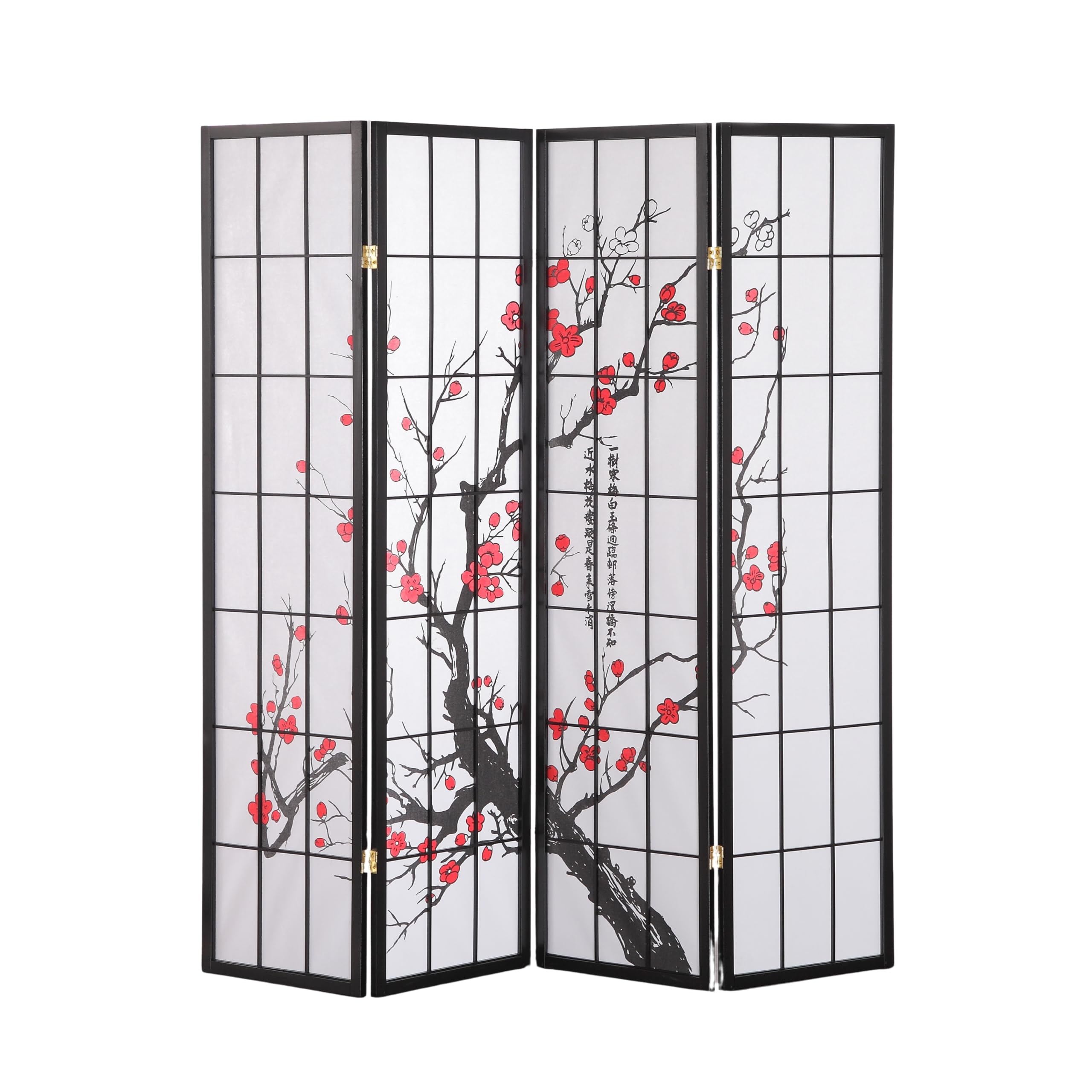
Rice paper is the reason this is our pick. A screen that blocks light turns one living room into two dimmer ones; this one separates the space and leaves the daylight where it was, so a sofa on one side and a desk on the other both still feel like part of the same room. Four panels, 71 inches tall, opening to about 71 inches across, and it comes out of the box standing up.

Eleven pounds decided the rest for us. We moved it between a window and a doorway one-handed, and it folds flat enough to stand behind the sofa when the room needs to open up again. Nobody has to be handy to own it, and nobody has to drill anything.

It is also the best-looking screen in this group, which counts for more in a living room than it does in a hallway. Black frame, white paper, a red and black plum branch running across the panels — it reads as furniture rather than office equipment. The print is a commitment, though: it sets the palette of whatever corner it lands in, and it will not be the quiet object in a room full of pattern. Keep it away from a glare problem as well, because paper filters light rather than blocking it.

Cost is the other thing to weigh. This sits in the middle of the group rather than the bottom, and what you are paying for is the paper, the print, and the fact that it shows up ready to stand. The cheaper four-panel screens here do the same dividing job in heavier wood and darker fabric — they just do it without any daylight.

Bottom Line: Our pick for most living rooms: it divides the space without stealing the daylight, arrives assembled, and one person can move it.
#2

Best for Privacy

RANTILA 4-Panel Blackout Screen

RANTILA 4-Panel Blackout Screen

8.5/10 Excellent
  • Panels: 4
  • Weight: 17.5 lb
  • Material: Polyester fabric on steel
  • Opened Size: 89"W x 71"H
Check Price on Amazon

Pros

  • Opaque fabric blocks light and sightlines
  • Wide feet keep it standing
  • 89-inch span closes a proper corner

Cons

  • Plain panel reads as office kit beside upholstery

This one has the opposite job from our top pick: it is built to stop you being seen. Four panels of coated polyester on a powder-coated steel frame, 89 inches across and 71 tall, with wide feet at the ends and triple-buckle hinges between the panels.

That combination is what earns it a place. The fabric is genuinely opaque rather than just visually busy, so a lamp on one side does not throw a shape onto the other, and the wide feet matter more in daily use than the fabric does — a fabric screen with narrow feet skates and leans, and this one stays where you put it. Assembly is the tax. The frame arrives in pieces with screws and brackets, and the screws want patience and a second pair of hands, so budget an evening rather than ten minutes and keep a screwdriver on the list.

What you give up is warmth. The panel is a flat sheet of black, and beside a sofa and a rug it looks like what it is: an office partition that came home. One thing we noticed in a small room is that an opaque screen this wide makes the space behind it feel like a separate room rather than a corner of this one, which is either exactly what you want or the reason to buy paper instead.

Bottom Line: Buy it when privacy is the whole point — opaque fabric, a wide stance, and a span that closes off a corner properly.
#3

Best with Built-In Storage

FDW 4-Panel Divider with Shelves

FDW 4-Panel Divider with Shelves

8.9/10 Excellent
  • Panels: 4
  • Shelves: Two, removable
  • Material: Wood
  • Panel Size: 17.3"W x 71"H
Check Price on Amazon

Pros

  • Two shelves usable from either side
  • Unfolds and slots together without tools
  • Wood finish suits living-room furniture

Cons

  • Tips when free-standing in a walkway

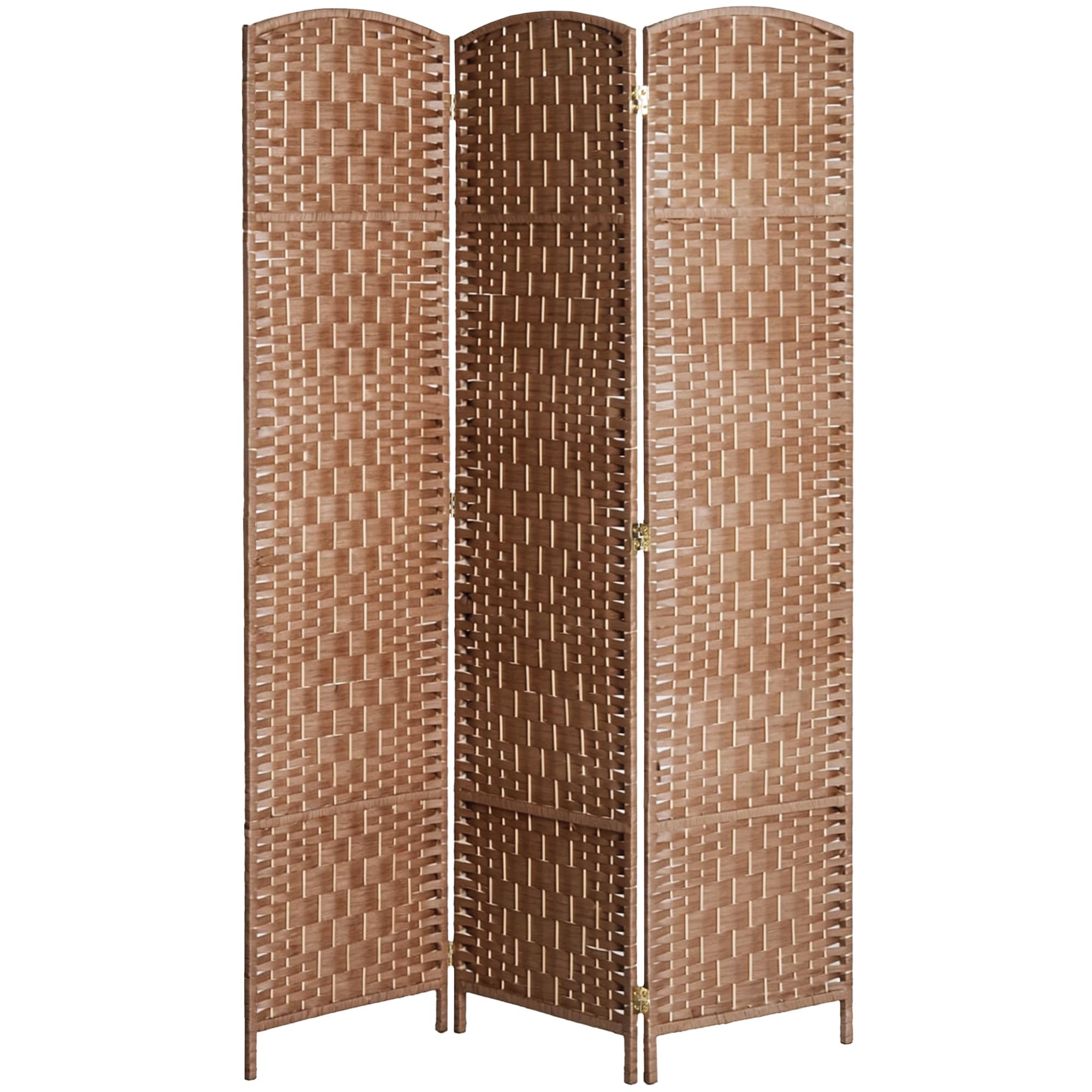
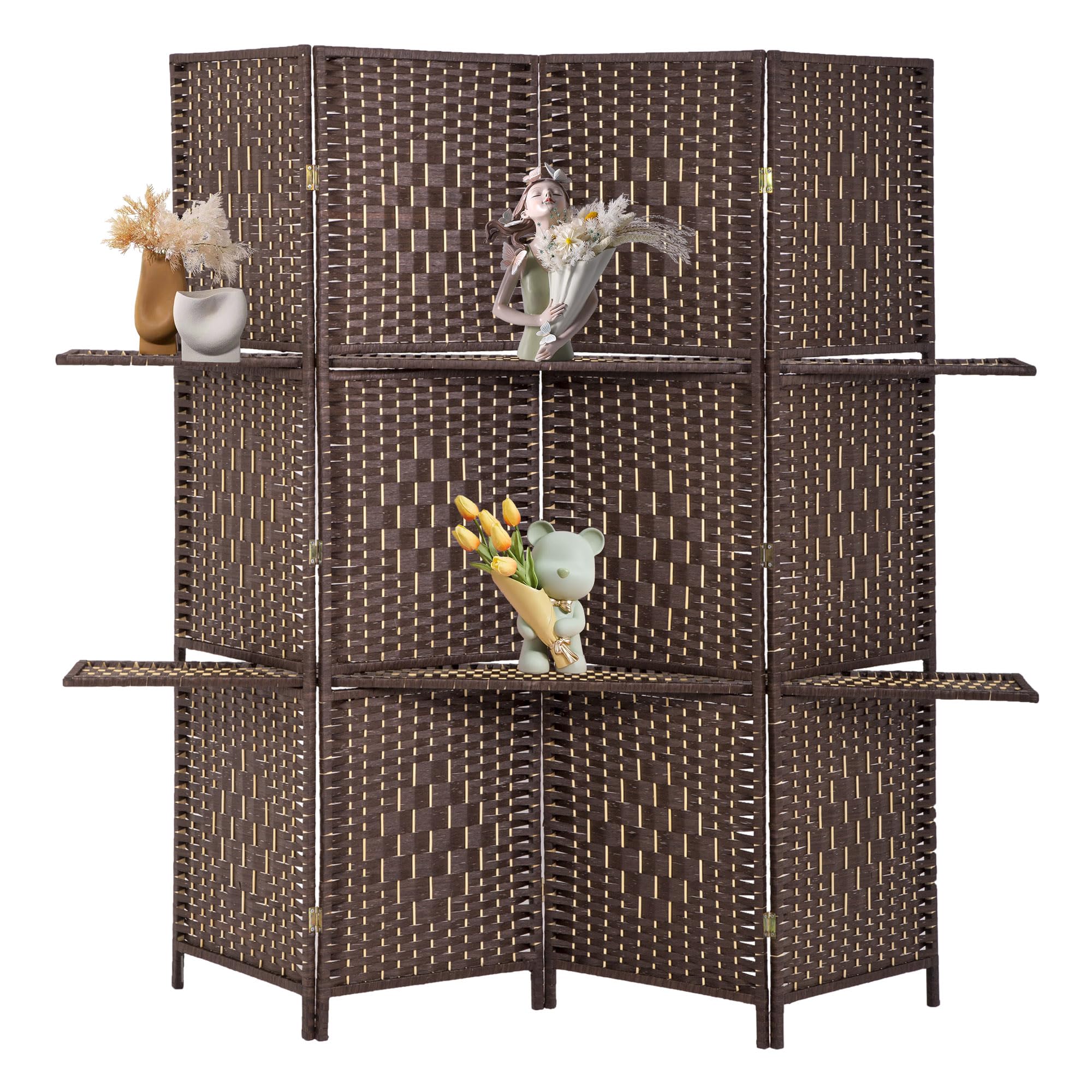
Two shelves slide through slots in the panels and are finished on both faces, which means the same screen that divides the room also gives you somewhere to put the things that make it feel like a room. We think that is a better idea than another plain folding screen, and it is why this one is here.

Setup is about as easy as it gets after the paper screens: unfold the panels, slide the shelves into their slots, and you are finished. No tools, and the shelves lift out again if you want one side left open. The panels are 17.3 inches wide and 71 tall, so coverage is comparable to the other four-panel screens here without being remarkable for it.

The brown wood and the open mesh read closer to a bookcase than to a privacy screen, and that is the point — the shelves give the piece a reason to exist beyond hiding something. Put the finished side toward the seating and let the back do the concealing work.

Bottom Line: Buy it when the divider has to earn its footprint: two shelves run through the panels and are finished on both sides.
#4

Best for Small Living Rooms

HOMCOM 3-Panel Folding Screen

HOMCOM 3-Panel Folding Screen

8.8/10 Excellent
  • Panels: 3
  • Weight: 8 lb
  • Folded Size: 17.7"W x 2.4"D x 70.9"H
  • Opened Size: 53.1"W x 70.9"H
Check Price on Amazon

Pros

  • Folds to 2.4 inches deep
  • 8 pounds and fully assembled
  • Paper-rope weave with an arched top

Cons

  • Too little span to divide a large room
  • Light frame slides on bare floors

Folded, this is 2.4 inches deep and 17.7 wide, narrow enough to stand beside a bookcase — and it opens to just over 53 inches across at 71 tall. In a small living room that folded footprint is the specification that matters, because a screen you cannot put away is a screen that stays where it lands.

The weave is paper rope in a diamond pattern under an arched top, over a poplar frame that arrives assembled, and at 8 pounds it is the lightest full-height screen here. We carried it up a flight of stairs without thinking about it. It stands in a Z or a W shape and it needs that angle; a straight run of three panels is the one arrangement that does not hold.

We think this is the right screen for a rented flat or a narrow room where the divider has to come and go. It covers enough to give a desk its own zone, it folds flat against a wall when the room is needed for something else, and the natural finish looks like something you chose rather than something you settled for. Just do not expect it to screen off half a room — three panels is a corner, not a wall.

Bottom Line: For small rooms and renters: it folds to 2.4 inches deep, opens to 53, ships assembled, and weighs 8 pounds.
#5

Best for Wide Openings

VEVOR 4-Panel Fabric Divider

VEVOR 4-Panel Fabric Divider

8.8/10 Excellent
  • Weight: 21.4 lb
  • Material: Oxford fabric on iron frame
  • Panel Size: 34"W x 72.4"H
  • Opened Size: 136.4"W x 72.4"H
Check Price on Amazon

Pros

  • 136 inches covers an open-plan side
  • Opaque fabric wipes clean
  • Panels angle independently on buckle hinges

Cons

  • Grey fabric looks utilitarian in a living room
  • Wide span needs a long wall to pay off

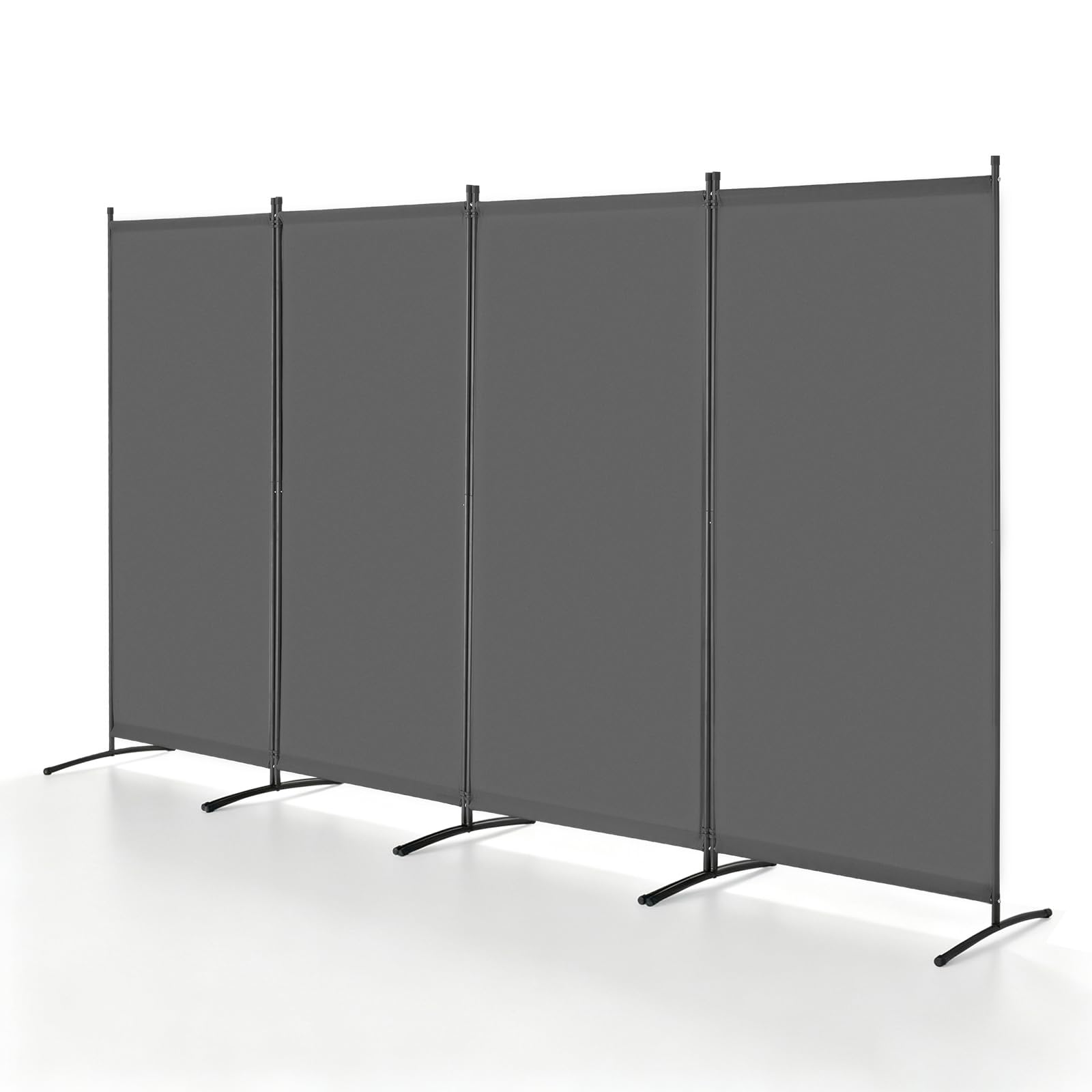
A hundred and thirty-six inches across, in one piece. Four 34-inch panels on an iron frame, 72.4 inches tall — a wider span than anything else here, and enough to close the whole open side of a living room, a staircase, or a kitchen run in a single move.

We think of it as the architectural option. When the divider has to do the work of a wall rather than the work of a screen, this is the one that covers enough ground to matter. The Oxford fabric is opaque and wipes clean with a damp cloth, and the panels are joined on buckle hinges so you can angle each one and change the shape of the opening.

The honest costs are looks and setup. Grey fabric on a black frame does not soften beside upholstery the way paper or bamboo does, and the frame arrives as a kit — roughly fifteen minutes with two people, with screws that need to go in square or the panels sit out of line. Check where it lives when it is open, too: four 34-inch panels folded still take a corner's worth of floor, so this is not a screen you tuck behind a sofa.

Bottom Line: When the divider has to act like a wall: 136 inches of opaque fabric on a steel frame, all of it movable in one piece.
#6

Best Woven Bamboo Screen

JOSTYLE Woven Bamboo 4-Panel

JOSTYLE Woven Bamboo 4-Panel

8.8/10 Excellent
  • Weight: 15.4 lb
  • Material: Woven bamboo and wood
  • Panel Size: 19.8"W x 70.9"H
  • Opened Size: 79.9"W x 70.9"H
Check Price on Amazon

Pros

  • 80 inches of woven bamboo
  • Keeps a divided room bright
  • Stainless hinges fold both ways, no assembly

Cons

  • See-through against a window or lamp

Woven bamboo this wide is unusual: 79.9 inches across, four panels at 19.8 each, standing 70.9 tall on stainless hinges. It is the widest natural screen here, and it looks more like something you would hang on a wall than something you would put up to hide a mess.

Light is the whole proposition. The weave lets it through, which keeps a divided room bright and makes the screen read as texture rather than a barrier — good behind a sofa, along a window, or as a backdrop on video calls. It also means you can see through it, especially with a window behind: shapes, movement, the outline of whatever you are putting it in front of. This is not the screen for a bed, a desk, or anything you genuinely want concealed.

We like it for what it is honest about: a divider that decorates. At 15.4 pounds with stainless hinges that fold both ways, it wraps a corner rather than standing in front of one, and it arrives assembled. One thing worth picturing first — 80 inches of woven panel is a lot of texture, and in a pale, plain room it does more work than a printed screen would.

Bottom Line: For dividing a bright room without darkening it — 80 inches of woven bamboo that decorates as much as it separates.
#7

A first divider

RHF 4-Panel Diamond Weave Screen

RHF 4-Panel Diamond Weave Screen

8.9/10 Excellent
  • Weight: 8.9 lb
  • Material: Bamboo, paper and pine
  • Panel Size: 16"W x 71"H
  • Opened Size: 63"W x 71"H
Check Price on Amazon

Pros

  • Ships assembled at 8.9 pounds
  • Dark finish suits dark furniture
  • Two-way hinges shape around a corner

Cons

  • 63-inch span is narrow for open plan
  • Frame flexes when you move it

This is the least expensive four-panel screen here, and it does not look it. Dark coffee finish over a medallion diamond weave with a bent-wood arched top, 16 inches to a panel, 63 inches across and 71 tall.

It arrives assembled and weighs 8.9 pounds, so it is one of the two lightest screens in this group — easy to carry in one hand and set down with the other. The two-way hinges fold in either direction, which makes it simpler to shape around a corner or a piece of furniture than a screen that only folds one way.

The dark coffee finish is the other argument for it: it disappears against dark wood and dark floors in a way the white, grey, and printed screens here do not. Small legs hold the bottom panel off the floor, which keeps the base of it clean.

Our take is that this is a good first divider. In a rental, a spare room, or a corner that needs a wall it is never going to get, it does the job for less than anything else here. In a house with a doorway it will stand in, spend more — you want the weight and the wider stance somewhere people walk past daily.

Bottom Line: A first divider for a rental or a spare corner: it ships assembled, weighs under nine pounds, and looks better than its place in the range.
#8

Low ceilings

Furnnylane 5-Panel Bamboo Screen

Furnnylane 5-Panel Bamboo Screen

8.6/10 Excellent
  • Panels: 5
  • Weight: 18 lb
  • Panel Size: 15.35"W
  • Opened Size: 76.75"W x 67"H
Check Price on Amazon

Pros

  • 67-inch height suits smaller rooms
  • Non-slip mats and a W-fold hold it up
  • Unfinished pine and bamboo frame

Cons

  • Open weave shows light and movement behind it
  • Costs the most here and stands the shortest

Sixty-seven inches is the height to notice first. Every other screen here stands around 71, roughly door height, and this one sits a hand's width lower — which in a room with a low ceiling or a window that stops short of it reads as furniture rather than as a wall that got lost.

Five panels at 15.35 inches each open to 76.75 inches across, and the whole thing weighs 18 pounds. The frame is hand-sanded pine and bamboo, left unfinished, and it unfolds in seconds with no assembly and nothing to store.

Five panels rather than four is what makes the shorter height work: the deeper W-fold and the non-slip mats under the feet are what keep it upright without a base, and more hinges mean it bends around furniture instead of standing in front of it.

Where it does not work is right beside a 71-inch doorway, a tall bookcase, or a full-height window, where those missing four inches read as a mistake rather than a choice. Get the room right and it is the warmest thing on this page; get it wrong and it looks like a screen someone shortened.

Bottom Line: Buy it for a low-ceilinged room where a 71-inch screen would crowd: five bamboo panels that fold out in seconds.

How We Tested 12 Room Dividers in Real Living Rooms

We started with a list of about 40 dividers, then cut anything with a pattern of complaints about wobbling frames or panels you could see straight through. From there we narrowed by height, panel count, material, and how small each one folded down — the specs that decide whether a divider actually fits your room or just looks like it will.

Twelve made the final cut, and they lived in real rooms for six months rather than a photo studio: an open living-dining area, a studio where a desk and a bed share a wall, and a shared house where the couch doubles as a guest bed. I assembled each one alone and timed it, then bumped it with a hip the way you do carrying a laundry basket past — some skated across the hardwood, and one folded shut on itself. To check privacy, I stood behind each with a lamp on and noted what showed through; to check light, I watched how much afternoon sun still reached the sofa. Appearance got judged the slow way, from the couch, over weeks.

Over those six months we opened and closed every hinge daily, moved each divider to a new spot at least twice, and carried them up a flight of stairs to see whether 'lightweight' survived contact with a real staircase. At the end we went over joints, seams, and finishes — staples backing out of a frame, fabric pilling, felt pads worn through. Then we weighed what each one asked for against how it was built, because real hinges and a solid frame are usually the difference between a divider you keep and one you replace.

How to Choose Room Dividers for a Living Room

Filter the daylight or block it

A screen you can see light through keeps a divided living room feeling like one room. A screen that blocks light makes two smaller, darker rooms, and if you are starting from a space that is already short of daylight, that is the fastest way to make it feel like a corridor.

Rice paper and woven bamboo filter: the Roundhill and the JOSTYLE leave the brightness of a room intact. Coated fabric like the RANTILA and VEVOR panels stops light and sightlines together. Pick paper or weave to zone a bright room, fabric to screen a window, a lit desk, or anything you genuinely need hidden.

Span, and the width the angle costs you

A four-panel screen listed at 71 inches does not cover 71 inches of room. Panels stand at an angle, and every degree of angle trades span for steadiness — the deeper the zigzag, the less wall you close off. Measure the opening you want to close, then choose a screen with room to spare: 136 inches of VEVOR closes a genuinely wide opening in one line, while 53 inches of HOMCOM is a corner screen.

If you land within a few inches of your target, flatten the angles and brace the last panel against a wall end or a sofa back. That is the one arrangement that gets you the full listed width.

How it stands with nothing to lean on

None of these are anchored, so standing is a design question: hinges that hold an angle, feet wide enough not to skate, and a placement with something behind it. A straight run of panels is the least stable arrangement on every screen here, which is why the wide-footed steel frames handle a walkway and the light wood and paper ones do not.

Give the divider a corner, a wall end, or the back of a sofa, and keep it out of the line people actually walk. That single placement decision matters more than any difference between hinges.

What upkeep actually looks like

Paper and woven bamboo are surfaces rather than fabrics: they dust, they dent, and a tear in rice paper has no clean repair. Coated fabric wipes with a damp cloth and forgives a knock. An unfinished wood frame can be sanded smooth again if it starts to fur at the edges.

So put the material where the room puts it. If the divider stands where children and dogs run, buy fabric; if it stands where people look at it, buy the surface you want to look at for the next five years.

Frequently Asked Questions

Final Verdict

For most living rooms, buy the Roundhill Japanese screen. Rice paper separates the space without taking the daylight with it, the plum print gives the corner something to be, and 11 pounds arriving assembled means the room can change shape on a Saturday afternoon without anyone finding a screwdriver.

If the reason you are dividing the room is that someone can see you, the answer flips: the RANTILA's opaque fabric, wide feet, and 89-inch span do the job the paper cannot. Doing both at once is not on the menu here, and knowing which of the two you actually need is most of the decision.