Living Room

Best Room Dividers with Shelves of 2026

A room divider with shelves is doing two jobs at once — carving out a private corner and holding what you would otherwise stack on the floor — and that double duty is where most of them fail. A freestanding wall has to stay upright on its own, and the moment you load one side with books, the whole thing wants to lean. What you are really paying for is stability, plus panels that look finished from both sides, since the entire point is that people see it. Get those right and it earns its footprint twice over: a bedroom that isn't also the office, a dining nook that isn't also the entryway.

I have lived with one version or another of these for years, and over the past six months my team and I have had 12 of them standing in our homes, folding and unfolding, loading shelves, and hauling them through doorways. The good ones are heavier than you expect and thinner than you fear. Measure the footprint with the shelves in place, not just the panel width — that is the number that decides whether it actually fits. The picks below are the ones we would happily keep standing.

#1

Best Overall

AMBITION LAND 4-Panel Divider

AMBITION LAND 4-Panel Divider

8.8/10 Excellent
  • Height: 67 in
  • Panels: 4
  • Shelf Boards: 3
  • Overall Width: 63 in
Check Price on Amazon

Pros

  • Three shelves usable from both sides
  • Solid wood frame that stays put
  • 19 pounds, folds flat, one-person setup
  • Double hinges let it wrap around furniture

Cons

  • 63-inch total span won't close a wide opening

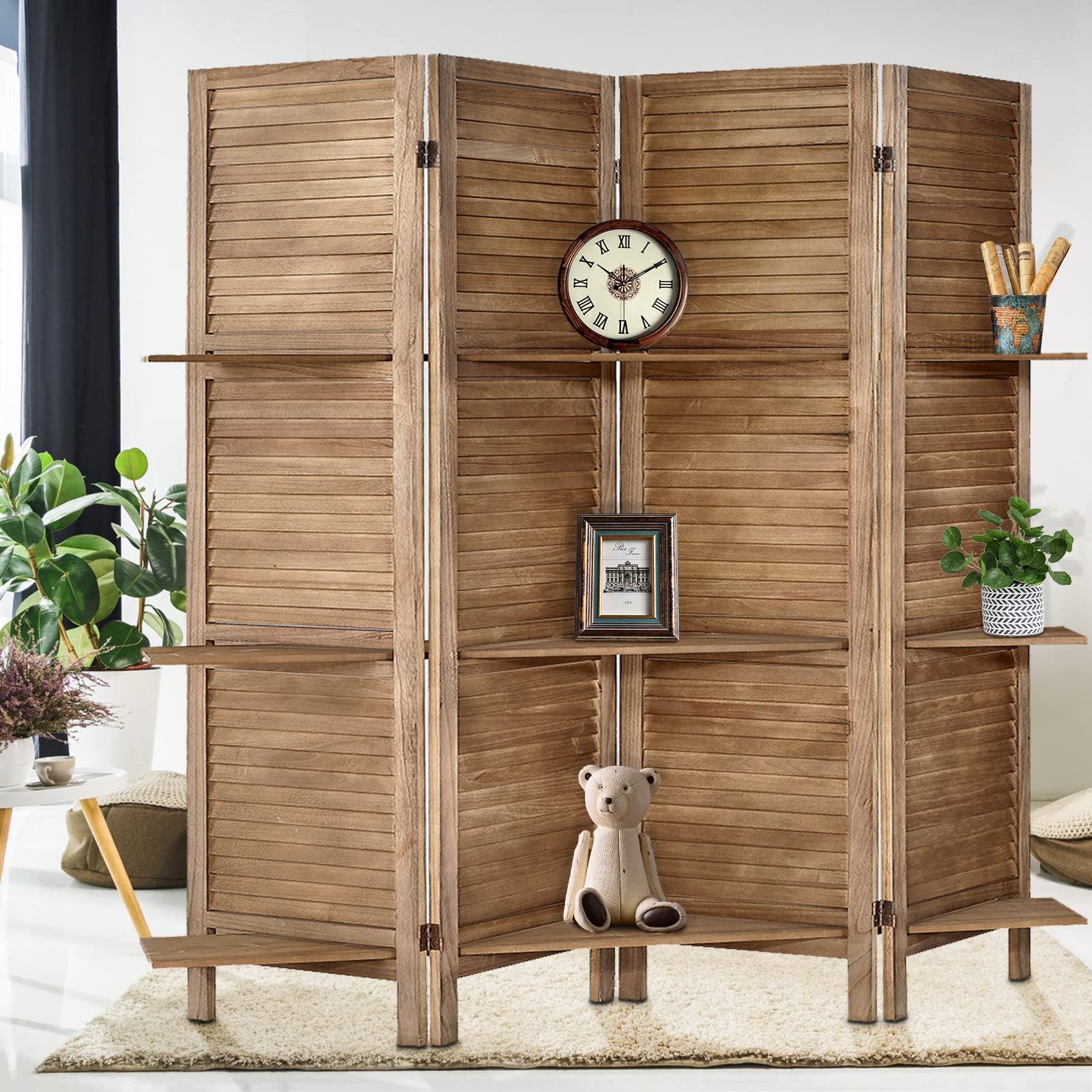
Three shelf boards is the detail that settles this one for us. Most screens in this group give you two; this one threads three through the frame, and because each board passes all the way through, both sides get a usable ledge — books and a plant on the office side, a dish for keys on the hallway side. That doubled storage is why it's the divider we recommend first.

The frame backs it up. Solid wood with louvered slats and a distressed brown finish that won't show every fingerprint, and four panels on double hinges, so it wraps around a desk or a chair instead of standing in a rigid line. The boards do structural work too: each one braces two panels, which is how 19 pounds of screen stays put when you brush past it. When we folded it flat, it stood behind a door with room to spare.

Setup is unfold and slide — no tools, one person, a couple of minutes. The louvered slats keep air and light moving, so a small room doesn't feel walled off, and the shelves sit at two heights so the display doesn't crowd into one line. Put a plant on the middle board and the whole thing reads as furniture rather than a temporary partition.
Bottom Line: Three shelves that work from both sides, a solid wood frame and 19 pounds you can move alone make this the divider we recommend to most people.
#2

Best Budget

FDW 4-Panel Divider with Shelves

FDW 4-Panel Divider with Shelves

8.9/10 Excellent
  • Height: 71 in
  • Panels: 4
  • Panel Width: 17.3 in
  • Shelf Boards: 2
Check Price on Amazon

Pros

  • Lowest price in this group
  • 71-inch height matches the tallest here
  • Shelves pull out, or come out entirely
  • Four narrow panels bend around corners

Cons

  • Two shelf boards only, where our top pick gives three

This is the least expensive screen here, and it earns its place by being tall: 71 inches, level with the tallest in the group, in four narrow panels just 17.3 inches wide. That narrowness is genuinely useful — you can bend it around the end of a sofa or into a corner without covering the wall you wanted to keep.

What the price buys is a light frame, and that's the honest trade. Run out in a straight line across a walkway, it shifts when someone catches it with a bag; folded into a zigzag with one panel against a wall, it sat still for us on carpet. The boards slide into slots and work from either side, and you can pull one out entirely if you want the screen without the display.

Nothing needs screwing together. You unfold it, slide the boards home, and it's done; taking it down for a move is just as quick, and it folds thin enough to stand upright in a closet. What we noticed after living with it is that the shelves are what stop it feeling like a folding screen at all — a couple of framed photos and it reads as a piece of furniture.

Bottom Line: When the budget decides, we take this one: 71 inches tall, with shelves that pull out and a frame light enough to move alone.
#3

Best for Wide Openings

HOMCOM 6-Panel Divider

HOMCOM 6-Panel Divider

8.9/10 Excellent
  • Span: 94.5 in
  • Height: 67 in
  • Panels: 6
  • Folded Depth: 4.5 in
Check Price on Amazon

Pros

  • 94.5-inch span, the widest here
  • Folds to a slim 4.5-inch stack
  • Three removable display shelves
  • Raised, padded feet protect floors

Cons

  • Thin painted wash scuffs easily

Ninety-four and a half inches is a lot of screen. Six paulownia panels spanning wider than any other divider here, and the one to look at when you're closing off the long side of a basement or splitting an open-plan living area in two. Three display shelves thread through the frame and lift out again, so you can run the whole thing bare or dress every opening.

The panels are three-quarters of an inch thick, and that thinness is the trade you're making: light enough to set up alone — we had ours standing in a couple of minutes — and it folds down to 15.75 inches wide by 4.5 deep, which is genuinely storable. But a tall, light screen wants an angle or a quiet corner, not a doorway people charge through. Fifteen steel hinges keep the folds honest, the raised feet have pads underneath to protect a wood floor, and it delivers the best span here without pretending to be the most solid.

Bottom Line: For a long opening, this is our pick: 94.5 inches of screen, three shelves, and a fold slim enough for a closet.
#4

Best Looking

Svimi 6-Panel Divider

Svimi 6-Panel Divider

8.7/10 Excellent
  • Span: 77 in
  • Height: 67 in
  • Panels: 6
  • Assembly: None required
Check Price on Amazon

Pros

  • Best-looking finish in this set
  • Arrives with nothing to assemble
  • Shelf boards can be flipped over
  • Six panels cover 77 inches

Cons

  • Wobbles when set up dead straight

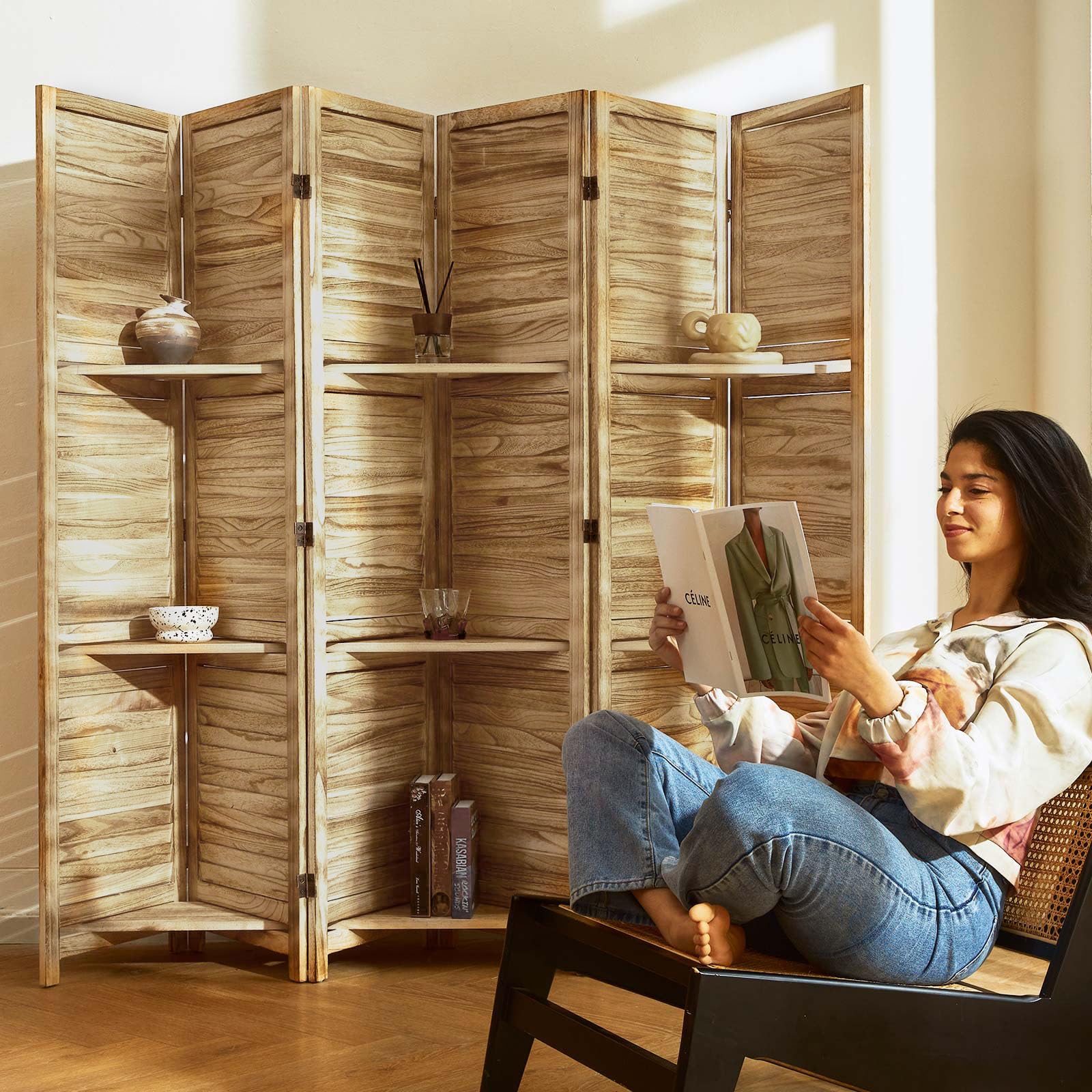
If the divider is going where guests sit, this is the one we choose. The paulownia panels come in a warm wood finish on a clean art deco line, and it reads as furniture rather than a folding screen propped across a room — the best-looking piece in this group.

Six panels, 67 inches tall, 77 inches across when opened out, with three boards through the frame. There is nothing to assemble: unfold it, slide the boards into their slots, and it's up. We flipped two of the boards over in their slots — they can go either way up — and got a slightly different shelf line for the trouble. Folding it flat takes one movement.

What you're paying for over the others is the finish, and if the screen is a backdrop for a bed or a dining table, that's the right place to spend it. It goes up in a minute and comes down in less, which matters if you're dividing a room for a season rather than a decade.

Bottom Line: If the divider sits where guests sit, this is the one we choose — the best finish in the set and nothing at all to assemble.
#5

Light filtering

JOSTYLE Bamboo 6-Panel Divider

JOSTYLE Bamboo 6-Panel Divider

8.8/10 Excellent
  • Span: 96 in
  • Height: 67 in
  • Panels: 6
  • Shelf Boards: 2
Check Price on Amazon

Pros

  • Natural bamboo that darkens with age
  • 96-inch span across six panels
  • Arrives assembled, folds flat in one motion
  • Two removable storage boards

Cons

  • Sheer weave shows shapes and light

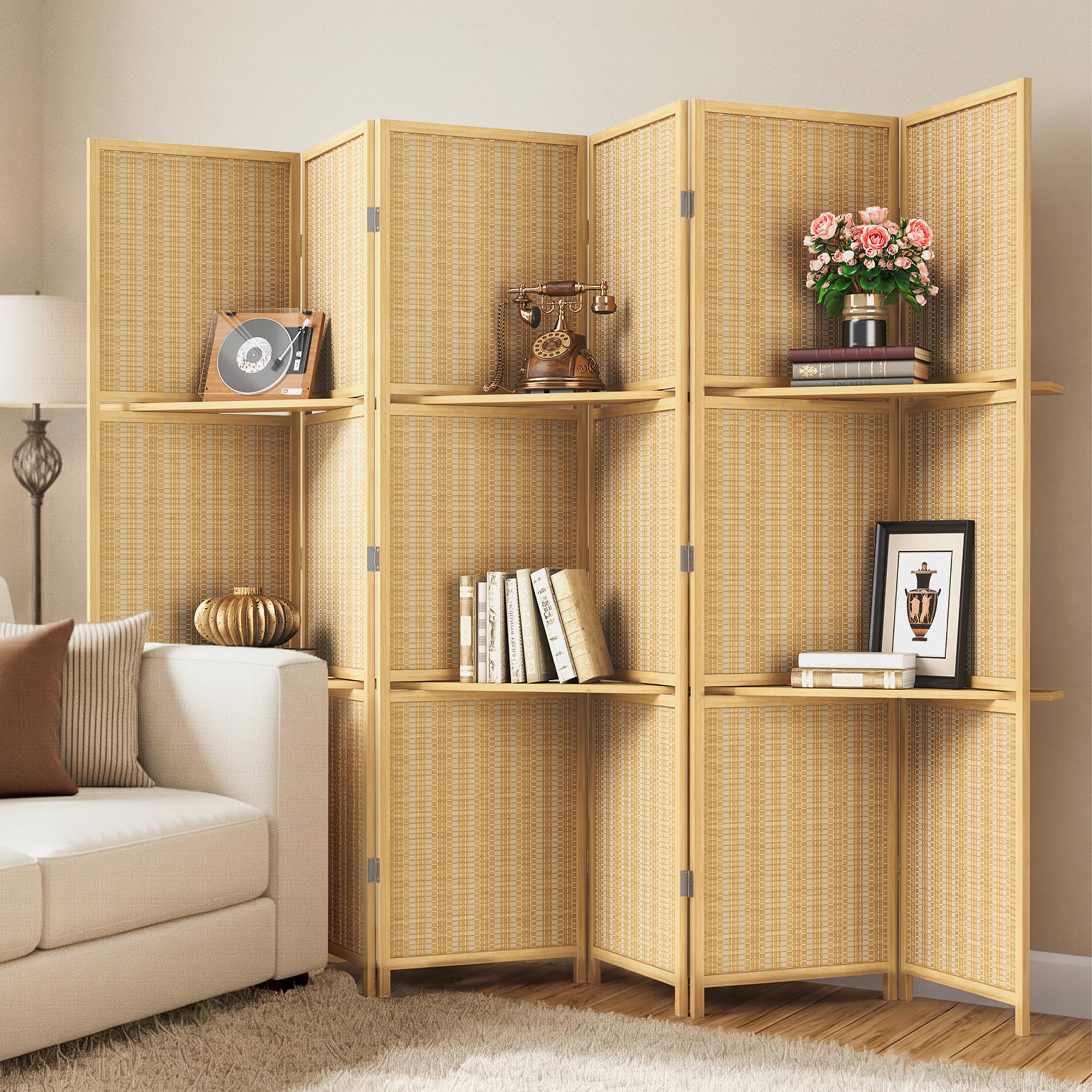
Start with what the weave does. The bamboo lattice looks dense from across a room, but backlit by a window it shows shapes, and the gaps between panels let a sightline straight through. That's the design rather than a fault — it's a divider that keeps the daylight — but it decides where the thing can go.

Everything else is generous. Six panels, 67 inches tall, 96 inches extended, on 180-degree hinges that fold it flat in one motion; two storage boards lift out; the frame is solid wood; and there's nothing to assemble, so it stands up straight out of the box. The natural bamboo darkens as it ages — patina if you like the direction, a color change if you don't.

We keep this one for studios and reading corners where light matters more than concealment: screening a desk from a sofa, softening the end of a long room, giving a daybed a sense of its own corner. For a guest sleeping area, or anything that needs a barrier rather than a filter, the AMBITION LAND closes the sightline properly.

Bottom Line: We like it for light and texture rather than concealment — the bamboo filters what's behind it but won't hide a room.
#6

Storage first

Tribesigns Storage Divider

Tribesigns Storage Divider

9.1/10 Outstanding
  • Depth: 11.8 in
  • Width: 47.2 in
  • Height: 70.9 in
  • Weight: 71.7 lb
Check Price on Amazon

Pros

  • Real shelf storage, not display ledges
  • Shallow 11.8-inch footprint
  • Anti-tip device and coat hooks included
  • Open frame keeps a room airy

Cons

  • 32.5 kg and a two-person, tools-out build

This isn't a screen. It's an open shelf unit — engineered wood on a metal frame with vertical bars — and you see straight through it to whatever is on the other side. What it gives you instead is real shelving, nearly six feet of it, in a footprint 11.8 inches deep.

The numbers matter: 47.2 inches wide, 70.9 tall, on a 6.5-inch thickened base, with an anti-tip device and a row of coat hooks in the box. That anti-tip fitting isn't decorative — a tall open unit carrying this much shelf wants fixing to the wall, so plan for it.

Where it wins is the entryway and the studio flat: a bookcase, a place for keys and a visual break between the door and the living space in one piece, with an open back that keeps a small room from feeling chopped in half. The 11.8-inch depth means it can stand in a hallway without stealing the walkway.

Bottom Line: If storage outranks privacy, this is our pick: a real shelf unit that happens to divide a room, in a shallow footprint.
#7

Studio backdrops

Giantex Rattan 6-Panel Divider

Giantex Rattan 6-Panel Divider

8.6/10 Excellent
  • Span: 95 in
  • Height: 71 in
  • Panels: 6
  • Shelf Boards: 2
Check Price on Amazon

Pros

  • Tallest screen here at 71 inches
  • Woven rattan texture no flat panel matches
  • No assembly, unfolds from the box
  • Six panels cover 95 inches

Cons

  • Shelf boards must come out before folding flat

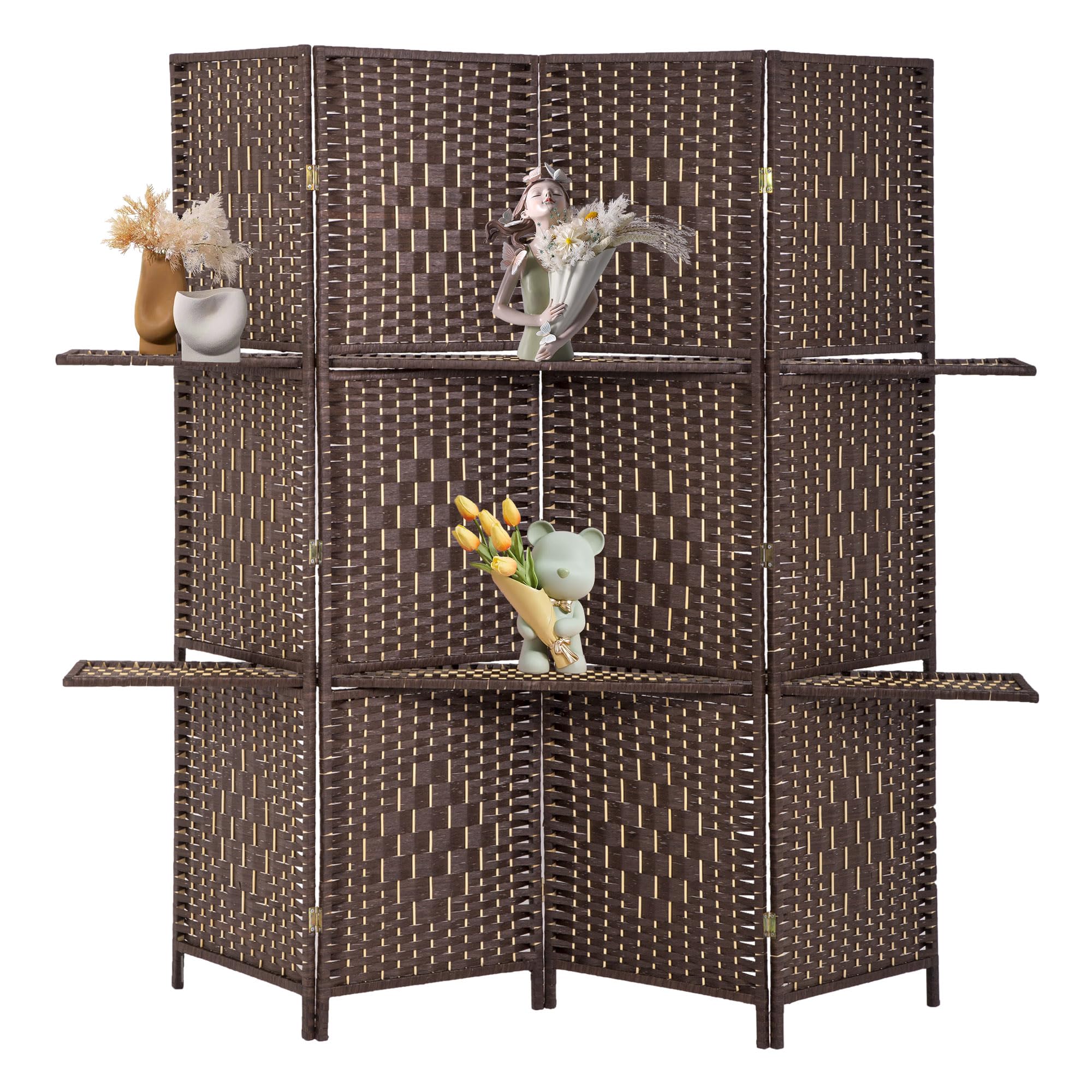
Seventy-one inches tall and woven rather than paneled, the rattan has a texture you notice from the far side of a room, and at 95 inches across it covers more gap than any of the four-panel screens here.

Two shelf boards slide through the frame and give display space on both sides, and there's no assembly at all — it unfolds out of the box. The boards bridge two panels each, so they come out before it folds flat, which is quick but has to be done.

It's light for its size, which cuts both ways. Moving it between rooms takes one person and no planning; on a hard floor in a throughway, a shoulder can send it leaning, so angle the panels or park it in a corner. The poplar arrives unfinished — an oil or a stain is the difference between raw wood and a piece that matches your floor.

Where it earns its place is as a backdrop: behind a desk on a video call, at the end of a narrow living room, anywhere the screen is on show as much as it's working. It has more character than anything else in this group, and it's the one we move around most.

Bottom Line: The tallest, most textured screen here, and the one we move from room to room: 71 inches of woven rattan.

How We Tested Room Dividers With Shelves

We built the shortlist around fit first: overall width open and folded, shelf depth, and how much floor the feet claim. From there we filtered by panel material, finish and color options, price, and whether the piece is meant to be seen from both sides. That left 12 dividers, which have spent the past six months in my apartment and my team's homes — standing between a bed and a desk, screening off a basement guest area, and cutting a shared office down to one person's half.

Every unit was assembled by one person with a stopwatch running. We counted the tools required, noted whether hardware arrived bagged and labeled by step, and recorded the point where the instructions stopped matching the parts. Then we loaded the shelves — hardbacks low, plants and baskets up top — and nudged each one at the top corner to see how far it moved. We noted which had adjustable feet for an uneven floor and which only felt secure once anchored to the wall.

Over the months we watched how each one aged: whether veneer lifted at the edges, whether a powder coat chipped where the panels meet, and whether the finish read the same in daylight as it did under a lamp — and against the listing photo. We checked function the way you would use it, reaching through open shelves for a book, walking around the back to see if it looked intentional, folding it flat to get it through a doorway, and wiping it down after a cat and a toddler got to it. Value came down to what the price bought in panel thickness and hardware, not in styling.

How to Choose Room Dividers with Shelves

Measure the gap, then buy longer

Panels don't stand flat in real rooms. A screen listed at 94.5 inches covers that only when it's nearly straight; fold it into the zigzag that keeps it upright and the span shrinks. Measure the run you want to close, then choose a screen longer than that number rather than exactly level with it.

Four panels suit a bedroom corner or the side of a desk, six earn their keep across an open-plan room. And leave the door swing clear — a divider standing in an exit path is a trip hazard, not a design choice.

Decide whether the shelves are for display or storage

Two or three boards threaded through a folding screen are display space: frames, a small plant, a bowl for keys. Because the boards pass right through the frame, both sides get a ledge, which is worth more than it sounds when the back of the divider faces a hallway.

If you want books, buy a divider that is built as shelving. The Tribesigns unit is the one here that holds a row of hardbacks rather than a photograph, and the folding screens are honestly better at decor than at a library.

Stability is something you arrange

A freestanding screen is stable in the shape you leave it. Panels angled back and forth brace each other; panels pulled into a straight line have nothing holding them up but their feet, which is exactly when a light screen goes over.

In a room with children, pets or a walkway behind it, anchor the top to the wall — the Tribesigns unit ships with an anti-tip device for this reason — or buy weight. Carpet holds a light screen better than tile does; on a hard floor, keep it out of the traffic line.

Privacy is the weave, not the label

Almost everything sold as a room divider divides a room; plenty of them don't hide anything. Solid louvered wood blocks a sightline while letting air through. A bamboo or rattan lattice filters light and shows silhouettes, especially with a window behind it. Open metal and wood shelving is a visual marker and nothing more.

Decide what the divider has to do — hide a bed from the front door, or stop a desk from spilling into the living room — and buy for that, because the prettiest weave is the wrong purchase if what you needed was a wall.

Assembly, weight and folding it away

Three kinds of setup turn up here: screens that arrive assembled and unfold, screens where you slide the shelf boards into slots, and flat-pack furniture that needs tools and a second pair of hands. All three are fine; what matters is whether you'll ever fold it.

A screen that stores at 4.5 inches deep can live in a closet between uses, while a 32.5 kg shelf unit stays where you put it. If the divider is seasonal — a guest bed in December, a workspace in July — buy for the fold.

Frequently Asked Questions

Final Verdict

Most people should buy the AMBITION LAND. Three shelves that work from both sides, a solid wood frame braced by those boards, and 19 pounds you can shift alone make it the best balance of storage, stability and fuss in this group. It covers a bedroom or a shared office, not the long side of an open plan.

When the gap is wide, the HOMCOM's span and slim fold win. When the budget decides, the FDW gives you the same height for less. And if shelving comes first and dividing second, the Tribesigns unit is the only one here that holds a real book collection — as long as privacy isn't the point.