Entryway

Best Coat Racks of 2026

There's a chair in my entryway that hasn't been sat in since October. It currently holds a coat, a tote, a scarf, and the dog's leash — which is the exact problem a coat rack solves. The right one turns that heap into a habit: walk in, hang, walk away. The wrong one tips the second you shrug off a wet parka, or spaces its hooks so tightly that two puffy jackets end up wrestling over the same six inches.

It also has to survive the people using it — kids yanking down backpacks, guests abandoning dripping umbrellas. Over the past six months, we assembled and lived with 12 racks, from freestanding trees to wall-mounted rails, loading each one until it held steady or gave in. One thing first-time buyers overlook: footprint beats height. A tall rack that eats your hallway is worse than a short one you walk past without turning sideways. The picks below are the ones still standing.

#1

Best Overall

SONGMICS 16-Hook Coat Rack

SONGMICS 16-Hook Coat Rack

9.0/10 Outstanding
  • Base: 4 legs, adjustable feet
  • Hooks: 16
  • Height: 70.1 inches
  • Load Capacity: 105.8 lb
Check Price on Amazon

Pros

  • Best stability here: four legs and adjustable feet
  • 16 hooks at varied heights
  • 105.8-pound load rating
  • Rounded hooks do not snag scarves

Cons

  • Allen key assembly, not tool-free

Tipping is the failure that runs through this whole category, so it was the first thing we watched for on every rack we loaded up. The Songmics is the one where the question stopped coming up. Four legs instead of the usual three, each with a screw-adjustable foot, so a hallway floor that slopes toward the door does not leave it rocking when someone brushes past. Of the racks here it has the strongest stability story, and that is most of why it is our top pick.

Sixteen hooks sit at varied heights around the post, and the spacing is what we appreciated in daily use: there is room to leave a gap between coats so nothing ends up wedged into a knot at the top. Short hooks take a child's backpack, long ones take an adult coat, and the rounded ends do not catch on a scarf or a hood lining. The listed capacity of 105.8 pounds is high enough that you stop planning around the number and start planning around the hanging space.

Assembly is the standard labeled-parts, Allen-key job, and the frame is plain steel in a brown finish. No basket, no tray, no umbrella well. That is the honest trade: you are buying the most planted and most capacious stand here rather than the most charming one. If the rack sits where guests see it and you want it to look like furniture, the bronze Simple Houseware or the pine Hupmad will please you more, and neither will hold as much.

Bottom Line: We recommend it as the default: four legs with adjustable feet keep it planted under a full load, and sixteen hooks give a family room to spread out.
#2

Best Traditional Look

Simple Houseware Bronze Coat Rack

Simple Houseware Bronze Coat Rack

9.0/10 Outstanding
  • Base: 4 legs, adjustable glides
  • Hooks: 12
  • Height: 72 inches
  • Maximum Weight Recommendation: 10 lb
Check Price on Amazon

Pros

  • Bronze finish reads as furniture
  • Breaks into four sections to move or store
  • Adjustable glides level it on uneven floors
  • Twelve hooks on a 72-inch post

Cons

  • 10-pound weight recommendation is light-duty

Of everything here, this is the one that looks least like storage. The bronze finish reads as a piece of furniture rather than a place to hang things, a slim post with a warm dark sheen, and it settles into a hallway instead of announcing itself. We kept coming back to it for that, and it is why it is the pick for a front hall where the rack stays on show.

Twelve hooks ring the top of a 72-inch post, and the whole thing comes apart into four interlocking sections. That is more useful than it sounds: it travels flat, stores in a closet between seasons, and goes back together without a tool bag. Four legs with adjustable glides do the stability work, and on an old, out-of-level floor those glides are the difference between a rack that sits square and one that clunks whenever you walk past.

Load it sensibly and it behaves. Load it the way people actually load coat racks, a heavy work bag slung high on one side and four damp coats bunched on the other, and you get the lean that gives slim metal stands a bad name. Spread the weight around the ring rather than clustering it, and it stays put through a normal week of comings and goings.

For the coat-and-a-bag traffic of an ordinary hallway it is plenty, and it is the shape most people picture when they hear coat rack, which is a compliment in a category full of fussy alternatives. Just do not expect it to do the job of a four-legged steel workhorse on a bad-weather Monday.

Bottom Line: We like it best as a hallway rack for a coat or two a day: handsome in bronze, easy to break down, and honest about its light-duty limits.
#3

Best with Umbrella Storage

Hoctieon Coat Rack with Umbrella Holder

Hoctieon Coat Rack with Umbrella Holder

8.9/10 Excellent
  • Hooks: 12
  • Height: 73.2 inches
  • Load Capacity: 220 lb
  • Umbrella Holder: Long-handle and folding
Check Price on Amazon

Pros

  • Only pick here with umbrella storage
  • Drip tray keeps wet floors clean
  • 12 hooks at heights adults and kids can reach

Cons

  • Assembly needs screws and the included Allen key

An umbrella has to go somewhere, and somewhere is usually the floor beside the coat rack, in a puddle. The Hoctieon is the only rack here that answers it: a well in the base that takes long-handle and folding umbrellas both, with a tray underneath to catch what drips off them. In a wet climate that one feature reorganizes the whole entryway, and it is worth the premium on its own.

The rest of the stand is a narrow 11-inch footprint, the smallest of the freestanding picks here, with twelve hooks at different heights. The mix does real work: a low hook means a child can hang a backpack without dragging over a step stool, and the ball tips do not catch a scarf on the way down. The 220-pound claim is far beyond anything we loaded onto it, but nothing about the frame felt like the weak point.

Stability is where it asks for your attention. A base that narrow is a deliberate trade for floor space, and a heavy coat on one side with nothing on the other can produce a lean, the same geometry problem every slim stand has. Keep the umbrellas in the well, where low weight does useful work, and push the heavy coats toward the middle, and it stays upright.

It is the pick we reach for in a household where canes, walking sticks, and a rotating cast of umbrellas end up by the door alongside the coats. If your entryway is dry and coats are all it holds, a plainer rack does the same job for less.

Bottom Line: For a wet-weather entryway we point to this one: a built-in umbrella well and drip tray, twelve hooks, and the narrowest footprint here.
#4

Best Wall-Mounted

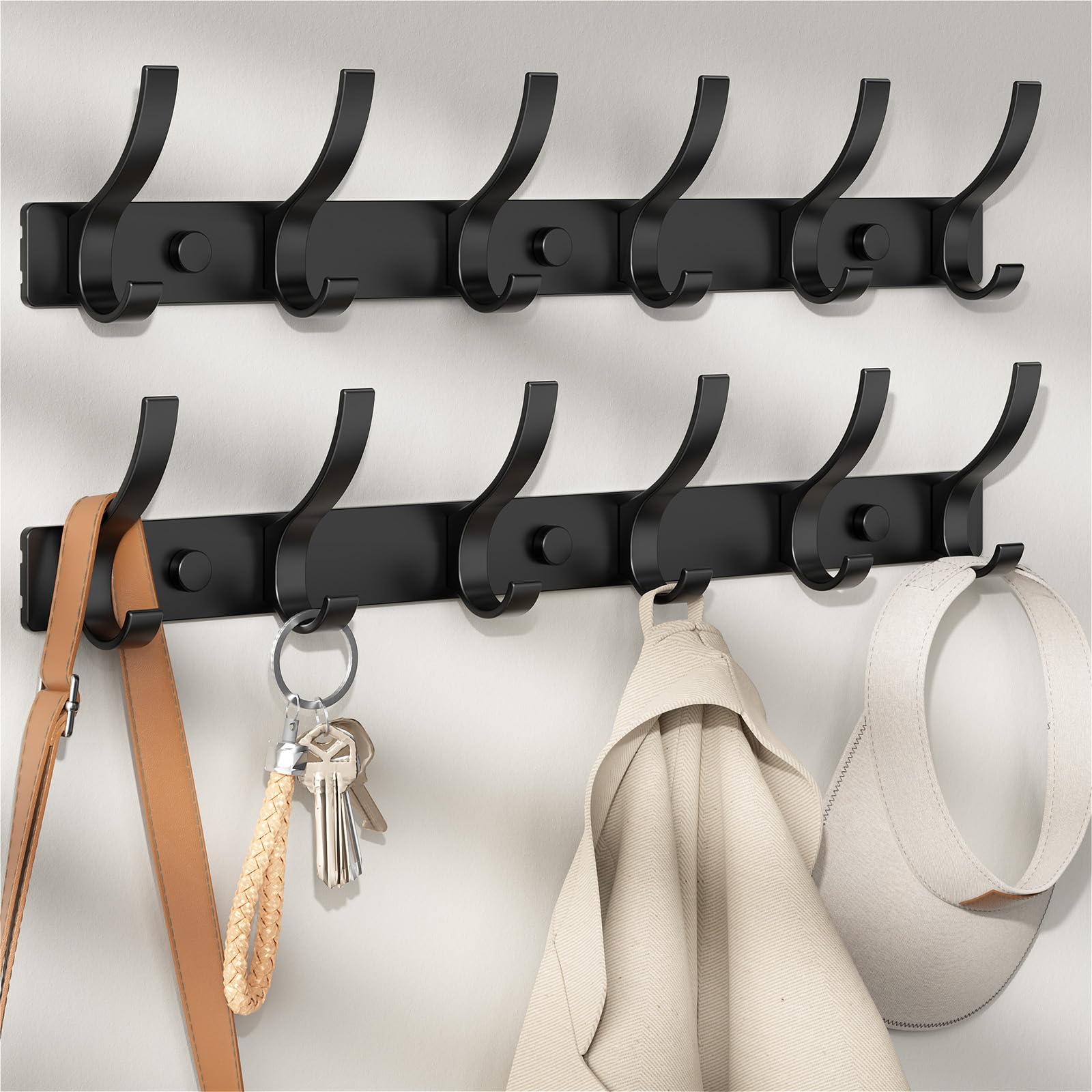
Optish 2-Piece Wall Coat Rack

Optish 2-Piece Wall Coat Rack

8.9/10 Excellent
  • Hooks: 12 across 2 panels
  • Mounting: Wall, anchors included
  • Load Capacity: 44 lb
  • Per-hook Capacity: 11 lb
Check Price on Amazon

Pros

  • Two panels put 12 hooks on a wall
  • 11 pounds per hook, 44 for the pair
  • Rounded hooks and hidden screw caps
  • Anchors and screws included

Cons

  • Hooks sit close together for bulky coats
  • Supplied screws are short for some walls

Some entryways have no floor to give: a narrow hall, the strip behind a door, the wall above a bench. That is the case for a rail of hooks, and this Optish two-pack is the least fussy version of the idea. Matte black aluminum, screw caps that hide the heads, twelve rounded hooks across two panels, and a footprint you could measure in paint.

The numbers to plan around are 11 pounds per hook and 44 for the pair. That is not a knock, it is about right for daily coats, bags, and hats, but it does mean the rack is happiest with weight spread across several hooks. Two coats and a bag per panel is realistic; one loaded work backpack on a single hook is asking more than the anchors want.

Where it gives ground is spacing. Six hooks on a short panel sit close together, and a puffy parka swallows the room of two, which quietly turns twelve hooks into six in a winter hallway. Slim coats, kids' jackets, hats, and towels are where this rack shines; four heavy work coats is where it stops being twelve hooks and starts being a compromise.

Installation is straightforward with the included screws and expansion anchors, and the screw caps are the detail that makes it look built in rather than bought. Mount the panels at shoulder height, as far apart as your wall allows, and the hallway gains a place for everything without losing a single square foot.

Bottom Line: We recommend the pair for narrow halls and behind-door walls: twelve rounded hooks, tidy screw caps, and no floor space spent.
#5

Best for Renters

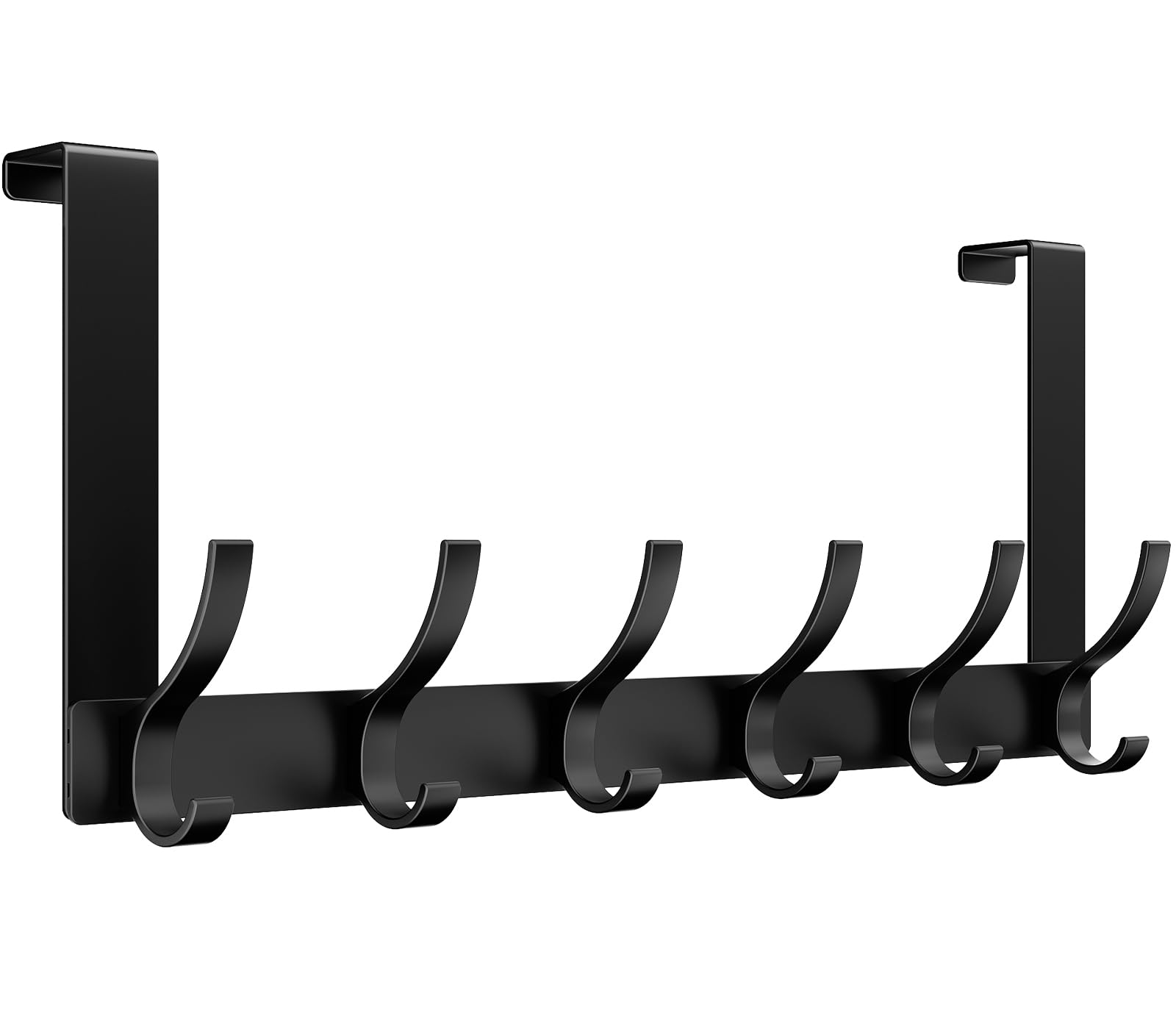
Optish Over-the-Door Hooks

Optish Over-the-Door Hooks

8.7/10 Excellent
  • Hooks: 12
  • Mounting: Over-the-door, no drilling
  • Load Capacity: 44 lb
  • Door Thickness: 3.8 to 4.4 cm
Check Price on Amazon

Pros

  • No drilling, no anchors, no holes to patch
  • Padded back protects door paint
  • 12 hooks on long 18 cm arms
  • Least expensive hanging space in this guide

Cons

  • Hooks shift slightly as the door swings
  • Small hooks crowd bulky hangers

The spec that decides everything here is door thickness. Optish gives a range of 3.8 to 4.4 cm, and a standard interior door sits at roughly 3.5 cm. Toward the thin end the bracket hangs loose and rattles; on a thick door it grips. It is a two-minute measurement, and it is the difference between the handiest way here to add hanging space and a return label.

Get the fit right and it earns its place. No drill, no anchors, no holes to fill when you move out, and the whole thing lifts off in a second for a repaint or a new apartment. The back is lined with soft sponge, a small thing we ended up valuing more than the hook count, because it does not scuff the paint or bang against the door every time someone closes it.

Twelve hooks on 18 cm arms hold more than the size suggests: a winter coat, a bag, a couple of towels, and the arms are long enough to clear the door molding so nothing presses against the frame. On a door that opens and closes a dozen times a day it is the least expensive way here to add hanging space, and it leaves every wall in the place untouched.

Bottom Line: For rentals and dorms we recommend it: twelve hooks, no drilling, a padded back that protects the door, as long as your doors measure in range.
#6

Best Wooden

Hupmad Wooden Coat Rack Stand

Hupmad Wooden Coat Rack Stand

8.9/10 Excellent
  • Hooks: 8
  • Base Spread: 17.5 inches
  • Load Capacity: 15 lb
  • Height Options: 39.5, 54.2, 69 inches
Check Price on Amazon

Pros

  • Three heights from 39.5 to 69 inches
  • No tools needed to assemble
  • Rounded pine pegs do not snag knits
  • Warm natural finish suits bedrooms

Cons

  • 15-pound capacity suits light layers only

Three heights in one box is the reason to look at this one. Leave a section out and it stands at 39.5 inches, which is a child's rack; add one back and it is 54.2 for a teenager; the full 69 inches takes adult coats. No tools are involved in changing it, so it can grow with the household instead of being replaced by it, and for a hallway with a small coat in the mix that flexibility is worth more than two extra hooks.

It is New Zealand pine, and the sections screw into each other by hand. Pine is soft, so the joints are where you take care: snug rather than forced, and no single peg carrying the whole family's wet laundry. Eight rounded pegs around the top and a 17.5-inch leg spread hold jackets, scarves, and bags comfortably within what the stand is rated for.

Loaded within that, it is steady, and it looks better in a bedroom than any metal stand here: natural pine, smooth rounded pegs, the tree silhouette everyone pictures when they hear coat rack. A knit scarf slides off without snagging, and the finish is polished enough that it does not read as flat-pack. We point people here when the rack goes somewhere a guest will see it and the coats are ordinary rather than expedition-grade.

Bottom Line: The wooden pick we recommend for bedrooms and family halls: three heights that grow with a child, tool-free assembly, and a warm pine look.

How We Tested the Best Coat Racks

We started with a catalog of more than 30 racks — freestanding trees, wall-mounted rails, over-the-door styles, and a few leaning ladder designs — and narrowed it by hook count, published footprint, stated weight limits, and whether the mounting hardware came in the box. Price worked as a filter rather than a ranking: anything costing more than a modest entryway bench had to justify it in materials and stability. That left 12 racks, which we assembled and used for six months.

Assembly came first, timed solo with a screwdriver and no second pair of hands, since most people put these together on a weeknight. We counted the pieces, noted whether anchors and screws were included or meant a hardware store run, and flagged any step where the instructions stopped making sense. Then each rack moved into a real entryway, its footprint marked on the floor with painter's tape so we could see how much hall it claimed and whether a door still swung past it. We also looked at every one from the front door in daylight, because that's the angle guests actually see.

The load test separated them. We hung loaded backpacks and grocery totes from the end hooks, doubled bulky parkas on a single hook, and draped wet umbrellas and rain-soaked jackets over the arms to see what the finish did. We bumped into racks on the way out the door and shook them hard at shoulder height. Over the months we tracked joints that loosened, hooks that bent and rounded tips that snagged knitwear, bases that crept across the floor, and paint that chipped. The ones that took all of it without wobbling are the ones below.

How to Choose Coat Racks

Start with the base and the feet

Three legs and a wide spread look stable in a listing photo and behave differently in a hallway. A four-leg steel base with screw-adjustable feet, the arrangement on our top pick, can be leveled to a floor that slopes, which is the most common reason a stand rocks every time someone walks past. A three-legged pine stand leans on the floor being flat and the load being balanced.

Whichever you choose, spread the weight around the ring instead of hanging everything on one side. That single habit does more for stability than any base design, and it is what separates a rack that lasts five years from one that lives in the garage.

Freestanding, wall-mounted, or over-the-door

Floor space usually decides this before preference does. The freestanding stands here spread their legs across 11 to 22 inches of floor, and you need clearance beyond that for a door to swing past. A wall rail gives you the most hooks per square foot and costs you four screw holes; the two-panel Optish is the version to consider when the strip behind a door is the only wall you have.

Over-door hooks cost no floor space and no holes, but they hinge on one measurement. Check your door thickness against the stated range before you order, because a bracket built for a thicker door hangs loose and rattles on a thin one.

Match capacity to the coats you actually own

Hook counts flatter. A twelve-hook rack does not hold twelve winter coats, because coats need air between them or they end up crushed at the shoulders. Two honest measures matter more: the stated weight rating, which runs from 10 pounds on the lightest stand here to 105.8 on the sturdiest, and the space between hooks, which decides whether a parka takes one slot or two.

For a household of four with real winters, look for a rating in the high tens of pounds rather than the low teens, and count the gap between hooks as carefully as the hooks themselves.

Height, reach, and the corner you have

Most stands top out between 68 and 73 inches, tall enough for a long coat to hang clear of the floor and short enough to reach without stretching. The question is who else needs a hook. Adjustable stands let you set a child-height section now and raise it later; fixed stands with hooks at several heights do a similar job with less flexibility.

Measure the corner before you commit. A stand placed where a door swings into it ends up moved, and a rack in a hallway narrower than its base spread becomes something you turn sideways to pass.

Material and finish

Coated steel shrugs off wet coats and keeps its look; painted wood chips at the joints, particularly where screws bite into it. Natural pine is warmer in a bedroom and hides scuffs better, but the screw-together joints loosen if you overtighten them or overload the pegs.

Look at the hooks as closely as the frame. Rounded or ball-tipped ends are the difference between a scarf that slides off and one that snags and pulls. Bronze reads traditional, matte black disappears against a wall, and pine suits rooms that already have wood in them.

Frequently Asked Questions

Final Verdict

For most hallways, the Songmics is the rack to buy: four legs with adjustable feet, sixteen hooks at usable heights, and a load rating that does not ask you to ration coats. It is the one we would put in a house where coats actually pile up.

Two situations change the answer. If umbrellas and wet weather dominate your entryway, the Hoctieon's built-in well and drip tray earn their premium. And if there is no floor to give up at all, the two-panel Optish wall rack adds twelve hooks without spending a square foot of it.