Entryway

Best Entryway Storage Cabinet of 2026

An entryway cabinet has one job: catch the shoes, bags, mail, and keys that come through the door before they spread into the rest of the house. The trouble is that most of them make you choose between capacity and floor space. Go too small and the shoes pile up beside it; go too big and a narrow hallway starts to feel like a storage unit. The right cabinet should earn its footprint, holding what you actually drop at the door while looking like furniture rather than a locker.

I spent eight months with 11 cabinets, assembling them solo, loading them with shoes and bags, and living with the finish, the wobble, and the instructions. The pattern: appearance and sturdiness matter most, but assembly and fit decide whether you keep it. A cabinet that is an inch too deep can block a door; one with vague instructions can turn a Saturday into a fight. We judged value by what held up after daily use, not by the sticker alone. The picks below are the ones that survived the morning rush.

#1

Best Overall

BORNOON Shoe Cabinet, 3 Flip Drawers

BORNOON Shoe Cabinet, 3 Flip Drawers

9.1/10 Outstanding
  • Drawers: 3 flip drawers
  • Material: Engineered wood
  • Footprint: 9.45"D x 31.5"W x 47.24"H
  • Shoe Capacity: 18 to 24 pairs
Check Price on Amazon

Pros

  • Three flip drawers hold 18 to 24 pairs
  • 9.45-inch depth clears a narrow walkway
  • Adjustable, removable dividers reconfigure each drawer
  • Walnut finish and top shelf read as furniture

Cons

  • Tall boots need a drawer reconfigured
  • Caps at 24 pairs; the widest pick holds about 30

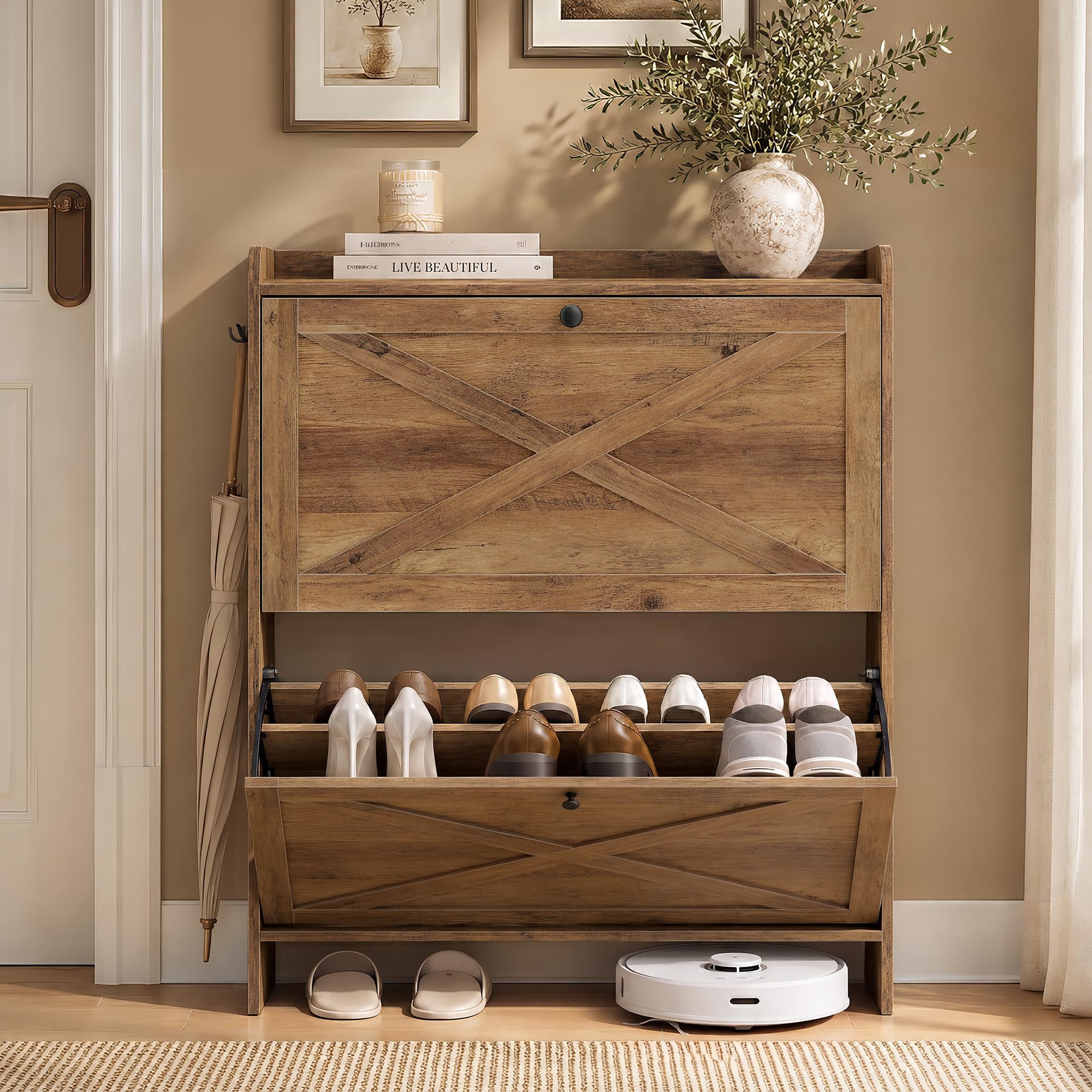
Eighteen to twenty-four pairs from a cabinet 9.45 inches deep sounds like a listing getting carried away, right up until you open a flip drawer and see the two tiers inside. That is the arithmetic that makes this the one we recommend first: a household's shoes, hidden, in the footprint of a narrow bookshelf.

The dividers in each drawer adjust and the panels lift out, so you can open a bay wide enough for chunky sneakers or a pair of ankle boots. The limit is the drawer's interior height rather than its width — tall boots need a drawer reconfigured into one deep row, and a full-height pair still will not be happy. The top panel gives you the display shelf the entryway has been missing: a tray, a plant, and somewhere for the mail.

At 47.24 inches tall and finished in walnut, it reads as furniture rather than a shoe rack, which is most of the battle in a hallway you actually look at. Two things to accept. It has to be anchored — a tall, shallow cabinet loaded with shoes is exactly what an anti-tip strap is for, and the hardware comes in the box. And assembly is an afternoon rather than twenty minutes; the parts are labeled, but there are a lot of them.

What we did not expect was how much quieter the hallway gets when the shoes disappear behind a door. If your entry currently has a rack, a pile, and a mat, this replaces all three and leaves you a shelf at the top for the things that arrive with you.

Bottom Line: The one we recommend for most hallways: three flip drawers swallow a household's shoes in a 9.45-inch-deep footprint, and the walnut finish makes the entryway look deliberate.
#2

Best for the Daily Drop Zone

RWYHG Shoe Cabinet, 2 Flip Drawers

RWYHG Shoe Cabinet, 2 Flip Drawers

8.6/10 Excellent
  • Drawers: 2 flip drawers
  • Footprint: 9.44"D x 31.5"W x 45.47"H
  • Open Storage: Drop-zone shelf and 6.29" base gap
  • Shoe Capacity: Up to 16 pairs
Check Price on Amazon

Pros

  • Open base keeps daily shoes off the floor
  • Drop-zone shelf for keys and sunglasses
  • Anti-tip device included

Cons

  • About 16 pairs, well short of the top pick

The 6.29-inch gap under this cabinet earns its keep faster than any drawer. It is where the shoes you actually wear live — slippers, the trainers kicked off at the door, the school shoes — so the two flip drawers stay shut until you need something else. Above them sits an open shelf at hand height for keys, wallet, and sunglasses.

We like that it treats an entryway as somewhere things land rather than somewhere things are stored. Most cabinets in this group hand you a top surface and nothing else, which is how daily shoes end up back on the floor beside the thing you bought to hold them. The open shelf asks for something in return: keep it tidy, or it becomes a display of receipts and lanyards.

Two flip drawers hold up to 16 pairs, with interior shelves that adjust for different shoe shapes, and the cabinet's 45.47 inches of height buys that capacity without taking floor space. The blue farmhouse panels and black metal handles are a point of view, not a neutral — this is not the cabinet for a pared-back hallway. It ships with an anti-tip device, and a cabinet this tall and this shallow should use it.

Sixteen pairs is an honest ceiling, and a lower one than our top pick's. What you get for it is a shelf and an open base you will touch every day of the week.

Bottom Line: For the shoes that never make it into a drawer, this is the pick: an open base, a drop-zone shelf, and two flip drawers for everything else.
#3

Best Narrow Farmhouse Pick

VASAGLE Narrow Shoe Storage Cabinet

VASAGLE Narrow Shoe Storage Cabinet

8.4/10 Very Good
  • Footprint: 9.4"D x 32.7"W x 40"H
  • Side Hooks: 2
  • Shoe Capacity: 14 to 16 pairs, to US 11
  • Drawer Shelves: 3-position adjustable
Check Price on Amazon

Pros

  • Hooks and a raised-edge top hold everyday gear
  • Three-position shelf in each drawer
  • 9.4-inch depth at a lower height

Cons

  • Caps out around a US 11

Set this beside our top pick and the footprints nearly match — 9.4 inches deep, 32.7 wide — but the VASAGLE is about seven inches shorter and holds 14 to 16 pairs instead of 18 to 24. The trade is worth it for the detail work: a raised lip running around the top panel so a plant or a set of keys does not slide off, and two hooks on the side for bags and lanyards. In a hallway that needs a landing spot more than it needs another tower, this is the version we pick.

Each flip drawer has a shelf that moves through three positions, so one drawer can be set up for flats while the other takes bulkier trainers. The barn-door fronts with metal accents give it a farmhouse look the plainer cabinets here do not attempt, and the honey-brown finish is warm enough to sit against wood floors without matching them exactly.

Open a loaded drawer and the whole thing rocks. The anti-tip kit and the non-slip foot pads come in the box, and fitting them is the difference between a cabinet that shifts under your hand and one that does not move at all. Do that on day one, before the shoes go in, and the wobble stops being something you notice.

Bottom Line: For a narrow entryway that needs somewhere to put things down, this earns the space: hooks, a lipped top, and 14 to 16 pairs behind farmhouse doors.
#4

Best Console-Height Option

Homleke Farmhouse Shoe Cabinet, 2 Barn Doors

Homleke Farmhouse Shoe Cabinet, 2 Barn Doors

8.8/10 Excellent
  • Doors: 2 barn doors
  • Shelves: 3 adjustable, 5 levels
  • Footprint: 13.8"D x 27.6"W x 31.5"H
  • Shoe Capacity: About 16 pairs
Check Price on Amazon

Pros

  • Console height sits under a window
  • Deep 13.8-inch interior takes bags and baskets

Cons

  • You crouch to reach the bottom shelf

Thirty-one and a half inches is short for a shoe cabinet and exactly right for a console. That height is the whole argument: the top lands where you can drop a bag and a set of keys, the cabinet settles under a window instead of looming over it, and it does not dominate a narrow entry the way a 47-inch tower does.

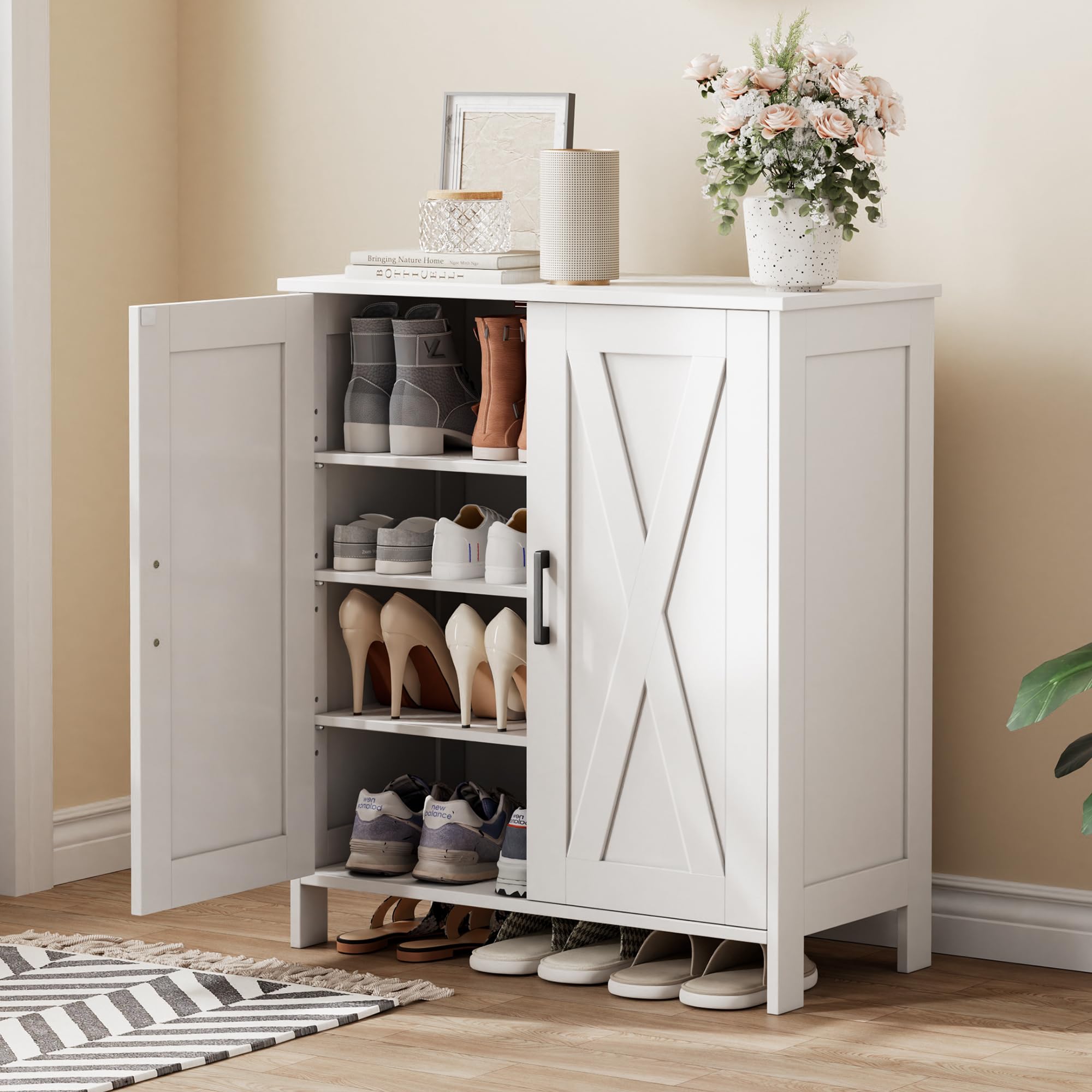
Behind the two barn doors, three adjustable shelves split the interior into five levels, so you can open one up for taller items and keep the rest tight for everyday pairs. The 13.8-inch depth is the most generous of the slim cabinets here — shoes sit flat rather than angled, and a shelf cleared out will take a tote or a basket of hats and gloves. Magnets hold the doors shut, and the white finish with black U-legs is easy to live with.

This is the one we put in a hallway that doubles as a room — a space you walk through rather than a closet by the door. Around 16 pairs covers a couple's everyday shoes plus a few extras, and it takes the bags and umbrellas that no flip drawer will. The compromise is vertical: fewer tiers than a tower means a four-person collection will not all fit, and the shelves are the part you will rearrange most.

Bottom Line: It is a console first and a shoe cabinet second: barn doors, deep adjustable shelves, and around 16 pairs, in a height that suits a room.
#5

Best for Big Families

ONBRILL Shoe Cabinet, 3 Doors

ONBRILL Shoe Cabinet, 3 Doors

8.7/10 Excellent
  • Weight: 86.3 lb
  • Footprint: 13.8"D x 43.8"W x 39.6"H
  • Top Capacity: 70 lb
  • Shoe Capacity: About 30 pairs
Check Price on Amazon

Pros

  • About 30 pairs behind three doors
  • Top rated to 70 pounds
  • Five adjustable legs level on uneven floors
  • Three doors let two people reach in at once

Cons

  • Two-person lift at 86 pounds
  • Doors can arrive out of alignment

Forty-three point eight inches wide, this holds about 30 pairs behind three doors — roughly double what the slim flip-drawer cabinets manage, and enough that nobody in the house needs a second storage spot. It is the only cabinet here that reads as furniture first and shoe storage second, which is what you want when the entryway is also the living room.

For a family with a pile at the door, that capacity is the whole point, and the details hold up their end: the top is rated to 70 pounds so a lamp or a heavy plant is fine up there, five adjustable legs let you level it on a floor that slopes, and the three-door split means two people can get at their shoes at the same time. That last part sounds trivial until you have shared one flip drawer with someone in a hurry.

The doors are where our enthusiasm cools. They can arrive sitting with visible gaps, and the fix is a hinge adjustment rather than a return — budget that time right after assembly, while the hinges are still easy to reach. Otherwise this is the cabinet for a household that owns more shoes than a slim hallway cabinet was ever going to hold.

Bottom Line: When the shoe pile is a family-sized problem, this is the cabinet that ends it: about 30 pairs behind three doors and a top that takes a lamp.
#6

Best Small-Household Pick

QIVOMIX Shoe Cabinet, 2 Flip Drawers

QIVOMIX Shoe Cabinet, 2 Flip Drawers

8.8/10 Excellent
  • Drawers: 2 flip drawers
  • Footprint: 9.4"D x 31.5"W x 38"H
  • Top Capacity: 80 lb
  • Shoe Capacity: About 14 pairs
Check Price on Amazon

Pros

  • Walnut grain with rose-toned handles
  • Thickened top rated to 80 pounds
  • Two flip drawers keep shoes out of sight

Cons

  • About 14 pairs: the smallest capacity here

Two people's shoes, not four. That is the honest read on a cabinet that holds about 14 pairs across two flip drawers, and it is the right size for a couple in a flat where the entry is a few feet of wall beside the bathroom door.

The walnut grain finish and the rose-toned arc handles are why you choose this over the plainer cabinets here, and we liked the thickened top: it is rated to 80 pounds, so a bowl for keys, a plant, and a lamp can all share it without the panel feeling like it is about to bow. The rounded handles are a small thing that matters more than it sounds — no corners at hip height in a tight hallway.

Assembly is the long pole. The parts are numbered and the steps are clear, but this is an evening's work, and the fiddly stretch is hanging the drawer fronts — have someone hold them while you drive the screws, and the last hour goes faster.

For two people who want the hallway to look finished, that is a fair trade: you give up capacity, you keep the look, and you get a top surface that swallows the clutter. A handsome cabinet that happens to hold shoes is the point of putting one where you will see it every day.

Bottom Line: A small-household cabinet that looks more expensive than it is: walnut grain, rose-toned handles, and a solid top for the drop zone.
#7

Lowest cost

GRUSIGN Shoe Cabinet, 2 Flip Drawers

GRUSIGN Shoe Cabinet, 2 Flip Drawers

8.4/10 Very Good
  • Weight: 43 lb
  • Top Load: 110 lb
  • Footprint: 9.45"D x 31.5"W x 39.8"H
  • Shoe Capacity: Up to 16 pairs
Check Price on Amazon

Pros

  • Least expensive way into a flip-drawer cabinet
  • Two drawers and four tiers hold up to 16 pairs
  • Anti-tip strap included

Cons

  • Tight for men's size 11 and up
  • Instructions are thin on detail

The least expensive cabinet here, and it shows in the places that matter least: the white finish is clean, the flip fronts line up, and the metal frame does most of the structural work while the panels stay thin. What you are buying is the format — two drawers, four tiers, up to 16 pairs — at the lowest entry point in this group.

Where the budget shows is shoe size. The drawer interiors are the tightest of the cabinets here: men's size 11 and up are a squeeze, and the 16-pair figure assumes a mix of smaller shoes, so a household of big sneakers should count on fewer. The instructions are thin on words, so keep the parts sorted and give yourself an afternoon.

We think it is a fair buy for a first apartment, a back door, or a rental where you do not want to spend much on a hallway. Anchor it before you fill it: a light, tall cabinet with a loaded drawer is exactly the case the included anti-tip strap is for, and doing it first is easier than doing it after. It will not be the piece guests mention, and it will end the pile by the door.

Bottom Line: If the budget is the constraint and your shoes run average-sized, this is the flip-drawer cabinet to start with: slim, anchorable, and cheap to get into.
#8

Styled console

REHOOPEX Fluted Storage Cabinet

REHOOPEX Fluted Storage Cabinet

8.6/10 Excellent
  • Doors: 2 fluted doors
  • Weight: 45 lb
  • Shelves: 2 adjustable
  • Footprint: 13.7"D x 30.3"W x 30.49"H
Check Price on Amazon

Pros

  • Fluted doors in a natural wood finish
  • Two adjustable shelves behind two doors
  • Deep top works as a console surface

Cons

  • No shoe-specific storage: flat shelves only
  • Doors can arrive out of flush

We kept coming back to the fluted doors, and they are the reason this one is on the list. Two grooved panels, slim metal handles, a natural wood finish that catches hallway light — it is the only cabinet in this group someone will ask you about, and the only one that does not look like it was bought to hide shoes.

What it is, though, is a sideboard: 30.3 inches wide, 30.49 tall, 13.7 deep, with two adjustable shelves behind two doors and nothing shoe-specific about the inside. Shoes go in flat and heel to toe, which turns a shelf into a jumble rather than a row, and a tall boot needs a shelf pulled out entirely.

Two things to look over when it lands. The doors can arrive not quite flush — the hinges adjust, and it is worth doing before you decide you have been sent a bad one. And the back panel is thin enough to chip in transit, so open the box over something soft and keep the packaging until every panel has been checked.

As entryway storage it earns its place when the room needs a surface and somewhere to hide the bags, hats, and dog leash, with the shoes living in a cabinet or a basket instead. If the shoe pile is the real problem, one of the flip-drawer cabinets above does more for the same hallway.

Bottom Line: The one to buy when the entryway needs to look good first: fluted doors, a console surface, and hidden shelves for everything except the shoes.

How We Tested Entryway Storage Cabinets

We started with two dozen entryway cabinets from furniture and home brands, then narrowed the list by footprint, depth, shelf layout, and price. We ruled out anything too deep for a standard hallway, anything with a shoe shelf too shallow for a men's size 10, and anything that looked flimsy in photos. The 11 finalists ranged from open benches to closed-door cabinets with drawers and cubbies.

Each cabinet was assembled solo and timed from box opening to last screw. We noted whether the instructions matched the hardware, whether the diagrams were legible, and whether a second set of hands was needed. We photographed the finish in morning light and under a hallway lamp, then checked for fingerprints, scuffs, and veneer that lifted after a few weeks. We measured depth and width against door swings and baseboards; a cabinet that blocks the coat closet is one you'll resent.

We loaded them the way an entryway gets loaded: shoes kicked off at the door, backpacks dropped on top, mail tossed in a basket, umbrellas leaning against the side. We counted how many pairs of adult and kids' shoes fit without cramming and tested shelves at their highest and lowest settings. For stability, we opened every door and drawer at once, nudged the frame, and leaned on it while putting on shoes. Wobble, sliding, and missing anti-tip hardware went into our notes.

After eight months of daily use, we checked for sagging shelves, loose hinges, worn edges, and sticking drawers. We compared materials, hardware, and usable storage against what each cabinet asked you to pay — not just at unboxing, but after the honeymoon phase. The 11 that made it through are the ones we'd recommend; the others either fought us during assembly or wasted floor space.

How to Choose the Right Entryway Storage Cabinet

Depth decides, then width

Every cabinet here is between 9.4 and 13.8 inches deep, and that half-foot is the difference between a hallway you walk through and one you turn sideways in. The flip-drawer cabinets run about 9.4 to 9.5 inches — barely deeper than the shoes inside them — while the console-style cabinets need closer to 14. Then check width: these picks run from 27.6 to 43.8 inches, and a 31.5-inch cabinet is not narrow if your entry is 30 inches across.

Tape the footprint on the floor for a day before you order, and look at what it covers: the light switch, the baseboard heat, the door swing. The trap is the word narrow itself. In these listings it usually means shallow, not small, and a slim cabinet that is three feet wide still blocks a tight hall.

Flip drawers, hinged doors, or open shelves

Flip drawers pull straight out, so you never need clearance in front of the cabinet and each drawer carries two tiers of shoes. They only take shoe-shaped things, though: boots often need a divider pulled, and a bag or a basket will not go in at all. Hinged doors over adjustable shelves take everything — boots, bags, a basket of hats — but you crouch for the bottom level and the doors eat floor space while they are open. Open shelves and bases are for the three pairs you wear this week.

Match the format to what is actually piling up. If it is shoes, drawers win on capacity per inch. If it is everything else that arrives at the door, doors and shelves win.

Shoe fit is measured in height, not pairs

Pair counts assume a mix of smaller shoes. If anyone in the house wears above a men's 10, treat the advertised number as a ceiling, not a promise: the drawer interior is the constraint, and the cabinets here that cap out around a US 11 are being honest about it. Boots are the other test, and a drawer with a removable divider can be opened into one deep bay where a fixed shelf cannot.

Before you buy, measure the tallest pair in the house — a boot shaft, a high-top — and check that the drawer splits or lifts out, or choose a cabinet with adjustable shelves instead.

Anchor it before you load it

Tall, shallow cabinets are front-heavy by design, and a flip drawer full of shoes pulls that weight forward every time it opens. The flip-drawer picks here ship with anti-tip hardware; use it, into a stud or with a wall anchor rated for the load, before the shoes go in. This is the step people skip because an empty cabinet feels solid. It is not empty for long.

What assembly and finish actually cost you

Flat-pack assembly is an evening, not an hour, and the last step is the one that needs a second pair of hands: hanging drawer fronts or aligning doors so they sit flush. Sort the numbered parts first and keep the packaging until every panel has been checked, because thin back boards and painted edges are where transit damage shows up.

On finish, walnut and honey-brown hide scuffs better than white, and a fluted or patterned front hides the everyday wear a hallway hands out. None of that matters as much as the anchor, but it is what you look at for the next five years.

Frequently Asked Questions

Final Verdict

Start with the BORNOON. Three flip drawers, 18 to 24 pairs, and a 9.45-inch depth make it the best default here for a hallway that has to stay a hallway, and the walnut finish means it does not have to hide.

Two requirements change that. If the household is big enough that 30 pairs is the real number, the ONBRILL does the job in one wide piece of furniture. If the entryway needs a surface for keys and bags more than another tower, the Homleke's console height is the better shape.