Home Office

Best Desks of 2026

A wobbly desk is a special kind of torture: every keystroke sends a ripple through your coffee, and no folded paper under one leg ever really fixes it. Then there's the assembly marathon, the desktop that doesn't fit through the door, and the finish that looks nothing like the photo. A good desk solves all of that—it stays solid, goes together without swearing, fits your space, and looks like it belongs there. My team and I spent seven months living with nine desks in a home office, and the differences came down to sturdiness, smart sizing, and honest materials.

The first thing most people get wrong is shopping by looks alone. A desk's footprint matters more than its style—measure your space and the doorways it has to come through before you fall for a finish. Value isn't just the sticker price; it's how the joints hold up after a year of daily use, whether the surface resists scratches, and how much the whole thing weighs when you need to move it. Below are the nine that earned a permanent spot.

#1

Best Overall

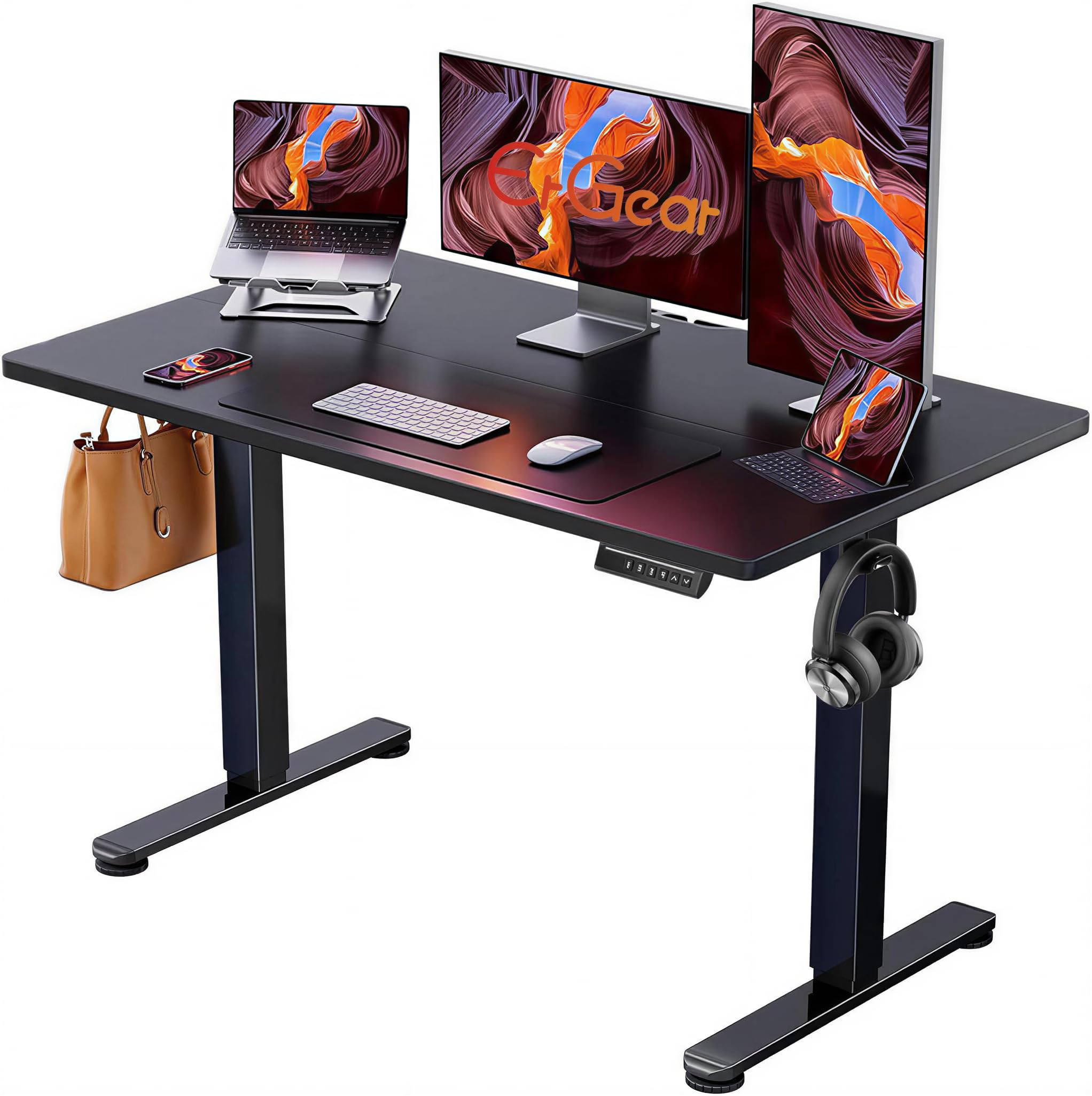
ErGear 48-Inch Standing Desk

ErGear 48-Inch Standing Desk

8.9/10 Excellent
  • Desktop Size: 47.2 x 23.6 inches
  • Height Range: 28.35 to 46.5 inches
  • Memory Presets: 4
  • Weight Capacity: 176 lb
Check Price on Amazon

Pros

  • Electric sit-stand at fixed-desk money
  • Four presets return you to your heights
  • 176-pound rating covers two monitors and an arm
  • Quiet motor we stopped noticing

Cons

  • Two people make the 43.8-pound assembly easier

The surprise with the ErGear is how little the standing mechanism costs you in practice. For roughly what a mid-range fixed desk runs, you get a 47.2 by 23.6 inch top that travels from 28.35 inches to 46.5, a steel frame rated for 176 pounds, and four memory presets on the control panel.

That makes it the desk we recommend to most people, and not because standing is a virtue in itself. The 24-inch depth keeps a monitor at a comfortable distance, the presets turn a posture change into one button press, and the motor is quiet enough that we stopped noticing it after a few days of raising and lowering the desk mid-task.

Assembly is the part to plan for. The frame and top together weigh 43.8 pounds and the manufacturer suggests two people; one careful person can manage, but the box is awkward rather than heavy. At full standing height the desk has a little side-to-side give when you lean on the front edge. Keep the tower on the floor rather than the desktop and it stops mattering.

What separates it from the fixed desks here is the working day rather than the spec sheet: two or three posture changes, no clearing of the surface, no unplugging. If you know you'll sit all day, the VASAGLE gives you more surface for less money; if you want a single-piece top the width of a bench, that's the Vari.

Bottom Line: Our default recommendation: a sit-stand desk that fits two monitors, remembers your heights, and costs about what a good fixed desk does.
#2

Best for a Big Workspace

Vari Classic 72-Inch Desk

Vari Classic 72-Inch Desk

9.4/10 Outstanding
  • Warranty: Lifetime
  • Desktop Size: 72 x 30 inches
  • Height Range: 25 to 50.5 inches
  • Top Construction: One-piece laminate
Check Price on Amazon

Pros

  • One-piece 72 x 30 top with no seam
  • Widest height range here, 25 to 50.5 inches
  • Lifetime warranty on the frame
  • Dual motors move a loaded top smoothly

Cons

  • By far the most expensive desk here
  • 135 pounds, so moving it takes two people

Seventy-two inches of desktop arrives in one piece — no seam, no split down the middle, and no spot where a clamp-on arm can't go. Against the 48- and 55-inch desks here, that changes the working day: two monitors, a laptop, a keyboard, and still a clear stretch of surface for papers or a notebook.

The frame is equally ambitious. Dual motors run the top from 25 inches to 50.5, with four saved heights, and the assembly is the least fiddly in this group: the frame comes preinstalled and the legs slide and lock rather than needing a dozen bolts.

This is the desk for someone whose work anchors the day, and the only one here we think of as a long-term buy. The low end of the range matters as much as the high one — at 25 inches it suits a shorter user or a chair with a tall cushion, where desks that stop at 28 leave your feet dangling — and the lifetime warranty is the longest commitment any maker here offers.

The 30-inch depth is the other thing you feel daily. With the monitor pushed back there's room for a keyboard and forearms on the surface, which none of the 19-inch desks here allows. If 72 inches isn't the point, the ErGear gives you the standing function on a much lighter frame.

Bottom Line: We reach for this when the desk is the center of the working day: a 72-inch one-piece top, dual motors, and a lifetime warranty.
#3

Best Value Full-Size Desk

VASAGLE 55-Inch Computer Desk

VASAGLE 55-Inch Computer Desk

9.1/10 Outstanding
  • Height: 29.9 inches
  • Desktop Size: 55.1 x 19.7 inches
  • Leveling Feet: Four, adjustable
  • Weight Capacity: 110 lb
Check Price on Amazon

Pros

  • 55-inch surface at the lowest full-size price
  • Adjustable feet level it on uneven floors
  • 24 pounds, light enough for one person

Cons

  • 19.7-inch depth is shallow for monitor arms

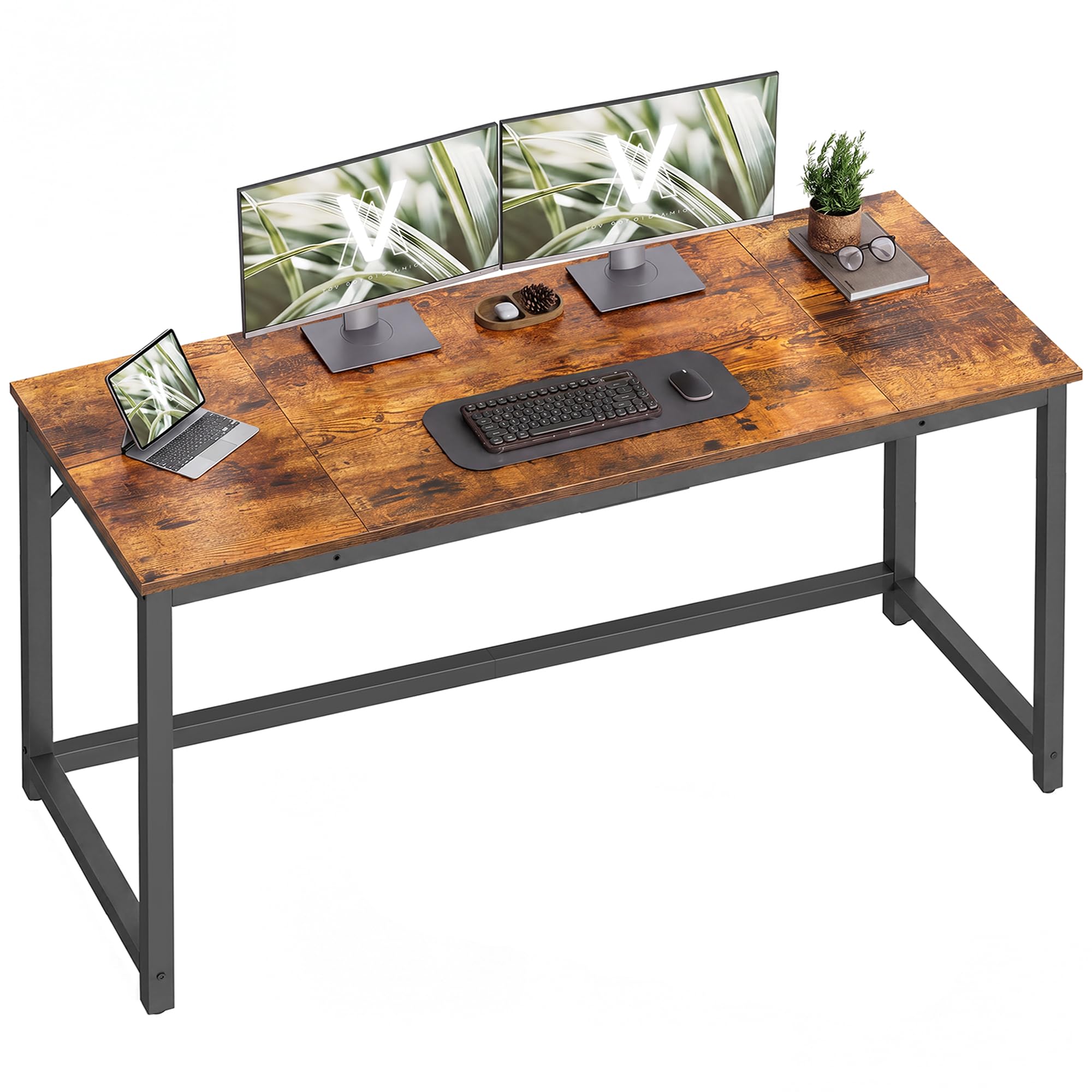
Fifty-five inches of desktop for less than either 40-inch desk here is the argument, and it holds up. The VASAGLE is the desk we point to when someone wants surface area and has no interest in a motor: a steel frame, a particleboard top in rustic brown, and four adjustable feet so an uneven floor doesn't turn into a wobble.

The 19.7-inch depth is the number to think about. A monitor on its own stand plus a keyboard fits comfortably; a large clamp-on arm and a notebook spread out, less so. If your setup is a laptop and a second screen on a riser, it's a non-issue. If you work with paper, look at the 24-inch platforms instead.

Assembly is the pleasant part — labeled parts, hardware in the box, and a 24-pound frame one person can flip over to fit the legs — and the 110-pound rating is sensible for the size. The warm brown top against black legs is also a nicer thing to look at than the all-black finish most budget desks wear, which counts for something in a bedroom.

Bottom Line: We send budget shoppers here: 55 inches of surface, leveling feet for uneven floors, and a frame light enough to move on your own.
#4

Best Corner Desk for Gaming

AODK 53-Inch L-Shaped Desk

AODK 53-Inch L-Shaped Desk

9.1/10 Outstanding
  • Power: 3 outlets, 2 USB ports
  • Height: 29.8 inches
  • Storage: Two shelves, CPU stand, hook, bag
  • Desktop Size: 53.15 x 18.9 inches
Check Price on Amazon

Pros

  • Three outlets and two USB ports in the top
  • Reversible L fits either corner
  • Shelves, hook, and bag take the clutter

Cons

  • 18.9-inch depth crowds a large monitor
  • CPU platform too narrow for big towers

A corner gaming setup usually means a power strip on the floor, a headset lying on the desktop, and a tower eating legroom. The AODK is built against that: three AC outlets and two USB ports in the top, an LED strip underneath, two shelves, a headphone hook, a storage bag, and a CPU stand, all on a reversible L measuring 53.15 by 18.9 inches.

The outlets are the part that earns its keep — one cable to the wall and everything else plugs in at desk level. The reversible design lets the shelves hang left or right, so the desk fits whichever corner the room gives you, and the 1-inch top is as thick as any in this guide.

The CPU platform under the desk is narrow, and a full-size tower can overhang it, so measure your case before you count on it living there. Assembly is well labeled, which matters more than usual on an L where two top panels have to line up, and the shelves are display space rather than hiding space: plan on baskets if you want the corner to stay tidy.

Bottom Line: Our pick for a gaming corner: built-in outlets, a reversible L, and shelves that get the console and the headset off the desktop.
#5

Best Small Corner Desk

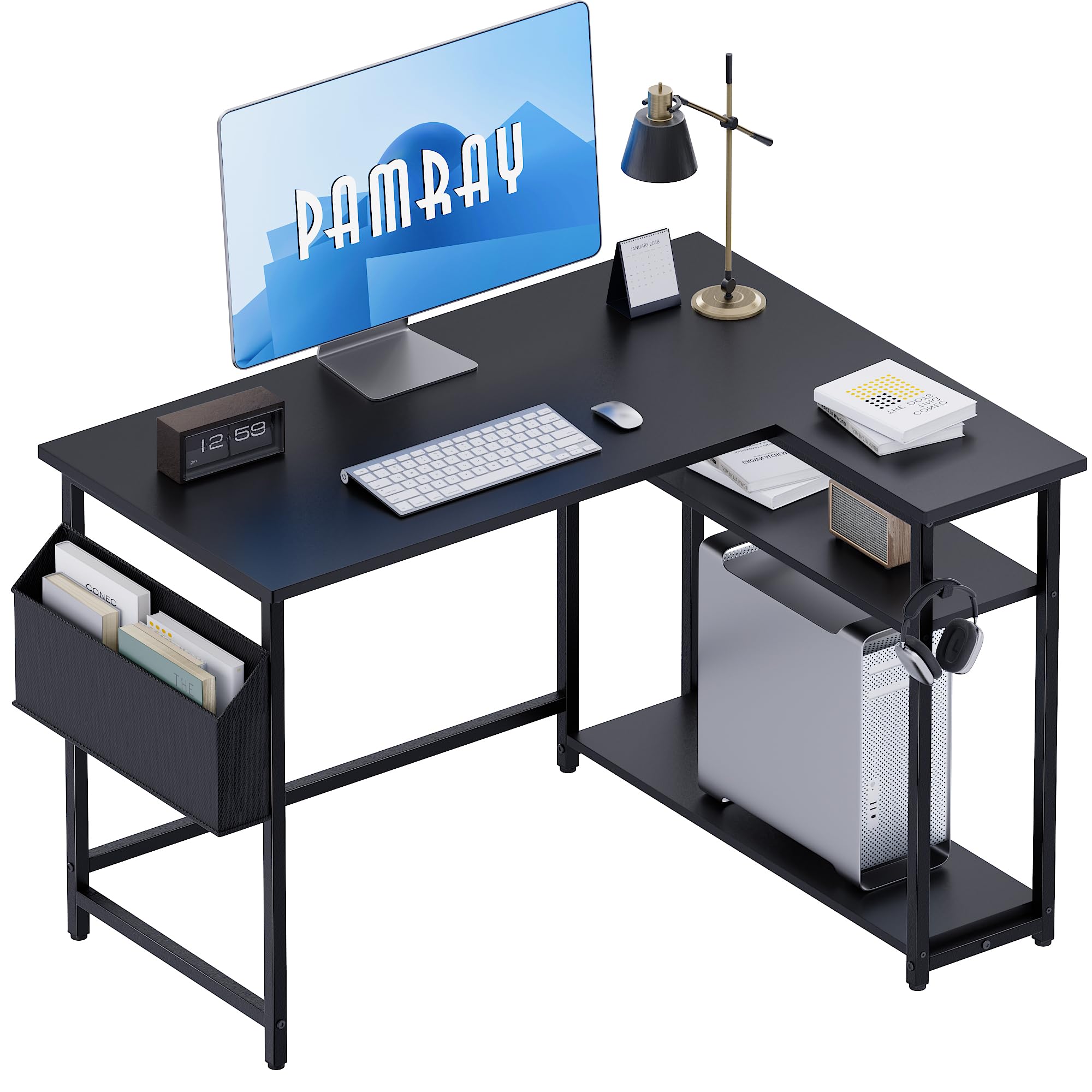
Pamray 40-Inch L-Shaped Desk

Pamray 40-Inch L-Shaped Desk

9.0/10 Outstanding
  • Height: 29.2 inches
  • Shelves: Two, adjustable and reversible
  • Desktop Size: 39.3 x 27.5 inches
  • Weight Capacity: 150 lb
Check Price on Amazon

Pros

  • True corner footprint in a small room
  • 27.5-inch depth leaves room for a keyboard
  • Reversible, height-adjustable side shelves
  • 150-pound rating with six leveling feet

Cons

  • Short arms make dual monitors plus speakers tight

Bedroom corners are the hardest place to put a desk, because a rectangle either blocks the bed or leaves a wedge of dead space behind it. The Pamray's answer is a compact L: 39.3 inches across the whole footprint and 27.5 inches deep, with two shelves on reversible, height-adjustable brackets.

The shelves are the reason to choose it over a plain small desk. They hang on either side, so it works in a left or right corner, and they lift the printer, the books, or a console off the surface without eating the 39-inch top. Six adjustable feet handle a floor that isn't level, and 150 pounds is a sensible rating for the size.

For a small room, this is the corner desk we pick. The depth is what sells it: 27.5 inches leaves your forearms supported and a monitor at a comfortable distance, where the 19-inch desks here have you sitting closer than you might like. What it won't do is host a wide dual-monitor setup with speakers — the arms are short, so treat the shelves as the overflow.

Bottom Line: We choose this when the room is small but the work isn't: a real corner footprint, 27.5 inches of depth, and shelves that keep the top clear.
#6

Best Compact Desk

SHW Mission 40-Inch Desk

SHW Mission 40-Inch Desk

9.2/10 Outstanding
  • Height: 28 inches
  • Warranty: 5-year limited
  • Desktop Size: 39.37 x 18.9 inches
  • Weight Capacity: 110 lb
Check Price on Amazon

Pros

  • 19 pounds: carry it, build it, move it alone
  • Longest warranty on a fixed desk here
  • Low 28-inch surface suits shorter users

Cons

  • Black top shows scratches and edge chips

Twenty-eight inches is the number to start with. That's lower than every other desk here and two inches below the usual 30, which makes the SHW either exactly right or quietly wrong depending on who sits at it: fine for a shorter user, a keyboard tray, or a child's study corner, and a hunch for anyone much over six feet.

Everything else is deliberately plain. A 40 by 18.9 inch top, a steel frame, a 110-pound rating, and 19 pounds of desk — light enough to carry upstairs alone and to shift when you vacuum. Assembly uses the included hardware and one person, and the parts go together in the obvious order.

The 5-year limited warranty is the longest on any fixed desk in this guide, and it's the sort of thing that matters more than a feature. On a desk this simple, coverage is the difference between a disposable purchase and one you keep through a couple of moves.

We recommend it to anyone furnishing a first apartment, a dorm room, or a spare-room study — people who need a surface, not a system. Go elsewhere if you're tall: the VASAGLE gives you 55 inches at a standard height and costs less, and the ErGear adds the standing option for a bit more.

Bottom Line: We keep this one in the guide for its 19-pound frame and five-year warranty: a plain desk one person can carry, build, and move again.
#7

Wood-tone setups

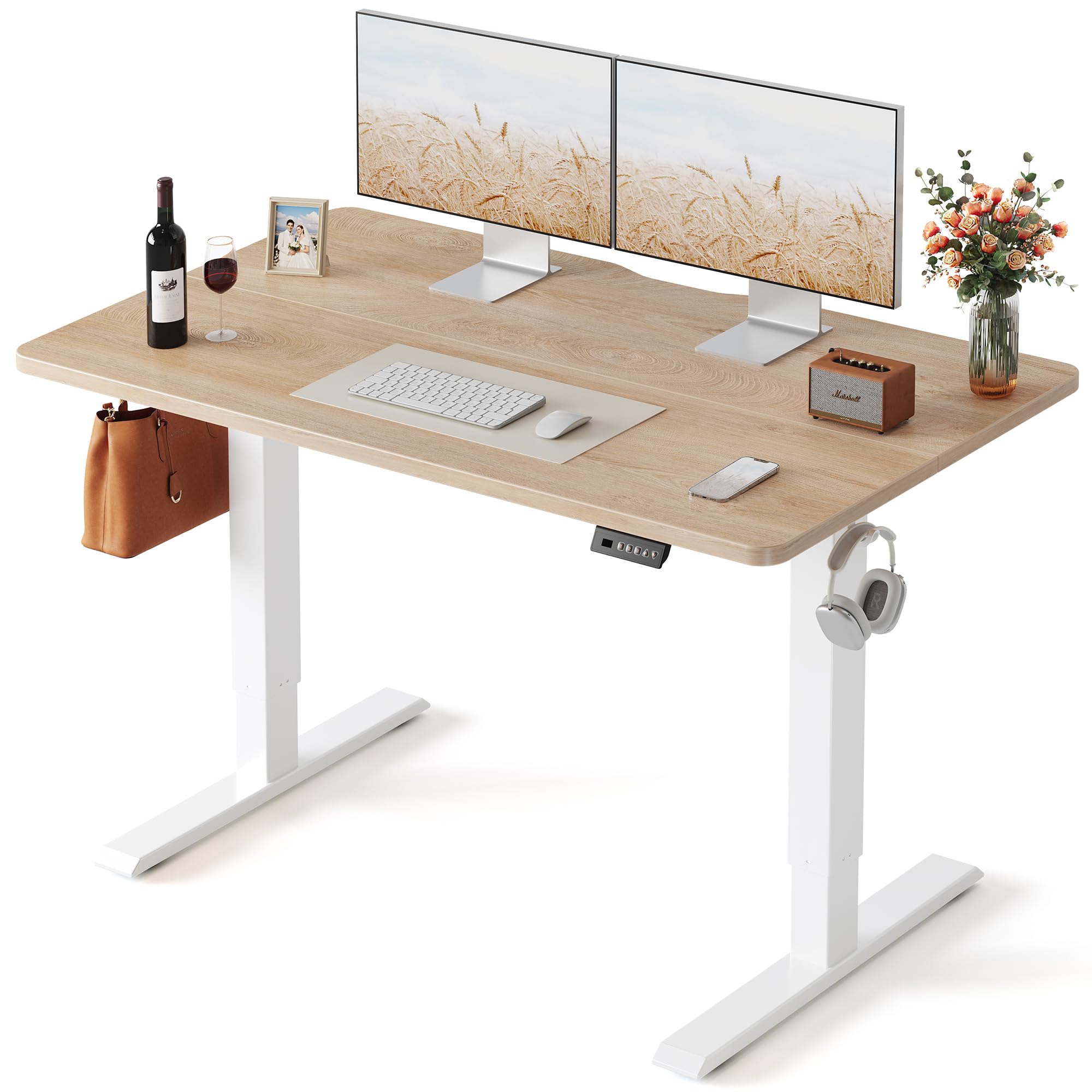
FEZIBO 48-Inch Standing Desk

FEZIBO 48-Inch Standing Desk

8.9/10 Excellent
  • Desktop Size: 47.2 x 23.6 inches
  • Height Range: 28.3 to 46.5 inches
  • Top Material: FSC-certified wood
  • Weight Capacity: 176 lb
Check Price on Amazon

Pros

  • FSC-certified wood in a maple finish
  • Three presets and a motor rated under 45 dB
  • Most of the frame arrives pre-assembled

Cons

  • Two-piece desktop leaves a seam down the middle

The maple top is why this desk is here. Every other standing desk in this guide is black, and the light wood finish — FSC-certified — makes a bedroom office feel less like a cubicle, which is a strange thing to pay for until you spend eight hours a day looking at it.

Underneath it's a familiar package: 47.2 by 23.6 inches, a 176-pound rating, three memory presets, and a motor rated under 45 decibels with a headphone hook on the side. Most of the frame arrives pre-assembled, and the desktop goes on in two pieces — which is the detail worth knowing.

Those two pieces meet in a seam that runs across the middle of the work surface. A laptop and a monitor on their own stands won't care. A clamp-on arm that lands on the seam won't hold as firmly as one on a solid top, and crumbs find it. If your setup is one screen and a keyboard, the seam never enters your day.

Set against the ErGear, it costs more for one fewer preset and that split top; the trade is the wood tone and the certification. If neither of those is the thing you're after, the cheaper desk is the better desk.

Bottom Line: We pick it when the finish matters: FSC-certified maple, three presets, and a quiet motor, with a seam across the top to work around.
#8

Tight nooks

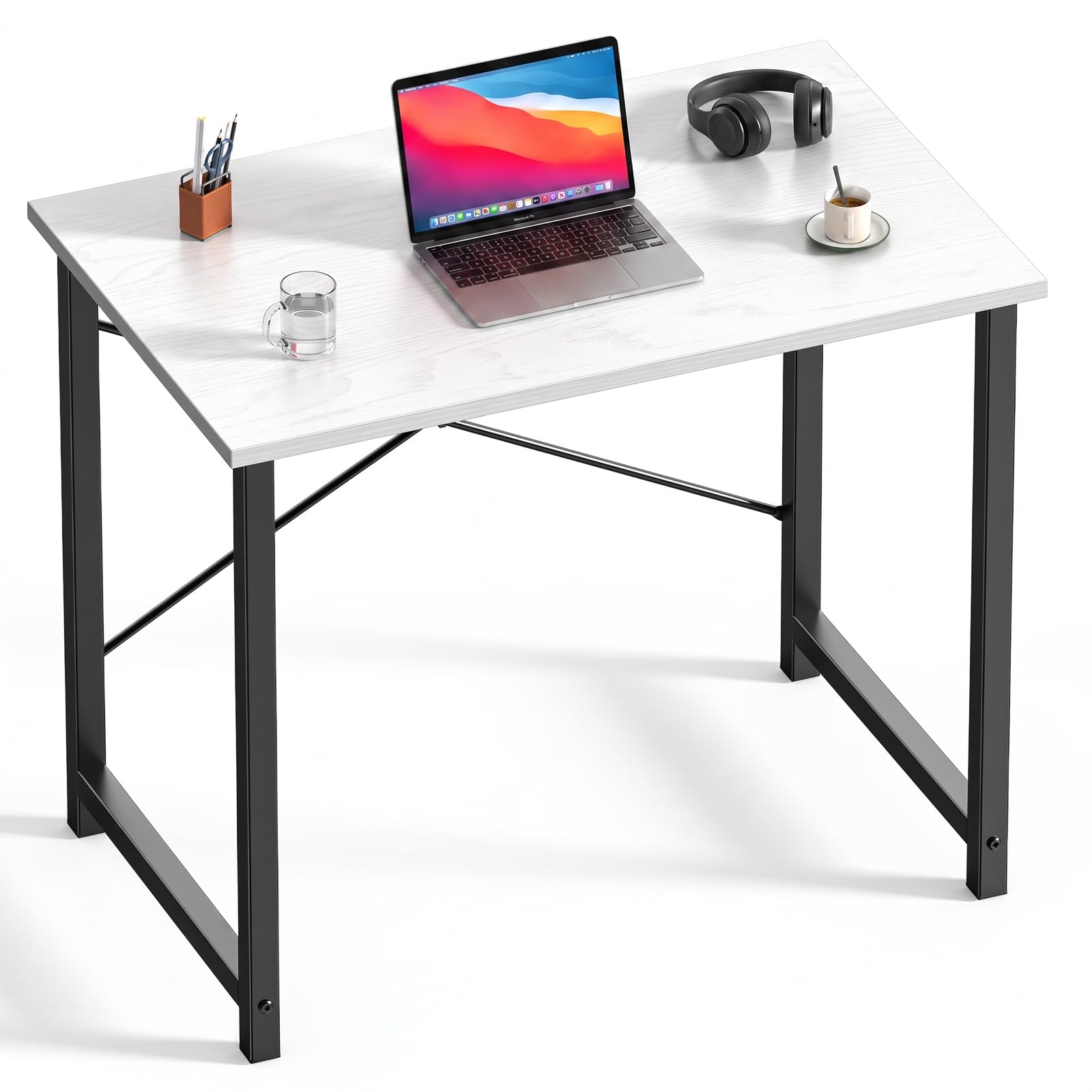
DUMOS 32-Inch Computer Desk

DUMOS 32-Inch Computer Desk

9.1/10 Outstanding
  • Frame: X-braced steel
  • Height: 29.7 inches
  • Desktop Size: 31.5 x 19.7 inches
  • Weight Capacity: 265 lb
Check Price on Amazon

Pros

  • Smallest footprint here at 31.5 inches
  • X-braced frame resists side-to-side sway
  • Lowest price in the roundup

Cons

  • 31.5 inches fits one monitor plus a laptop

At 31.5 inches wide, this is the smallest desk in the guide and the cheapest, and that's the whole case: if the room offers a nook rather than a wall, this is the desk that fits it. It's 29.7 inches high — a standard working height rather than the 28 inches of the SHW — so a normal chair and a normal keyboard position work without adjustment.

What the money buys is an X-braced steel frame that resists the side-to-side sway cheap desks are known for, a 0.6-inch top, and a 265-pound rating that's higher than desks twice the size. The top is thin enough that a clamp-on monitor arm wants a reinforcement plate underneath.

The finish is the trade. Scuffs and pencil dents stay put on a top this thin, and the white-and-black version shows marks sooner than a woodgrain would. At 17.4 pounds it goes up stairs and into a car without help, which is more than the bigger desks here can say.

Bottom Line: We hand this to anyone with a nook instead of a room: the smallest footprint here, a braced frame, and the lowest price in the guide.

How We Tested the Best Desks

We started by researching the desks that showed up most often in reviews and design roundups, then narrowed the list to nine models that spanned different sizes, materials, and assembly styles. Over seven months, we assembled each one solo, set it up as a primary workspace in a home office, and rotated in friends and family for real workdays. That meant typing, writing, paying bills, and helping kids with homework, not just looking at the desk from across the room.

Assembly was timed from unboxing to first usable moment, with notes on how many tools were needed and whether the instructions made sense. Once built, we spent at least two weeks per desk, paying attention to how much it wobbled during aggressive typing or when we leaned on the edge. We also measured every footprint with a tape measure and tested whether each desk could fit through a standard doorway and into a small bedroom versus a larger office.

To judge sturdiness and durability, we loaded each desk with a monitor, a stack of books, and a coffee mug, then checked for sway and surface scratches after a month of daily use. We weighed each desk and moved it from room to room to see how easy it was to reposition alone. For quality and appearance, we inspected joints, hardware, and finish, and noted how the materials held up to sunlight and cleaning wipes. Finally, we compared each desk's price to its construction and features—value here meant how well it would age, not just what it cost on day one.

How to Choose Desks

Width and depth: what the top actually fits

Width decides how many screens; depth decides how far away they sit. A 40-inch top holds one monitor and a laptop. Forty-eight to 55 inches is where two monitors, a keyboard, and a mouse sit comfortably. At 72 inches you stop thinking about space at all. Depth is the quieter number: 19 to 20 inches puts a large monitor closer than many people want, 24 inches is the comfortable middle, and 27 to 30 inches leaves room for paper as well as a keyboard.

The trap is buying width when you need depth. A 55-inch desk that's 19.7 inches deep looks generous in a photo and feels tight once a monitor arm and a notebook are on it. Measure the distance from your eyes to the screen you like — usually 20 to 24 inches — and let that set the shortlist before you fall for a wide top.

Fixed height or electric sit-stand

The mechanism is the biggest decision after size. A fixed desk at 29 to 30 inches suits most adults; 28 inches, like the SHW, is lower and better for shorter users or anyone working with a keyboard tray. Electric desks add a motor, memory presets, and usually 15 to 25 pounds of frame, which is where the extra money goes.

Check the bottom of the range, not just the top. The Vari starts at 25 inches, the ErGear at 28.35; if you're short or your chair sits high, the lower figure is the one you live with. And every frame has more sideways give at full height, so buy the range you'll actually use — if you stand once a day, a fixed desk and a monitor riser do much of the same job for a lot less.

Corners, small rooms, and the L-shape question

An L-shaped desk buys work surface without needing a longer wall, and it turns dead corner space into somewhere to work. The catch is that the quoted width is the whole footprint, not the length of each arm: the Pamray's 39.3 inches and the AODK's 53 inches are measured across the entire shape, so an L that fits a corner still leaves fairly short arms.

An L only helps if both walls are genuinely free and nothing needs the corner — a wardrobe, a door swing, a radiator. Reversible designs let you choose which side the shelves hang on, and that is often the difference between fitting a room and not. In a tight room we would rather have 40 inches with 27.5 inches of depth than 55 inches with 19.7.

Tops, weight, and assembly

Almost every affordable desk is particleboard or engineered wood under a laminate. That's fine — it wipes clean and doesn't warp — but the edges are the weak point and black finishes show every scuff. Thickness is the tell: an inch resists flex and holds a clamp better than the 0.6 inch on the smallest desks here.

Then look at the box. A 19-pound desk is a solo job; a 135-pound frame with a one-piece 72-inch top is not, and good instructions don't change that. Rated capacity matters if you plan a monitor arm, a printer, or a tower on the desktop: 110 pounds covers a screen and a laptop, 176 covers a heavier setup.

Frequently Asked Questions

Final Verdict

Start with the ErGear. It covers a normal home office without a compromise you'll notice: two monitors fit, four presets remember your heights, and the motor is quiet enough to disappear.

Spend more only if you want the Vari's 72-inch one-piece top or the FEZIBO's wood tone. Spend less only if you know you'll never stand, in which case the VASAGLE's 55-inch surface at the bottom of the price range is the better buy.