Home Office

Best Sit-Stand Desks of 2026

A sit stand desk sounds like an upgrade until you're staring down a wobbling surface, a cryptic instruction booklet, and a motor that groans halfway up. The point is to make switching between sitting and standing feel effortless — not to add a new project to your week. Over eight months, I've lived with eight different desks, and my team has assembled, raised, lowered, and shaken every one of them. The right desk disappears into your routine: it holds steady when you type standing, moves smoothly, and looks good enough that you don't want to hide it in a spare room.

What I didn't expect is how much the little things separate a great desk from a frustrating one: the clarity of the instructions, whether the frame stays aligned after months of use, and how easily it rolls if you need to move it. And value isn't about the lowest price — it's about getting a desk that feels solid, looks intentional, and doesn't make you dread assembly. Below are the ones that earned a permanent spot in our offices and homes.

#1

Best Overall

FLEXISPOT EN1

FLEXISPOT EN1

9.0/10 Outstanding
  • Desktop Size: 48 x 24 in
  • Height Range: 28-46.5 in
  • Memory Presets: 4
  • Weight Capacity: 176 lb
Check Price on Amazon

Pros

  • One-piece top avoids a center seam
  • 176-pound capacity handles dual monitors
  • Four presets and a five-year frame and motor warranty

Cons

  • No drawer or cable tray, only clips

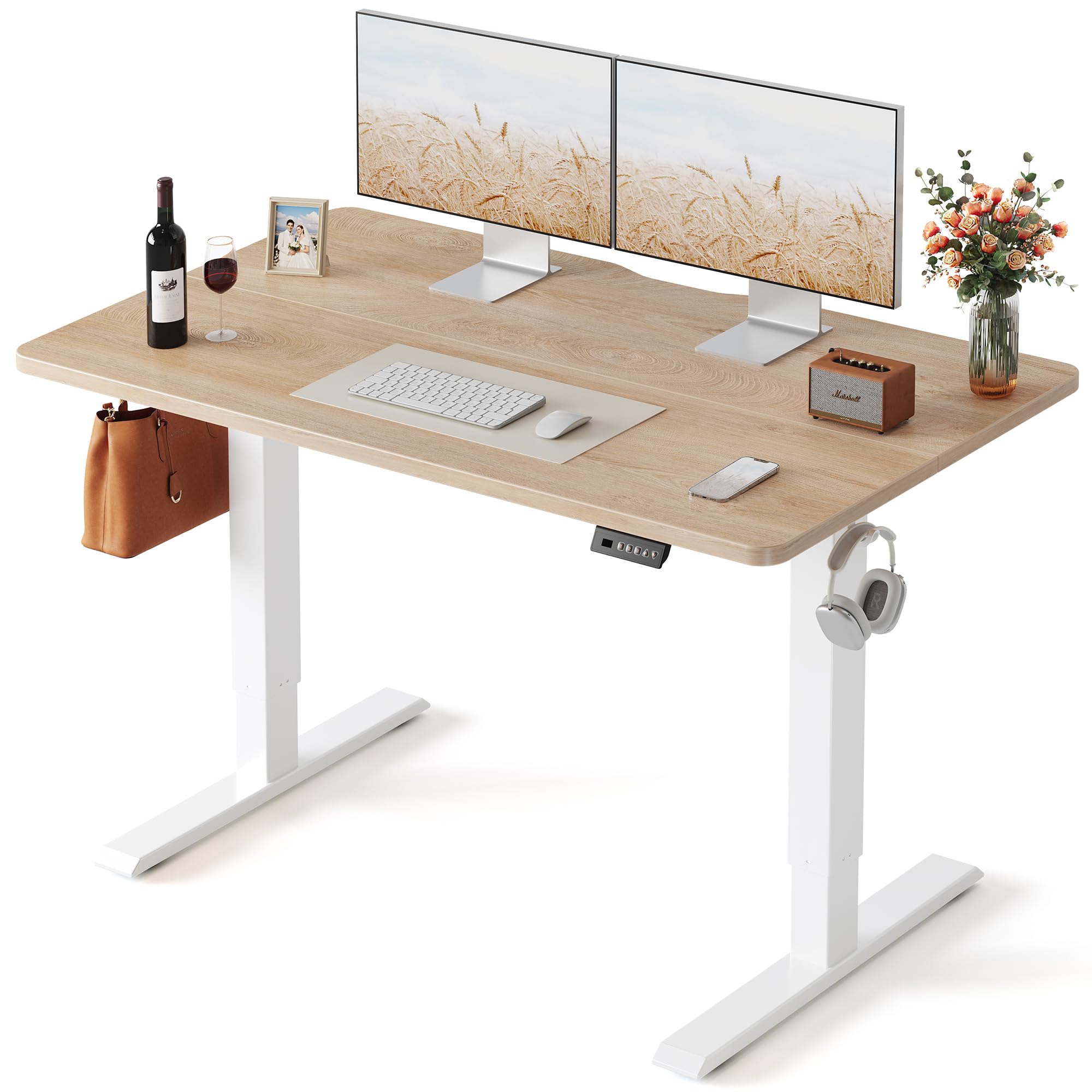
A one-piece desktop sounds like a small detail until you have worked on a split top with a seam under your mouse. The EN1's seamless 48-by-24 surface is the reason we put it at the top: it gives you a clean writing and pointing area, and the 176-pound rating means a dual-monitor setup sits well within its comfort zone. The five-year frame and motor warranty is the other half of the case.

Four presets are more useful than they look on a shared desk, and the 28-to-46.5-inch range covers most seated and standing positions. We like that the frame is rated for 176 pounds rather than a lighter budget frame. Assembly is a one-person job, though the bracket images are the weakest part of the guide; dry-fit the top and leave the bolts loose until everything lines up.

The 48-inch width is the main trade-off. For a laptop and one or two monitors it feels generous, but two large monitors plus speakers will crowd it, and that is where the 60-inch Desktronic HomeOne earns its place. If your setup is closer to a single screen and a keyboard, the smaller surface is an advantage: it leaves more room around the desk.
Bottom Line: The EN1 is the desk we recommend as the default home-office buy: one-piece top, four presets, and a 176-pound frame cover a normal monitor setup without overbuying.
#2

Best for Large Setups

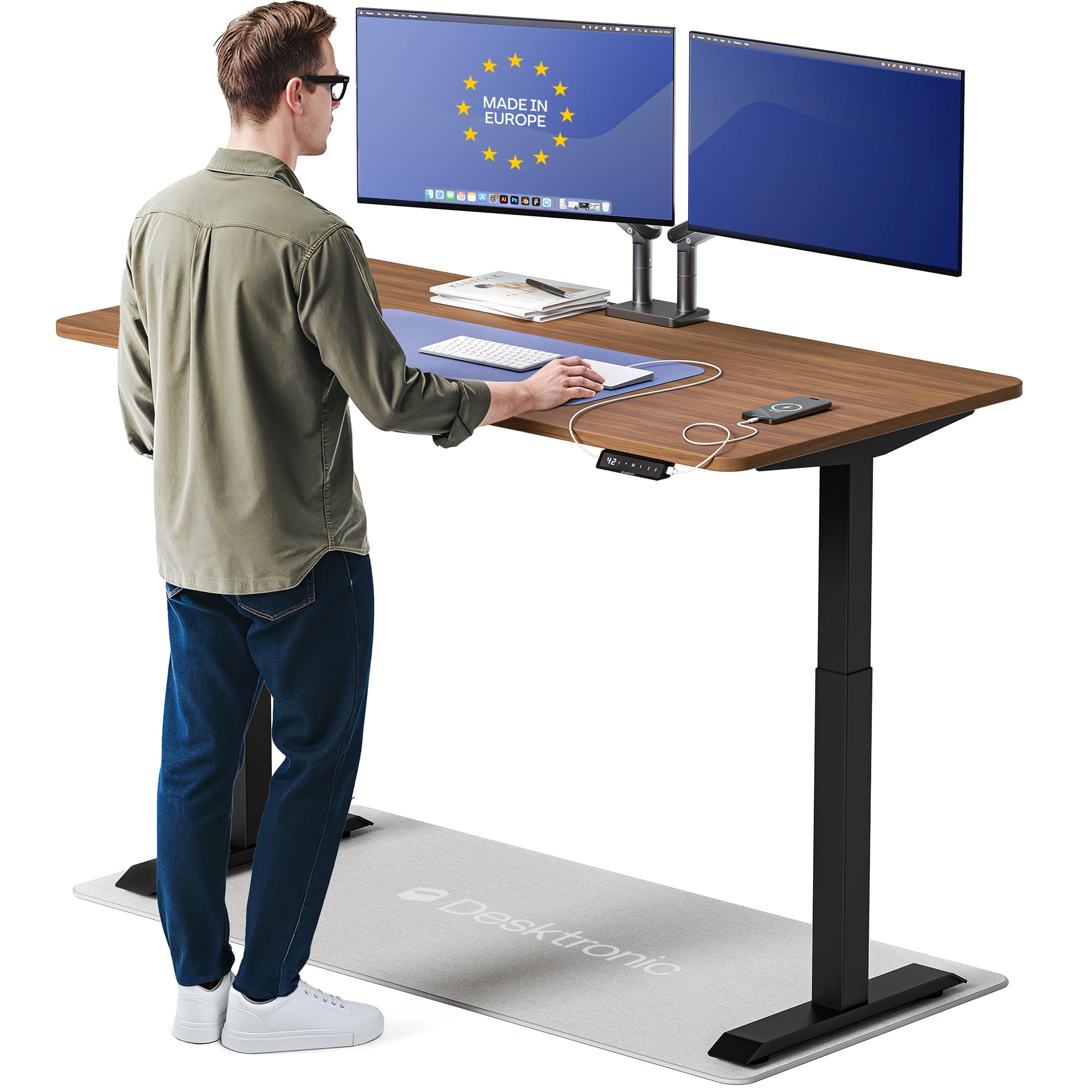
Desktronic HomeOne

Desktronic HomeOne

9.4/10 Outstanding
  • Desktop Size: 60 x 30 in
  • Height Range: 28.9-48 in
  • Charging Ports: USB-A and USB-C
  • Weight Capacity: 265 lb
Check Price on Amazon

Pros

  • 60-by-30 top leaves room for multi-monitor work
  • Dual motors and 265-pound capacity
  • USB-A and USB-C charging built into controller

Cons

  • 28.9-inch minimum is high for shorter users
  • 80-pound build needs two people to move

The HomeOne is the desk in this group that assumes you are staying put. Its 60-by-30 top gives a monitor arm, a laptop, and a keyboard room to spread out, and the dual-motor frame carries up to 265 pounds. That is the specification that separates it from the 48-inch desks here.

What stands out to us is the combination of size and charging: USB-A and USB-C ports sit in the controller, so a phone or headset can stay topped up without a separate hub. Three presets cover a shared sit-stand routine, and the 28.9-to-48-inch range goes higher than most. We recommend it for a dedicated office, not a corner you are trying to keep minimal.

The 60-inch width is a commitment. Measure the wall and the door swing before ordering, because this desk dominates a small room. What you get in return is a surface that does not feel crowded when a second monitor arrives, and an 80-pound build that stays put once it is assembled.

Bottom Line: For a permanent workstation, the HomeOne is our pick: its dual-motor frame, 60-by-30 top, and 265-pound capacity take a heavy multi-monitor load in stride.
#3

Best Value

ErGear 48-Inch

ErGear 48-Inch

8.9/10 Excellent
  • Desktop Size: 48 x 24 in
  • Height Range: 28.35-46.46 in
  • Memory Presets: 4
  • Weight Capacity: 176 lb
Check Price on Amazon

Pros

  • 176-pound frame at a budget position
  • Four memory presets
  • 48-by-24 top fits a normal setup

Cons

  • Two-piece top leaves a center seam

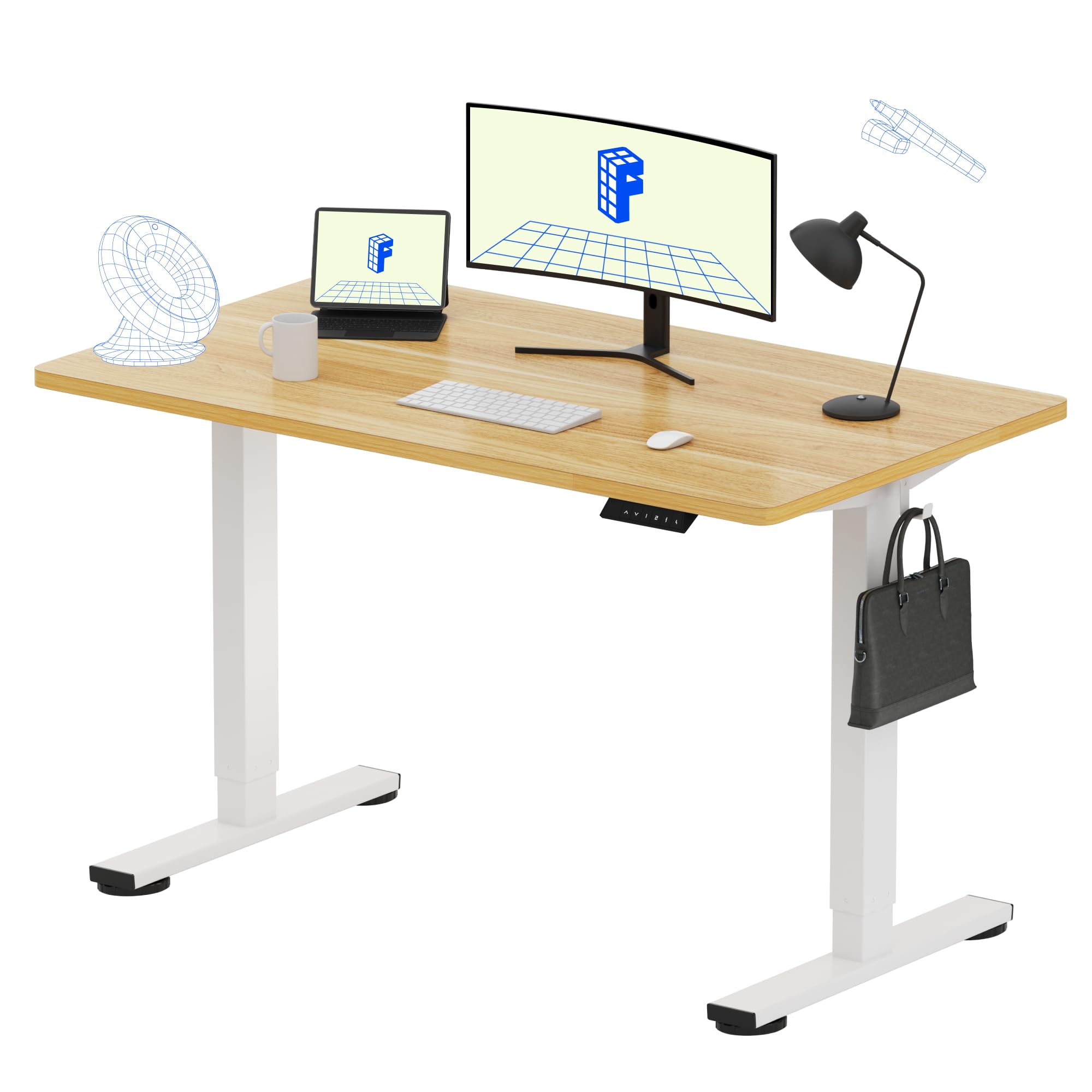
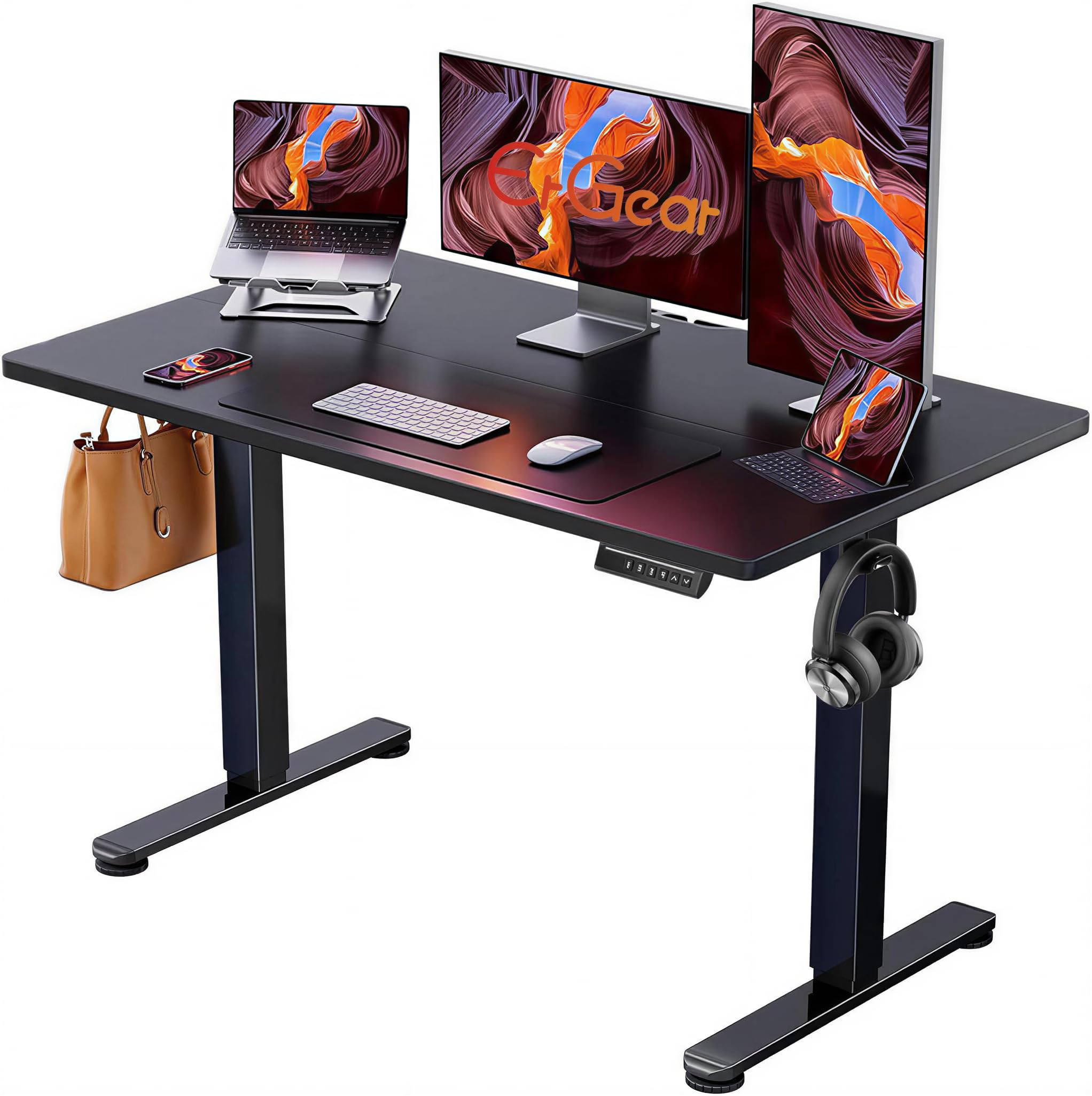
A budget desk usually asks you to accept a lower weight rating or a two-button controller. The ErGear does neither: it carries 176 pounds and gives you four memory presets, which is the same core package as desks costing more. That is why we treat it as the value pick.

The 28.35-to-46.46-inch range covers most seated and standing positions, and the 48-by-24 top is the right size for a laptop and a monitor or two. The frame is carbon steel, and the desk weighs about 44 pounds, so one person can move it without a fight. Assembly is straightforward; leave the frame bolts loose until the top is aligned, then tighten in a cross pattern.

We prefer the four presets to a phone app or a touchstrip, because they are the controls you actually use every day. The motor is rated for the same 176 pounds as the bigger names, and the desk does not ask you to pay for a lot of extras. It is the first standing desk we point to when the budget is the deciding factor.

Bottom Line: Our value pick is the ErGear: 176-pound frame, four presets, and a 48-by-24 top without the usual corner-cutting.
#4

Best for Lower Seating

FEZIBO 48-Inch

FEZIBO 48-Inch

8.9/10 Excellent
  • Desktop Size: 48 x 24 in
  • Height Range: 27.3-45 in
  • Memory Presets: 3
  • Weight Capacity: 176 lb
Check Price on Amazon

Pros

  • Starts at 27.3 inches for lower seating
  • 50,000-cycle motor rating
  • FSC-certified wood top

Cons

  • 45-inch maximum is low for tall users

At 27.3 inches, the FEZIBO drops lower than most desks here. That matters if you are shorter or if your chair sits low: the desk can meet your seated elbow height instead of forcing you to raise the chair and let your feet dangle.

The 50,000-cycle motor rating is the other number we noticed. It is a durability claim, not a guarantee, but it tells you the lifting system is built for daily use. The 176-pound capacity and three presets are normal for the money; the FSC-certified wood top is a nice extra if indoor materials matter to you.

The splice top is the compromise: a seam runs across the middle, so writing or mouse work can catch it. We think it is a fair trade for the lower starting height, but if you want a continuous surface, the FLEXISPOT EN1 is the better pick. For the shorter user who wants a lower sit position, the FEZIBO earns its place.

Bottom Line: The FEZIBO earns our recommendation for lower seating: it starts at 27.3 inches, and the 50,000-cycle motor rating and FSC-certified top are useful bonuses.
#5

Best Mobile Desk

Monomi 48-Inch

Monomi 48-Inch

9.1/10 Outstanding
  • Casters: Included
  • Desktop Size: 48 x 24 in
  • Height Range: 28.35-46.46 in
  • Weight Capacity: 188 lb
Check Price on Amazon

Pros

  • Casters included for moving between rooms
  • 188-pound capacity
  • Anti-collision system

Cons

  • Casters add height beyond the quoted range

The Monomi is the only desk in this group with casters in the box. That changes how you use a desk: you can roll it from a work corner to a window, or push it aside when the room needs to serve another purpose. The 48-by-24 top and 188-pound capacity keep it a real desk, not a rolling cart.

We recommend it for anyone who rents, shares a room, or rearranges often. Three presets and an anti-collision system are useful here: the desk stops if it meets an obstacle, which matters more when the desk itself is movable. The casters are the reason to pick it.

The 48-by-24 top is still a full-size surface, so this is not the desk for a hallway nook. It is the one for a room that has to do two jobs: work on weekdays, something else on weekends. If the desk stays in one spot, a fixed-foot model like the FLEXISPOT EN1 gives you one less variable.

Bottom Line: Our mobile pick is the Monomi: included casters, a 188-pound capacity, and an anti-collision system make it the most flexible full-size desk here.
#6

Best for Small Spaces

HUANUO 32-Inch

HUANUO 32-Inch

9.0/10 Outstanding
  • Storage: Two drawers
  • Desktop Size: 32 x 21 in
  • Height Range: 28.35-46.5 in
  • Weight Capacity: 176 lb
Check Price on Amazon

Pros

  • 32-by-21 top fits tight rooms
  • Two drawers add storage
  • C-clamp-compatible rear edge

Cons

  • 32-inch top suits one monitor only
  • 21-inch depth limits keyboard space

The HUANUO is the smallest desk here by a wide margin: 32 inches wide and 21 inches deep. That is the point. In a bedroom, a hallway alcove, or a rented room where the desk has to share space with everything else, a full 48-inch desk can be the thing that makes the room feel cramped.

The two drawers are the practical surprise. They give you somewhere to put a notebook, cables, and the small clutter that otherwise lives on the desktop. The rear platform edge is also extended to 2.6 inches, which is enough for a C-clamp monitor mount if you want to lift the screen off the surface.

The 176-pound capacity is the same as the larger budget desks, and four presets cover sitting and standing heights from 28.35 to 46.5 inches. The frame is carbon steel, and the desk weighs about 34 pounds, so it is manageable to move before assembly.

We recommend it for the room where a bigger desk simply will not fit. The drawers and the C-clamp-ready rear edge make the small size work harder, and the 176-pound frame means you do not have to baby it. If you have the floor space for 48 inches, though, the extra surface is worth taking.

Bottom Line: For a tight room, we point to the HUANUO: a 32-by-21 top, two drawers, and a 176-pound frame turn a slice of wall into a workable standing desk.
#7

Attractive budget desk

CubiCubi 48-Inch

CubiCubi 48-Inch

9.3/10 Outstanding
  • Desktop Size: 48 x 24 in
  • Height Range: 28-46.5 in
  • Memory Presets: 3
  • Weight Capacity: 176 lb
Check Price on Amazon

Pros

  • Light-walnut finish looks above its budget
  • 176-pound capacity
  • 48-by-24 top

Cons

  • No drawer or cable tray

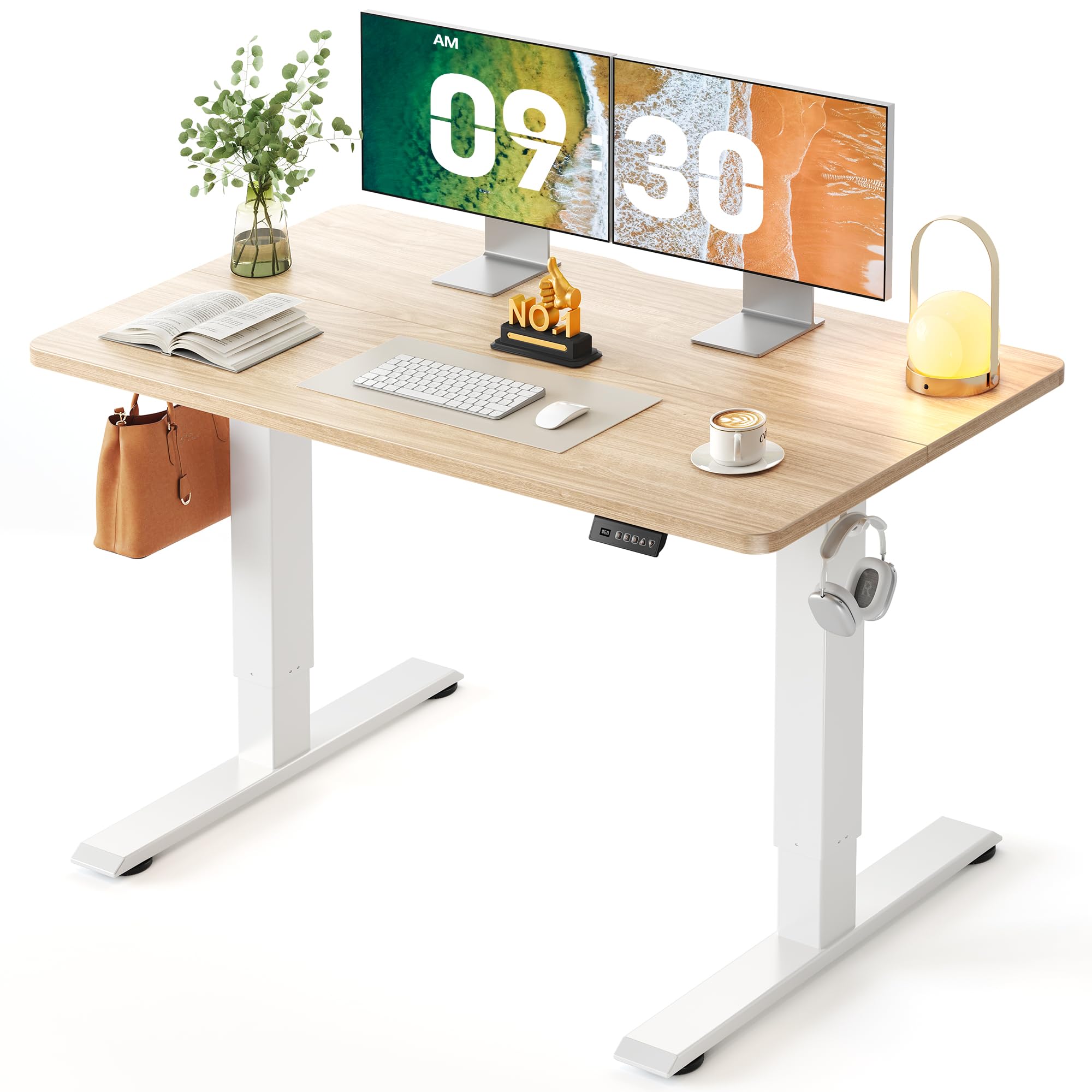
The light-walnut finish is what makes the CubiCubi worth a second look. Most budget desks in this group are black or maple; this one has a warmer surface that reads more like furniture than office equipment. The 48-by-24 top is the same workhorse size as the FLEXISPOT EN1, and the 176-pound capacity is right there too.

You get three presets, and the height range runs from 28 to 46.5 inches. The frame is alloy steel and the desk is rated for the same 176 pounds as the bigger names. Assembly is designed to be simple, but the pre-drilled holes are the part to watch: dry-fit the frame and leave the bolts loose until everything lines up.

We think it is the right pick for a guest room or a home office where the desk is visible, not tucked away. The finish does the work that a more expensive desk usually has to earn with features. It is a desk you buy because you like looking at it, not because it has the longest feature list.

Bottom Line: We think the CubiCubi is the best-looking budget desk here: a 48-by-24 top, 176-pound frame, and three presets for a desk that does not look like a spreadsheet.
#8

Quick setup

VASAGLE 48-Inch

VASAGLE 48-Inch

9.0/10 Outstanding
  • Desktop Size: 48 x 24 in
  • Height Range: 28.3-47.2 in
  • Memory Presets: 4
  • Weight Capacity: 154 lb
Check Price on Amazon

Pros

  • Four presets on a light frame
  • Sedentary reminder
  • 30-minute assembly claim

Cons

  • 154-pound capacity limits heavy setups

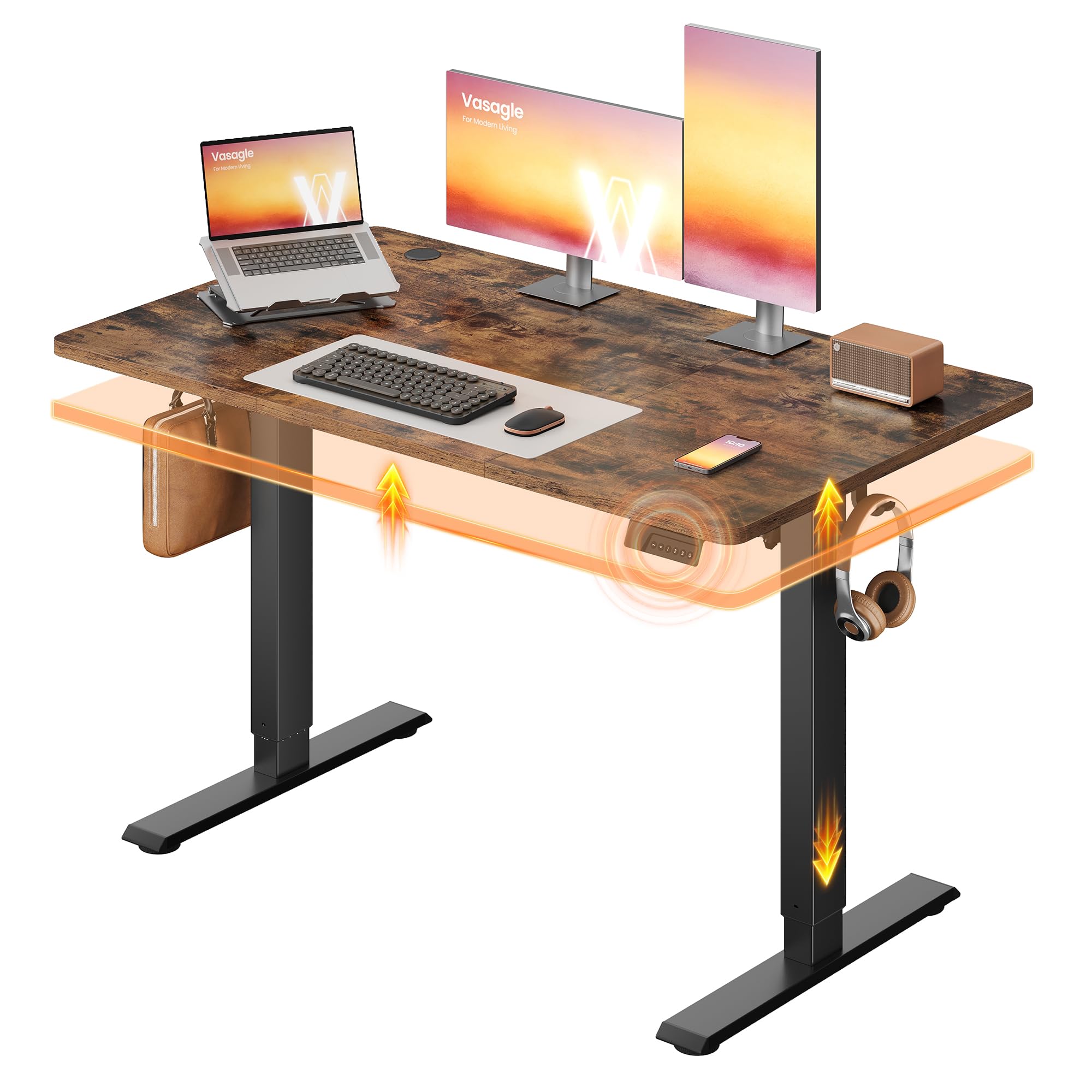
The VASAGLE is the lightest full-size desk here at 36.3 pounds, and it still manages four memory presets. That combination is unusual: most light desks cut back to two or three buttons. The top is 48 by 24 inches, and the frame runs from 28.3 to 47.2 inches, so it covers the usual sit-stand range.

The sedentary reminder is a small feature with real use: it nudges you to stand every hour, which is the habit a standing desk is supposed to build. The 30-minute assembly claim is backed by pre-drilled holes and an accessory kit.

We like the light frame for a spare room or a first apartment: it is easy to move, and the four presets make it feel less like a starter desk. It is the full-size desk that feels least like a piece of office equipment. The finish is rustic brown, so it fits a warmer room better than a black frame.

We recommend it for a light setup where quick assembly and a low profile matter more than a heavy frame. It is the easiest full-size desk here to set up and live with.

Bottom Line: We like the VASAGLE for a light, quick-to-assemble setup: four presets, a sedentary reminder, and a 154-pound frame make it a sensible spare-room desk.

How We Tested Eight Sit Stand Desks Over Eight Months

We began by researching the most-recommended models from established desk brands, filtering for dual-motor frames, weight capacity, and a height range that works for both shorter and taller users. From that list, we narrowed to eight desks that spanned the price spectrum — from budget-friendly to investment pieces — and assembled each one in a real home office, not a showroom. Testing ran for eight months, with each desk rotating into daily use.

Assembly was the first test: I timed how long it took to unbox and build each desk solo, following only the included instructions. I noted whether the steps were clear, whether the hardware was labeled, and whether I needed a second person for the frame flip — a common frustration point.

Once built, each desk went through a week of normal use: morning stand-ups, afternoon sitting, switching mid-email, and raising it to full height with a coffee mug and monitor in place. I shook the desk at standing height, typed hard, and watched for wobble. I raised and lowered each one a dozen times in a row, listening for motor strain and checking whether the surface stayed level. I also checked alignment after a month: did the frame stay square, did the desktop sag, did the legs stay parallel?

For desks with casters, I rolled them across carpet and hardwood to see how easily they moved and whether they stayed put when locked. I lived with each desk for weeks to judge appearance — cable clutter, scratch resistance, how the finish held up — and weighed what you actually get for the cost, including warranty and extra features. The desks that scored highest were the ones that made switching positions feel like second nature, not a chore.

How to Choose Sit-Stand Desks

Start With the Height Range, Not the Motor

The lowest height matters as much as the highest. If the desk stops around 28 inches, a shorter user may end up raising the chair and losing foot contact with the floor; a desk that drops to 27.3 inches, like the FEZIBO, gives more room to sit properly. Measure from the floor to your bent elbow while you sit in your usual chair, then compare that with the desk's minimum. For standing, aim for a height where your elbows stay near 90 degrees and your wrists are flat. We prefer four presets for a shared desk; for one person, three are enough.

Size the Top and the Load Together

A 48-by-24-inch top is the workhorse size in this group: enough for a laptop and one or two monitors, without dominating a room. A 60-by-30 top, like the Desktronic HomeOne, is for a permanent multi-monitor office; a 32-by-21 top, like the HUANUO, is for a single screen and a tight wall. Match the weight rating to what you will actually put on it. A 176-pound desk covers most dual-monitor setups; 265 pounds gives you headroom for heavier arms and equipment. Stability at full height matters as much as the number: a deeper rear edge helps if you plan to clamp a monitor arm.

One-Piece or Split Top?

We strongly prefer a one-piece top when the budget allows. It gives you an uninterrupted surface for writing and mouse work, and there is no seam to collect crumbs or catch a notebook. The FLEXISPOT EN1 is the clearest example here. A split top can be fine, especially on a budget, but it puts a line down the middle and makes alignment more important. If you choose one, assemble it on a flat floor and leave the frame bolts loose until every hole starts. Then tighten in a cross pattern.

What the Motor and Warranty Are Worth

A dual-motor frame is not automatically better for a light setup; a single motor with a 176-pound rating is plenty for a laptop and a monitor. What we value more is a clear warranty and a controller you can live with. The FLEXISPOT EN1 covers its frame and motor for five years, which is the kind of backup that matters when the lift is the one part you cannot fix yourself. Presets are worth paying for if more than one person uses the desk. USB ports and casters are conveniences; check that casters do not push the desk above your comfortable seated height.

Frequently Asked Questions

Final Verdict

For most people, the FLEXISPOT EN1 is the sit-stand desk we recommend. The one-piece top, four presets, 176-pound capacity, and five-year frame and motor warranty make it the safest everyday buy, and the 48-by-24 footprint fits a normal home office without swallowing the room.

If your desk is a permanent multi-monitor workstation, the Desktronic HomeOne is the better choice: its 60-by-30 top and dual-motor frame carry more gear and more weight. The EN1 remains the one we point to first.